
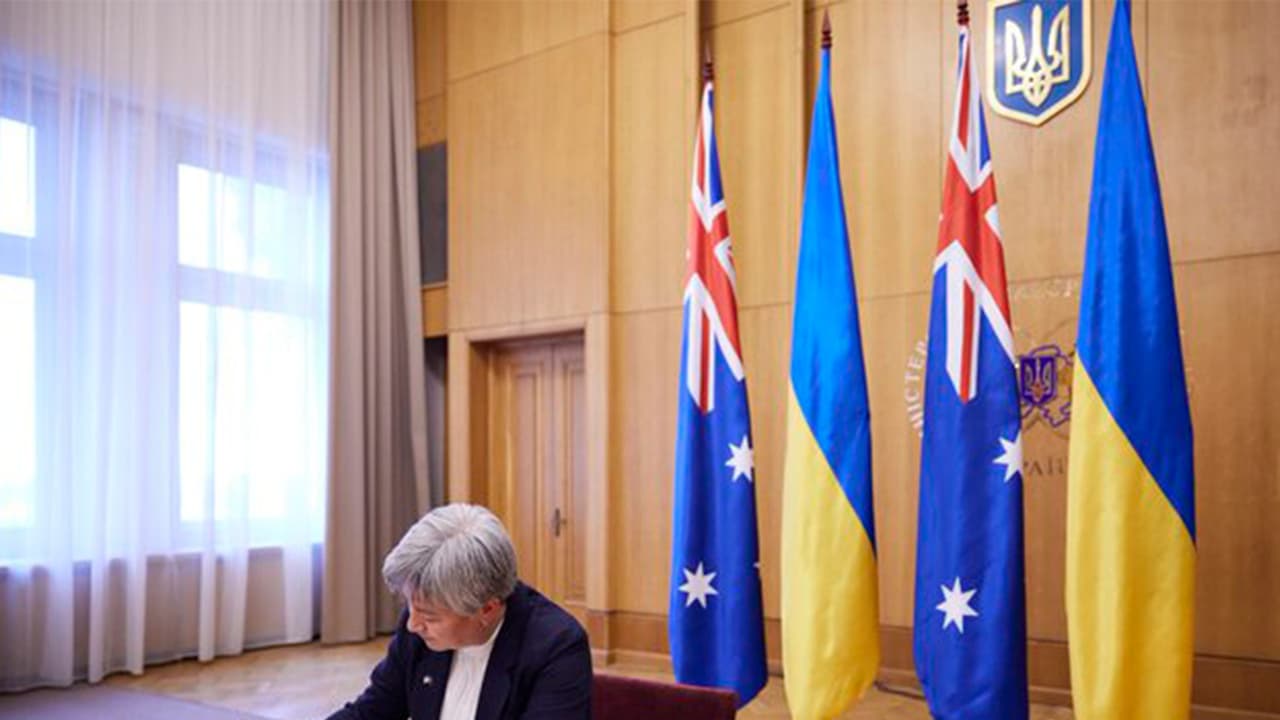
Australian Foreign Minister Penny Wong announced that the Department of Foreign Affairs and Trade (DFAT) has opened a crisis portal for Australians in the UAE and Qatar, urging them to register for updates amid a major conflict in the Middle East.
Australia's Response to Crisis
Australian Foreign Minister Penny Wong said that Department of Foreign Affairs and Trade (DFAT) opened registrations for all Australians in UAE and Qatar amid the ongoing conflict in the Middle East. In a post on X, Wong wrote, "Today DFAT opened registrations for its crisis portal for Australians, permanent residents and immediate family members in the UAE and Qatar to provide timely information to those impacted by travel disruptions, in addition to registrations for Israel and Iran opened yesterday."
"DFAT will contact registered Australians directly to provide updates. Register at: http://crisis.dfat.gov.au. This will be a challenging time for many people, particularly those with family in the region or travel plans. Our priority is the safety and security of Australians," Wong wrote further.
Escalation of Middle East Conflict
This announcement by Wong came on the heels of a full-scale conflict that has erupted in the Middle East involving the United States, Israel, and Iran, following a major "military offensive" launched on February 28. In a coordinated operation known as Operation Epic Fury/Roaring Lion, US and Israeli forces carried out large-scale air and missile strikes across Iran, targeting key military sites, nuclear-related infrastructure, missile batteries, and leadership compounds. These strikes included the reported assassination of Iran's Supreme Leader Ayatollah Ali Khamenei, confirmed by Iranian authorities -- a watershed moment that has deepened the crisis.
Iran's Retaliation and Regional Spillover
Iran has responded with widespread retaliation. Ballistic missiles and drones have been fired toward Israel and multiple Gulf Arab states, and Iran has declared that all American and Israeli assets in the region are legitimate targets. Countries across the Middle East, including Bahrain, the United Arab Emirates, Qatar, Kuwait, Saudi Arabia, and Iraq, have experienced strikes or missile interceptions, underscoring the conflict's regional spillover.
Global Impact and Calls for De-escalation
The war has caused civilian harm and global disruption. Reports indicate hundreds of deaths and injuries inside Iran, including civilian casualties from strikes, and several foreign nationals have been affected abroad. The crisis has also seriously disrupted air travel, with hundreds of flights cancelled worldwide, and triggered protests and geopolitical tensions in places like India.
World leaders and international bodies are urging de-escalation as the risk of wider regional conflict grows, but fighting continues without a clear end in sight.
(Except for the headline, this story has not been edited by Asianet Newsable English staff and is published from a syndicated feed.)