
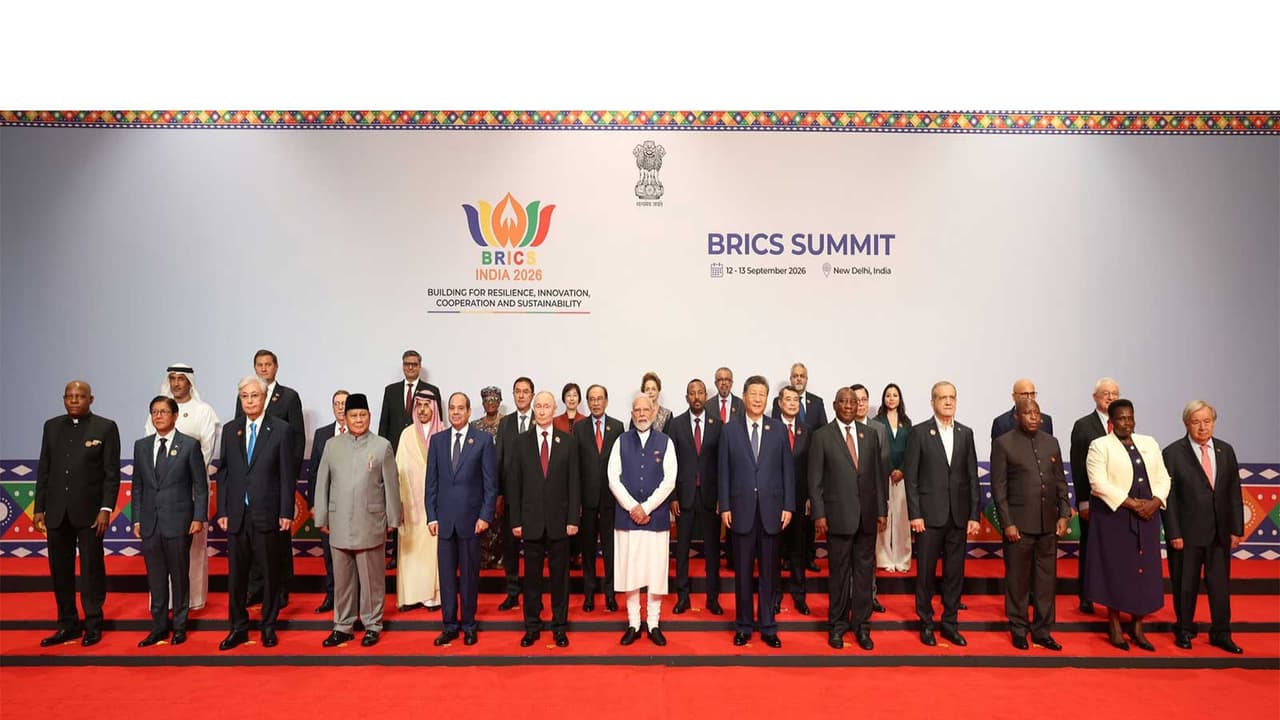
On the sidelines of the 18th BRICS Summit in New Delhi, PM Narendra Modi held 15 sit-down bilateral meetings over three days with leaders from Russia, China, Iran and Africa, discussing ties, conflicts, and Global South priorities.
From Russia and China, to Iran and Africa, Prime Minister Narendra Modi’s diplomatic calendar has remained packed on the sidelines of the 18th BRICS Summit, with PM Modi holding 15 sit-down bilateral meetings with Heads of State and Heads of Government over the last three days.
The meetings, held alongside the BRICS Summit in New Delhi, have been in addition to pull-aside interactions with various world leaders and leaders of international institutions, giving a broad sweep to India’s diplomatic engagement during its BRICS chairship.
Among the most significant engagements were PM Modi’s meetings with Russian President Vladimir Putin, Chinese President Xi Jinping and Iranian President Masoud Pezeshkian, with discussions covering bilateral ties, regional conflicts, multilateral cooperation, border peace, maritime security and the priorities of the Global South.
PM Modi Chairs Session on BRICS Priorities
On Sunday, PM Modi also chaired the BRICS session on “Resilience, Innovation, Cooperation and Sustainability: Shaping the Future for Inclusive Global Growth”, where he outlined key initiatives under India’s four priority pillars of resilience, innovation, cooperation and sustainability.
PM Modi said the grouping had placed emphasis on strengthening resilience amid growing conflicts, pandemics, climate disasters and supply-chain disruptions. He highlighted the BRICS Integrated Early Warning System for infectious diseases, Early Warning Data Integration Guidelines for disaster management and the BRICS Logistics Supply Chain Cooperation Framework.
Under innovation, he highlighted the BRICS Incubator Network, the proposed BRICS Startup Innovation Fund and the BRICS Network on Digital Agriculture, which will connect AI, geospatial technology and Digital Public Infrastructure with the needs of farmers.
The Prime Minister also said India had sought to ensure that BRICS cooperation remained inclusive and involved entrepreneurs, farmers, researchers, women, youth and ordinary citizens. “From my personal experience, I can say that the Global South countries’ confidence in BRICS has grown, because within BRICS: Their voices are heard. Their experiences are respected. And solutions are developed not for them, but together with them," he said.
The Prime Minister said that the strength of BRICS lay in its diversity and cooperation and stressed that solutions developed within the grouping should be adaptable and accessible to the wider Global South.
Key Bilateral Meetings
Russia
PM Modi met Russian President Vladimir Putin on September 11 on the margins of the BRICS Summit. It was their second meeting this year, following their meeting on the sidelines of the 26th SCO Summit in Bishkek on August 31. The two leaders reviewed bilateral cooperation across political, economic, defence, energy, space, skill mobility and people-to-people domains. They also welcomed Russia’s International Industrial Exhibition “INNOPROM India”, held in India from September 9-11. The leaders discussed India-Russia engagement in the multilateral sphere, particularly BRICS under India’s 2026 chairship, besides exchanging views on regional and global issues, including the conflicts in West Asia and the Black Sea region that have affected maritime trade and the safety and security of Indian seafarers. PM Modi reiterated that dialogue and diplomacy were the way forward in resolving conflicts and said India stood ready to assist in peace efforts. The two leaders agreed to remain engaged to further strengthen the Special and Privileged Strategic Partnership between India and Russia, which the MEA said continues to register significant growth and has shown resilience amid geopolitical uncertainties. Putin invited PM Modi to visit Russia for the 24th India-Russia Annual Summit, which the Prime Minister accepted.
China
On September 12, PM Modi met Chinese President Xi Jinping on the sidelines of the BRICS Summit. The two leaders welcomed the steady progress in India-China bilateral relations since their last meeting in Tianjin in August 2025 and reaffirmed that both countries should take a strategic and long-term perspective of their ties. The two sides agreed that differences should not become disputes, while Modi highlighted the importance of three mutuals — mutual respect, mutual sensitivity and mutual interest. PM Modi also stressed that peace and tranquillity in the border areas remained an essential basis for the continued development of bilateral relations and underlined the need for both sides to observe existing agreements and understandings on border-related issues. The two leaders expressed commitment to a fair, reasonable and mutually acceptable resolution of the boundary question, proceeding from the political perspective of their overall bilateral relations and the long-term interests of the two peoples. They also discussed people-to-people ties, cultural exchanges, business linkages and greater mobility, besides economic and trade issues, including structural trade imbalance, supply-chain issues and meaningful and predictable market access. The leaders agreed to continue expanding common ground on regional and global issues.
Iran
PM Modi met Iranian President Masoud Pezeshkian on September 11 on the sidelines of the BRICS Summit. It was their second meeting in under two weeks, after they met on the sidelines of the SCO Summit in Bishkek. The two leaders discussed various aspects of bilateral relations, with PM Modi thanking Iran for its regular, high-level participation in BRICS-related meetings despite the challenging circumstances. They also exchanged views on recent developments in West Asia, with Modi reiterating India’s consistent position that all issues must be resolved through dialogue and diplomacy. The Prime Minister underscored the need for continued efforts to ensure lasting peace and stability in the region, safeguarding freedom of navigation and commerce and the safety and well-being of seafarers.
Engagements with African and Other World Leaders
On Sunday, PM Modi met Burundi President and African Union Chairperson Évariste Ndayishimiye. The two leaders stressed that the India-African Union partnership is a key pillar of cooperation within the Global South and discussed the early convening of the 4th India-Africa Forum Summit. With South African President Cyril Ramaphosa, PM Modi reviewed the progress in diverse areas of cooperation and exchanged views on the multifaceted strategic partnership. In the context of the successful translocation of cheetahs from South Africa to India, Modi invited South Africa to consider joining the International Big Cat Alliance. With Nigerian Vice President Kashim Shettima Mustapha, PM Modi reviewed the multifaceted India-Nigeria relationship, with discussions focusing on trade and investment, defence and security, energy, agriculture, health and digital technologies. Both sides reaffirmed their commitment to strengthening the India-Nigeria Strategic Partnership. PM Modi also met Ugandan Vice President Jessica Rose Epel Alupo and reviewed bilateral ties, with emphasis on technology partnerships, capacity building, knowledge sharing, investment facilitation and private-sector collaboration. PM Modi reaffirmed India’s support to Uganda’s ‘Vision 2040’. With Philippines President Ferdinand R. Marcos Jr., PM Modi discussed further cooperation in defence and security, trade and investment, space, railway infrastructure, fintech, education, tourism, science and technology, innovation and people-to-people ties. PM Modi also met Kazakhstan President Kassym-Jomart Tokayev and reviewed cooperation in political, trade, defence and security, connectivity, energy, critical minerals, emerging technologies, creative economy and people-to-people ties. With Egyptian President Abdel Fattah El-Sisi, PM Modi reviewed the strong momentum in the India-Egypt Strategic Partnership and discussed trade and investment, defence and security, technology, connectivity and people-to-people exchanges. The two leaders also exchanged views on regional and global developments and stressed continued cooperation through BRICS to advance the priorities of the Global South. On September 12, PM Modi met UAE Crown Prince Sheikh Khaled bin Mohamed and reiterated the significance of the India-UAE Comprehensive Strategic Partnership, built on political, cultural, commercial, energy and people-to-people ties. The leaders also discussed cooperation in strategic and emerging areas, including defence, space, nuclear energy, technology and innovation. They noted the announcement by the UAE’s International Holding Company of an investment of USD 11.5 billion in an integrated greenfield aluminium project in Odisha. PM Modi also met Vietnamese Prime Minister Le Minh Hung and welcomed Vietnam’s participation in the BRICS Summit as a Partner Country. The two leaders reviewed bilateral ties and exchanged views on regional and global issues of mutual importance. With Malaysian Prime Minister Anwar Ibrahim, PM Modi reviewed bilateral cooperation across trade and investment, defence and security, semiconductors, infrastructure, digital economy, energy, fintech, education, tourism and people-to-people ties. PM Modi also met Ethiopian Prime Minister Abiy Ahmed Ali. The two leaders discussed strengthening the bilateral Strategic Partnership and reviewed economic cooperation, defence and security partnership and capacity building, besides exchanging views on regional and international developments.
PM Modi also met UN Secretary-General António Guterres on the sidelines of the BRICS Summit. The two leaders underscored the significance of multipolarity and the need to reform multilateral institutions, including the UN Security Council, to reflect contemporary realities. They also discussed ongoing conflicts and freedom of navigation, sustainable development, human-centric AI, renewable energy and global food security.
New Delhi BRICS Leaders' Declaration Adopted
The meetings came alongside the adoption of the New Delhi BRICS Leaders' Declaration, which expressed deep concern over the continued escalation of tensions in West Asia and called for maximum restraint and avoidance of actions that could further aggravate the situation. The declaration called for the protection of civilians and civilian infrastructure, respect for sovereignty and territorial integrity, and greater efforts through dialogue and diplomacy towards lasting peace, security and stability in the region. It also stressed the need to maintain the smooth flow of global trade, supply chains and energy in accordance with international law.
On Gaza, BRICS called for the implementation of relevant UN General Assembly and UN Security Council resolutions, maintenance of a ceasefire and full and unhindered humanitarian access. The grouping also expressed deep concern over continued violence in Gaza despite the October 2025 ceasefire agreement and opposed policies aimed at the forced displacement of Palestinians. The declaration said a just and lasting solution to the Israeli-Palestinian conflict can only be achieved through peaceful means and fulfilment of the legitimate rights of Palestinians, including self-determination and return.
Push for Global South's Role in Governance
The diplomatic outreach unfolded alongside PM Modi’s push for greater representation and a stronger voice for the Global South within global governance. While chairing the BRICS session on “Inclusive Global Governance and Strengthening Multilateralism” on September 12, PM Modi said the Global South was “at the front row of global crises, but the back row of decision-making” and called for the “pyramid of privilege” to be turned into a “platform of partnership”. He stressed that global governance must reflect contemporary realities, with greater representation, particularly in institutions such as the UN Security Council. PM Modi also called for efforts to help the Global South move from being a rule-taker to a rule-shaper and proposed a Seafarers Emergency Support Network to support seafarers during times of crisis. The session concluded with the adoption of the New Delhi BRICS Leaders' Declaration, setting the shared priorities, commitment and direction for BRICS cooperation.
As India’s BRICS chairship draws together bilateral diplomacy, multilateral initiatives and a sustained focus on the Global South, PM Modi’s 15 sit-down meetings over three days have brought a wide range of strategic, economic and geopolitical issues to the centre of India’s engagement with the expanded BRICS grouping. (ANI)
(Except for the headline, this story has not been edited by Asianet Newsable English staff and is published from a syndicated feed.)