Bangladesh: To rush into a general election now, while the inflation rate tears at the flesh of the common man and the export engines sputter into silence, is not a triumph of democracy but a suicide pact.
New Delhi: With the national inflation skyrocketing, plummeting exports, and floods displacing millions, Bangladesh stands today at a crumbling edge where the feverish desire for a ballot box is violently colliding with the brutal reality of an economic implosion.
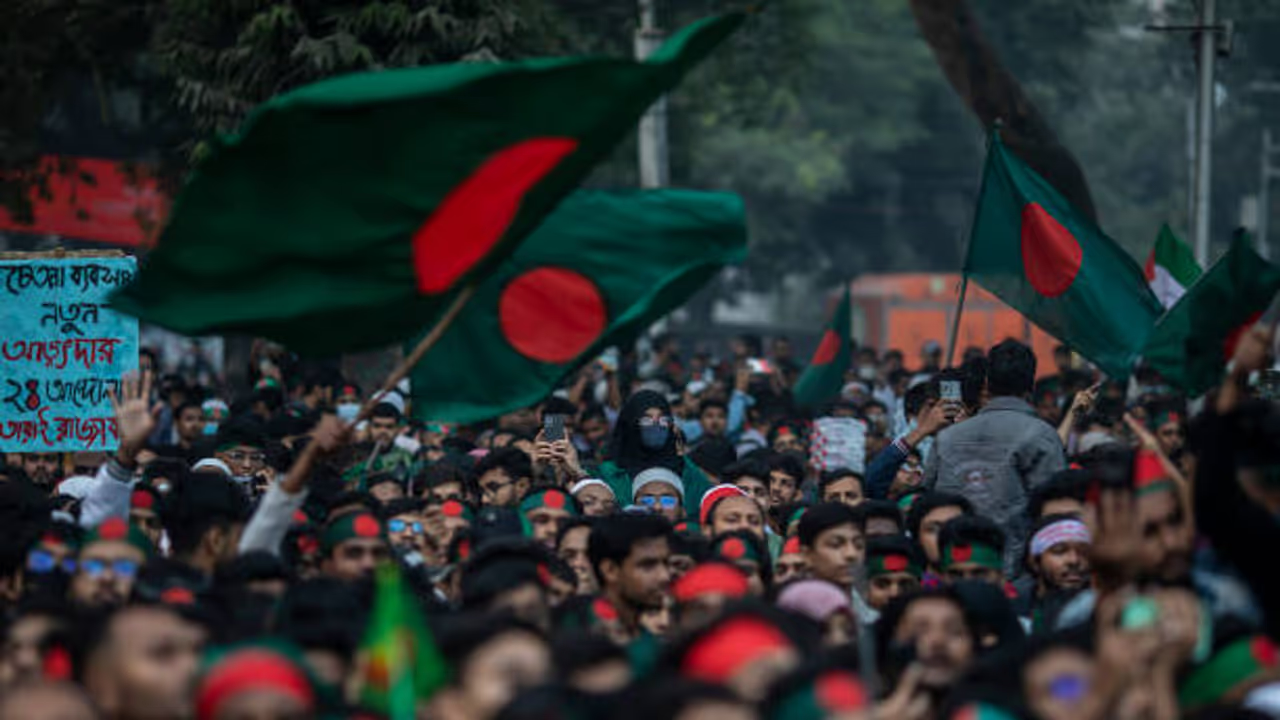
The streets of Dhaka, still echoing with the chants of the 2024 protests that left over a thousand dead, are now humming with a different, more desperate frequency. It is the sound of a nation running on fumes, pushing for an election it cannot afford--in a timeline that guarantees chaos rather than legitimacy.
To rush into a general election now, while the inflation rate tears at the flesh of the common man and the export engines sputter into silence, is not a triumph of democracy but a suicide pact.
Related Articles

The immediate burning imperative is not the printing of ballot papers, but the stabilisation of a state that is currently dying from a thousand fiscal cuts.
Inflation spiked above 11% in mid-2024 and has stayed stubbornly high, still in the high single digits to around 10% in later readings. This is not just a number on a central bank spreadsheet but a daily catastrophe for the millions who congregate in the kitchen markets of Karwan Bazar, Dhaka, watching the price of onions and rice drift steadily out of reach. Inflation of this magnitude acts as a tax on survival.
To imagine that a government can implement the targeted price controls or the complex supply chain fixes required to tame this beast, while simultaneously engaging in the chaotic and rather expensive theatre of a national campaign, is to live in delusion.
Election cycles are notoriously inflationary, flooding the market with liquidity, printed money, and campaign spending that promise to pour gas on the fire.
Then there is the silence of the factories. The Ready-Made Garment (RMG) sector is the monolithic engine that powers the Bangladeshi economy. Yet, today, it’s facing an existential crisis. Exports are collapsing, not because of a lack of global demand but because of a collapse in trust.
International buyers in London, New York, and Berlin rely on stability. They cannot place orders for the Christmas season in a country that is threatening to tear itself apart in a premature electoral frenzy.
The violent disruptions of the past year (2024-2025) have already shaken investor confidence to its core. Rushing to the polls now guarantees months of uncertainty, filled with strikes, blockades, and political violence. This may prove to be the final nail in the coffin for many factories that are already operating on razor-thin margins. Furthermore, observers must also look at the humanitarian map. Millions have been affected by catastrophic floods, with roughly half a million or more displaced at peak periods.
These people are currently living under plastic sheets on embankments, fighting for clean water and food - basic human necessities.
To ask them to participate in a voter registration drive, or to navigate the complexities of a polling station is a grotesque insult to their suffering. The state’s resources, every truck, every taka, and every hour of administrative manpower, must be directed towards rebuilding their homes and their lives.
Diverting these scarce resources to organise a colossal electoral exercise at this precise moment is not just bad policy; it is immoral. It prioritizes the political ambitions of the elite over the survival of the destitute. A delay allows the state to focus on flood recovery, ensuring that when the election is finally held, the voters are actually in their homes to cast their ballots, rather than being washed away by the tides of neglect.
The argument for delay is often met with the hysterical cry that it is undemocratic. This is a hollow critique.
The region offers stark examples of the validity of the pause and reset model, and in this case, Bangladesh needs to learn from Pakistan’s playbook. A delay of six to twelve months allows for the updating of a voter roll that is currently riddled with errors, whilst also allowing for the reformation of an Election Commission that has been thoroughly discredited by past complicity, and most importantly, it allows the economy to breathe.
The goal here is legitimacy. An election held amidst hyperinflation, with a discredited referee, and a population underwater, will produce a government that has no mandate and no money.
It will be a weak, fractured administration that threatens to fall within months, plunging the nation back into the cycle of violence. By contrast, an Interim Government that prioritizes economic triage and brings the inflation down to single digits, while restoring the flow of exports, and rebuilding the shattered infrastructure, would be presented as the hero of the story. It will hand over a stable, functioning state to the next elected representatives, giving democracy a fighting chance to survive.
The adrenaline of the moment must be rejected. The rushed election is a drug, a quick fix that offers the illusion of progress while masking the rot beneath.
The sober, responsible choice is to wait. To fix the foundations before trying to build skyscrapers. Bangladesh has paid a high price in blood since 2024, with over a thousand lives lost in the pursuit of a better future. The debt owed to those dead is to build a country that actually works, not just a country that votes. The ballot box is the destination, but economic survival is the road. And right now, the road is broken. Fix the road first.