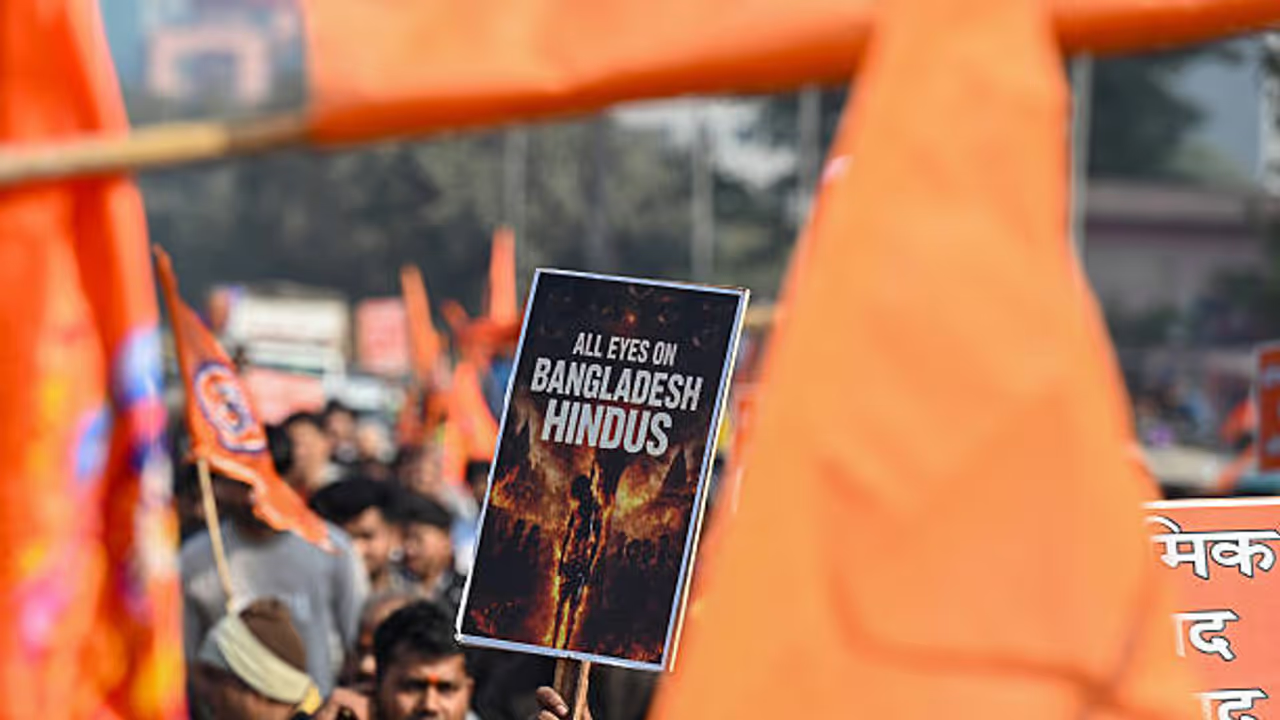
Bangladesh’s 2022 census recorded Hindu representation in public sector employment at between nine and fourteen percent of government positions, broadly proportional to their 7.95 percent share of the national population, at first glance.
Bangladesh’s 2022 census recorded Hindu representation in public sector employment at between nine and fourteen percent of government positions, broadly proportional to their 7.95 percent share of the national population, at first glance. But for a community that in 1901 constituted a third of the territory’s population and has watched that share contract in every census since, proportionality in employment figures is a floor, not an achievement. How minority communities navigate daily institutional life in a country shaped by four decades of incremental Islamisation has no single, clean answer.
The constitutional record gives the most precise account of how that Islamisation happened. Bangladesh’s 1972 constitution listed secularism as one of four foundational pillars of the state. In 1977, President Ziaur Rahman’s martial law government removed it and inserted the invocation “Bismillah-ar-Rahman-ar-Rahim” at the document’s opening; this change was formally ratified as the Fifth Amendment in 1979.
In 1988, President Hussain Muhammad Ershad’s Eighth Amendment declared Islam the state religion. The 2011 Fifteenth Amendment, passed under the Awami League government, restored secularism as a stated principle while leaving Islam as the state religion, a constitutional contradiction that Bangladeshi legal scholars have since described as structurally unresolved.
Related Articles

That legal contradiction maps onto the lived experience of Hindu communities in rural Bangladesh, where Jamaat-e-Islami has cultivated an alternative institutional network. Jamaat operates madrassas, hospitals, orphanages and coaching centres. Its principal financial institution, Islami Bank Bangladesh Limited, founded in 1983 with about 70 percent foreign capital, primarily from Saudi and Kuwaiti investors, along with institutions including the Islamic Development Bank, Kuwait Finance House and Dubai Islamic Bank, extended financial services into areas where state banking penetration was thin. The bank was listed among the top 1,000 banks in the world by The Banker magazine for nine consecutive years starting in 2012, the only Bangladeshi bank to achieve that distinction. (Its ownership structure changed substantially after a 2017 restructuring reduced foreign shareholding, and the bank has more recently faced scrutiny over large irregular loans.)
In districts where Jamaat-linked institutions are among the primary providers of credit, welfare and education, minority communities face an additional layer of marginalisation. A Hindu family navigating access to a Jamaat-affiliated micro-credit programme, or a student competing for a place in a Jamaat-run coaching centre, does so within an institutional culture that is not neutral about religious identity. Islami Chhatra Shibir's stated objective, as documented by security researchers, is to reshape the education system along Islamic lines and to prepare students to take part in the struggle for an Islamic state.
Employment discrimination in the private sector exists alongside the public employment figures. Research drawing on private-sector employment data has found that educated Hindu men show a slight wage advantage in formal private employment, suggesting that those who reach formal employment tend to do relatively well but the history of land dispossession, which research building on Prof. Abul Barkat’s estimates puts at having left around 60 percent of Hindus landless, sharply narrows who reaches formal employment in the first place.
The Vested Property Act’s legacy extends into agricultural districts where land tenure determines economic survival. Even after the 2001 Vested Property Restoration Act nominally required restitution, civil society groups found that collusion between local officials and powerful landowners continued to obstruct the effective return of confiscated property. A temporary absence, a disputed document, a deceased family member: each remained a vulnerability that local actors with access to land registries could exploit.
Social ostracism operates alongside legal vulnerability. In areas where Jamaat-influenced political culture has been strongest, minority communities report that participation in local governance and civic institutions, union councils, dispute resolution, market access, is mediated by religious identity.
The 2001 BNP-Jamaat coalition government placed Jamaat leaders Motiur Rahman Nizami and Ali Ahsan Mohammad Mujahid as Minister of Agriculture and Minister of Social Welfare respectively, giving the party direct access to the state institutions through which rural communities accessed land records, agricultural credit and social welfare programmes.