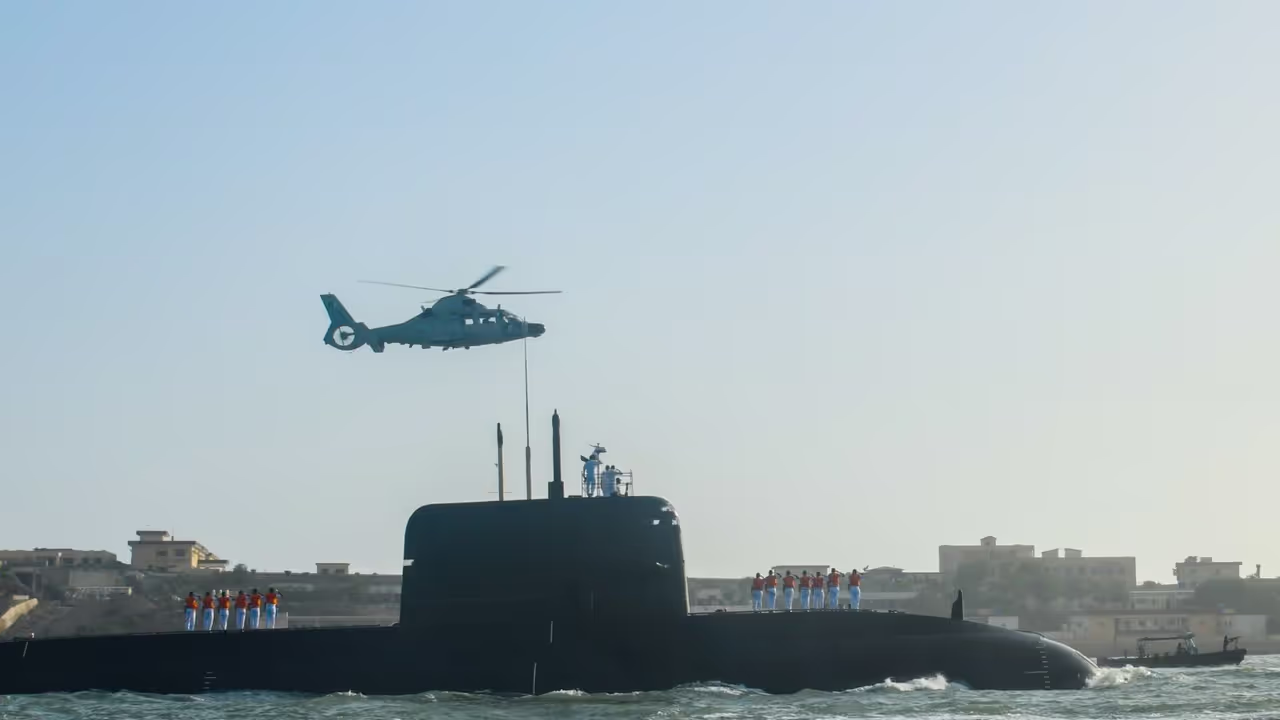
The arrival of the new submarine, PNS Hangor, marks a milestone for the Pakistan Navy as part of a multi-billion dollar deal with China. However, this acquisition coincides with a significant surge in Pakistan's defense budget, which has been prioritized over social sectors like health and education.
Days ago, on 11 June, PNS Hangor sailed into Karachi to a ceremonial naval welcome – cadets of the Pakistan Naval Academy presenting a salute, Z9EC helicopters in fly-past overhead, families of the crew assembled at the dockyard. It was a good day for the Pakistan Navy. It was also the right moment to ask a question that official ceremony tends to foreclose: what did this submarine actually cost the country, and who is still paying?
The Ship and the Deal Behind It
When Pakistan commissioned PNS Hangor on 30 April 2026 in Sanya, China, with President Asif Ali Zardari and Chief of Naval Staff Admiral Naveed Ashraf in attendance, it marked the first operational milestone in a programme that has been repeatedly and emphatically described as a game-changer for the Pakistan Navy. Eight submarines. Chinese collaboration. A price tag estimated at $4-5 billion, the largest arms export contract in Chinese military history at the time of signing.
The capability case is real. Unlike conventional diesel-electric submarines requiring frequent snorkeling cycles, AIP-equipped submarines can remain submerged for weeks, substantially reducing detection vulnerability from maritime patrol aircraft, satellites, and anti-submarine warfare assets.
Related Articles

In the wake of Operation Sindoor, India’s May 2025 strikes on Pakistani territory and the most serious bilateral military confrontation in nearly three decades, the strategic logic of undersea deterrence is not abstract.
But a $4-5 billion acquisition cost is also not abstract. It is a number that exists inside a specific budget, made by a government with specific constraints. And that budget tells a story the commissioning ceremony did not.
The Year the Pattern Was Set: FY26
The Hangor programme spans a decade. But the fiscal year that crystallised Pakistan’s defence-first logic most sharply was 2025-26. The budget raised defence to Rs 2.55 trillion ($9 billion), a 20 per cent increase on the previous year, the largest single-year jump in a decade. Total federal expenditure was simultaneously cut by 7 per cent.
Health, education, and infrastructure absorbed the reductions. The defence line was untouched by the austerity that reached everywhere else.
The new allocation surpassed combined federal spending on higher education, agricultural development, and climate resilience, a point opposition lawmakers raised during the budget session. After debt servicing, which consumed over 45 per cent of the entire federal budget, defence became the single largest expenditure the government actually controlled. Everything else was negotiable.
Pakistan was, through all of this, operating under a $7 billion IMF Extended Fund Facility requiring systematic cuts to public subsidies. Energy subsidies were slashed. Social protection restructured. Millions of the country's poorest households felt it directly. The IMF cannot and has not tried to constrain the defence line and so the burden of fiscal consolidation fell not on military expenditure but on the programmes serving the lowest-income population.
FY27: The New Normal
Last week, Finance Minister Muhammad Aurangzeb presented the federal budget for 2026-27. The government proposed allocating Rs 3 trillion for defence services, marking a 17.65 per cent increase over the outgoing year's original allocation of Rs 2.55 trillion, as it sought to sustain military preparedness amid continuing tensions with India, a deteriorating security situation along the Afghan border, and persistent militant violence at home.
Aurangzeb attributed Pakistan’s “enhanced global stature” directly to the successes of the military. From Rs 2,122 billion in 2024-25, the defence budget has grown by Rs 878 billion across two years of consistent year-on-year expansion, despite persistent concerns over fiscal pressure and debt servicing. PNS Hangor docking in Karachi and the FY27 defence allocation landing in the National Assembly arrived within four days of each other. They are the same argument in two different registers.
What tends to get lost in both is the trajectory that predates the post-Sindoor political moment. Defence spending grew 14 per cent in 2022-23, 15.4 per cent in 2023-24, and 17.6 per cent in 2024-25, all during years of near-default, inflation touching 40 per cent, and rising poverty.
Operation Sindoor provided political cover for an acceleration that was already built into the system. Military pensions, while not formally part of the headline defence figure, add a massive parallel expenditure: of Rs 1,169 billion allocated for pensions in FY27, Rs 822 billion is earmarked for retired military personnel alone.
The Questions the Ceremony Didn't Answer
In any country with functioning defence oversight institutions, a naval programme that has slipped behind its original schedule, changed its core propulsion technology mid-stream, and is unlikely to deliver its full contingent before 2030 would generate significant accountability demands.
The original bilateral plan envisaged Pakistan receiving all eight submarines across a delivery window running from 2022 to 2028. Of the four China-built boats, only the lead vessel PNS Hangor has been commissioned; sisters PNS Shushuk, PNS Mangro, and PNS Ghazi completed their launches across 2025 and are in late-stage sea trials.
The four vessels to be assembled at Karachi Shipyard present a more concerning picture, full fleet induction is now expected between 2028 and 2030.
The US State Department’s 2025 Fiscal Transparency Report urged Pakistan to place its defence and intelligence budgets under parliamentary or civilian oversight, stating directly that the military and intelligence budgets were not subject to adequate scrutiny.
In Pakistan, a $4-5 billion programme with slipping timelines, a mid-stream engine change, and decades of sustainment costs ahead generates ceremonies. The harder accounting happens nowhere publicly visible.
Who Actually Pays?
Pakistan’s tax-to-GDP ratio stands at 8.77 per cent against a World Bank-estimated capacity of 22.3 per cent, among the lowest of any comparable developing economy. Agriculture, real estate, and retail remain largely outside the tax net. For every Rs 100 the FBR collected in FY26, Rs 70 went directly to interest payments before any allocation for salaries, development, defence, or social protection.
Pakistan is not a country too poor to fund both security and social welfare. It is a country that has chosen, across successive governments, not to tax itself enough to fund both.
The Hangor programme is a $4-5 billion expression of that choice. The FY26 and FY27 budgets are its annual renewal. And this week, with helicopters flying over Karachi harbour and the Navy’s newest submarine finding its home berth, the bill remains, as it always does, with those least able to contest it.