
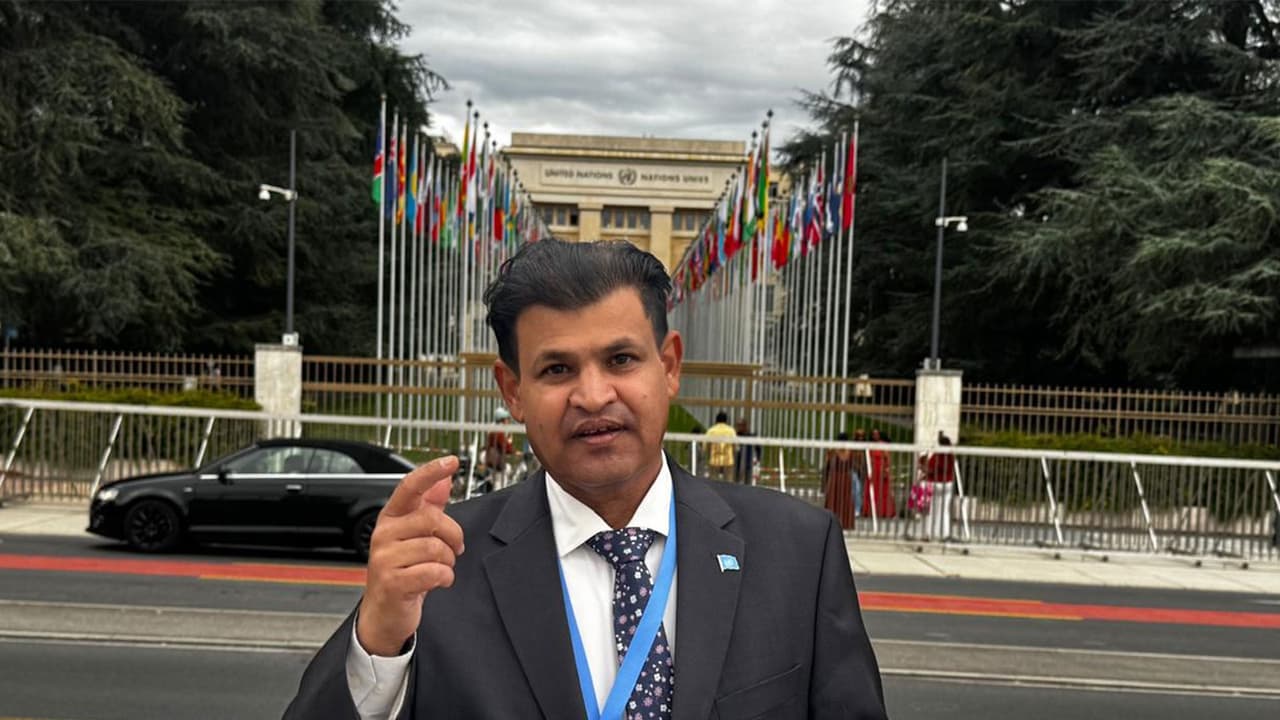
President of Baloch Voice Association, Munir Mengal, alleged at a UNHRC session that daily military operations in Balochistan are killing civilians, especially women and children, and urged the UN and EU to pressure Pakistan to stop the violence.
President of the Baloch Voice Association Munir Mengal has raised concerns over the situation in Balochistan, alleging that ongoing military operations are having severe consequences for civilians, particularly women and children. He made the remarks on the sidelines of the 63rd session of the United Nations Human Rights Council (UNHRC).
'Women and children are worst victims'
Mengal said that wherever there is a military operation or conflict involving separation, children and women become among the worst victims. He alleged that a similar situation was taking place in Balochistan, where common people, women, children, infants, school-going children, and college- and university-going students were becoming the first and most vulnerable victims of military operations.
According to Mengal, such military operations were taking place on a daily basis in Balochistan. He alleged that whenever an operation was conducted, reports were received of children and women being killed or sustaining gunshot wounds. He further alleged that houses were demolished during such operations and that bodies were sometimes found beneath the debris.
Mengal alleged that this was how military operations were being carried out in Balochistan and accused state forces of eliminating Baloch people.
Call for international intervention
He further said that Pakistan would not take steps on its own to protect the lives of Baloch people in Balochistan. He called it the collective responsibility of the United Nations and the international community to put pressure on Pakistan to take steps to protect the lives of Baloch people.
Mengal alleged that Pakistan was not taking such steps because, according to him, the Pakistani military was eliminating Baloch people. He claimed that the objective of the state was to eliminate as many Baloch people as quickly as possible and alleged that this was being carried out through state forces. He urged international organisations, UN bodies, UN treaty bodies, UN special procedures and UN rapporteurs to take notice of what he described as Pakistan's actions against the Baloch people.
Appeal to the European Union
Mengal also said that the Baloch Voice Association had repeatedly urged European parliaments and the European Union, particularly the European Commission, to take notice of the situation. He said the European Commission had an important role because, according to him, it could put pressure on Pakistan in relation to treaties concerning business and human rights.
Referring to Pakistan's Generalised Scheme of Preferences Plus, or GSP+, Mengal said the benefits associated with GSP+ should not be treated as a "free diet" for Pakistan. He called on the European Commission to take notice of the situation in Balochistan and hold Pakistan accountable in this regard.
At the same time, Mengal appreciated steps taken by the European Union and EU treaty bodies during previous sessions. He specifically welcomed questions raised by the EU and its treaty bodies, as well as letters and communiques sent to Pakistan concerning human rights issues. He said the Baloch Voice Association had been informed that the European Commission and EU treaty bodies had sent communiques to Pakistan on different aspects of human rights in order to seek information from the Pakistani authorities. Mengal welcomed these steps but said that more needed to be done to protect the lives of people in Balochistan, calling it "high time" for international institutions to act.
'A political conflict over sovereignty'
Addressing the broader situation in Balochistan, Mengal said the situation was getting worse day by day. He referred to the issue of enforced disappearances and described the situation as a political conflict between the Baloch people and the Pakistani state. He said the Baloch people were demanding what he described as their right to regain sovereignty over their land.
According to Mengal, the situation was deteriorating across different walks of life because, he alleged, the state was attempting to dominate the region through force. Mengal argued that military operations could not provide a solution to the situation in Balochistan. He said the issue could not be resolved through force or suppression, which he attributed to the Pakistani state.
He further said that the Baloch people were highly motivated to regain what he described as their sovereignty. According to Mengal, they had repeatedly called for dialogue between the Baloch and Pakistan, with a guarantor involved in the process. (ANI)
(Except for the headline, this story has not been edited by Asianet Newsable English staff and is published from a syndicated feed.)