The Chinese Communist Party has long claimed the May Fourth Movement as its own – a founding inspiration, a legitimising origin story.
New Delhi: The Chinese Communist Party has long claimed the May Fourth Movement as its own – a founding inspiration, a legitimising origin story. But a direct comparison between what the 1919 protesters demanded and what the CCP delivers today exposes that claim as hollow. On almost every principle the movement stood for, Beijing's present government stands in opposition.
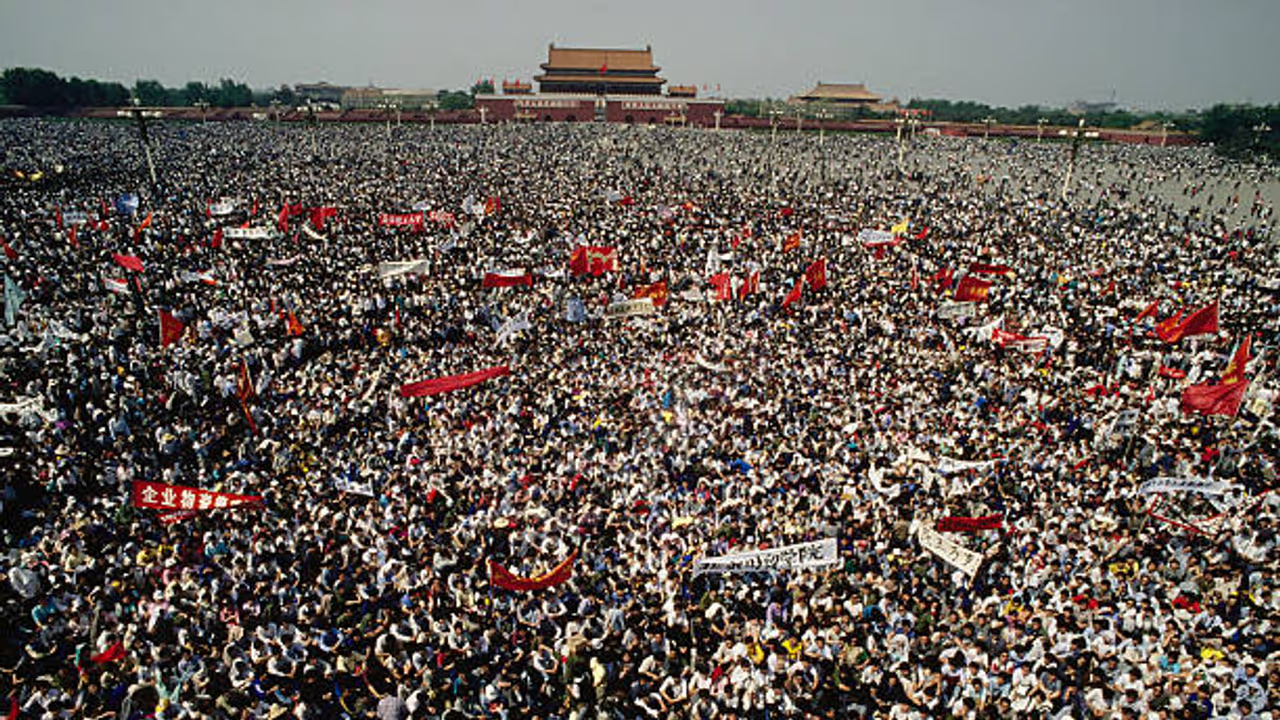
The protests that began on May 4, 1919, in front of Tiananmen Gate were triggered by a diplomatic disaster. The Treaty of Versailles, rather than returning Germany's Shandong concessions to China, handed them to Japan.
For students and intellectuals already frustrated by a weak, unaccountable government, this was the breaking point. Thousands took to the streets – not just to protest Japan, but to demand something more fundamental: that their own leadership answer to its citizens.
Related Articles

That demand for accountability was inseparable from the movement's broader intellectual agenda. Drawing on the New Culture Movement, May Fourth protesters rallied around "Mr. Science" and "Mr. Democracy" as the twin engines of national renewal. Science, to them, meant rational inquiry, openness, and the free exchange of ideas.
Democracy meant political participation, institutional checks on power, and civil liberties. These were not slogans. They were a coherent vision for transforming China into a self-determining, modern nation.
More than a century later, the CCP selectively honours one and quietly buries the other.
"Mr. Science" survives – but only in truncated form. The party enthusiastically embraces technological advancement, innovation, and economic modernisation. What it does not embrace is science's underlying epistemology: open inquiry, the freedom to publish inconvenient findings, or the ability to challenge official positions without professional or personal consequences.
Scientific institutions in China operate under political constraints that the May Fourth generation would have recognised immediately as the very stagnation they were fighting against.
"Mr. Democracy" has fared worse. Political power remains concentrated within a single party. There are no meaningful electoral contests at the national level, no independent judiciary, and no institutional mechanism for citizens to hold leadership accountable – the precise accountability the 1919 protesters were demanding. Public dissent is systematically suppressed rather than occasionally discouraged.
Independent journalism is curtailed. Academic inquiry is monitored. The digital infrastructure that might have expanded public discourse has instead been turned into one of the most sophisticated surveillance and censorship apparatuses in history.
The May Fourth protesters targeted foreign powers for dictating China's fate. Today, the Chinese state directs that same coercive energy inward, toward its own citizens. The enemy of sovereignty, in 1919, was imperial Japan. The constraint on sovereignty today is the party itself.
The CCP's appropriation of May Fourth is not merely hypocritical – it is a calculated inversion. By invoking the movement's nationalist energy while suppressing its democratic core, the party claims the emotional inheritance of 1919 without accepting any of its political obligations. The rhetoric of youthful courage and national awakening is preserved; the demand that the government answer to the governed is discarded.
That gap between what May Fourth meant and what the CCP says it means--is not a footnote. It is the central political question of modern China. The movement's legacy does not belong to any party. It belongs to the ideals of accountability, open inquiry, and democratic participation that animated it. Those ideals were not fulfilled in 1949. By most measurable standards, they remain unfulfilled today.