
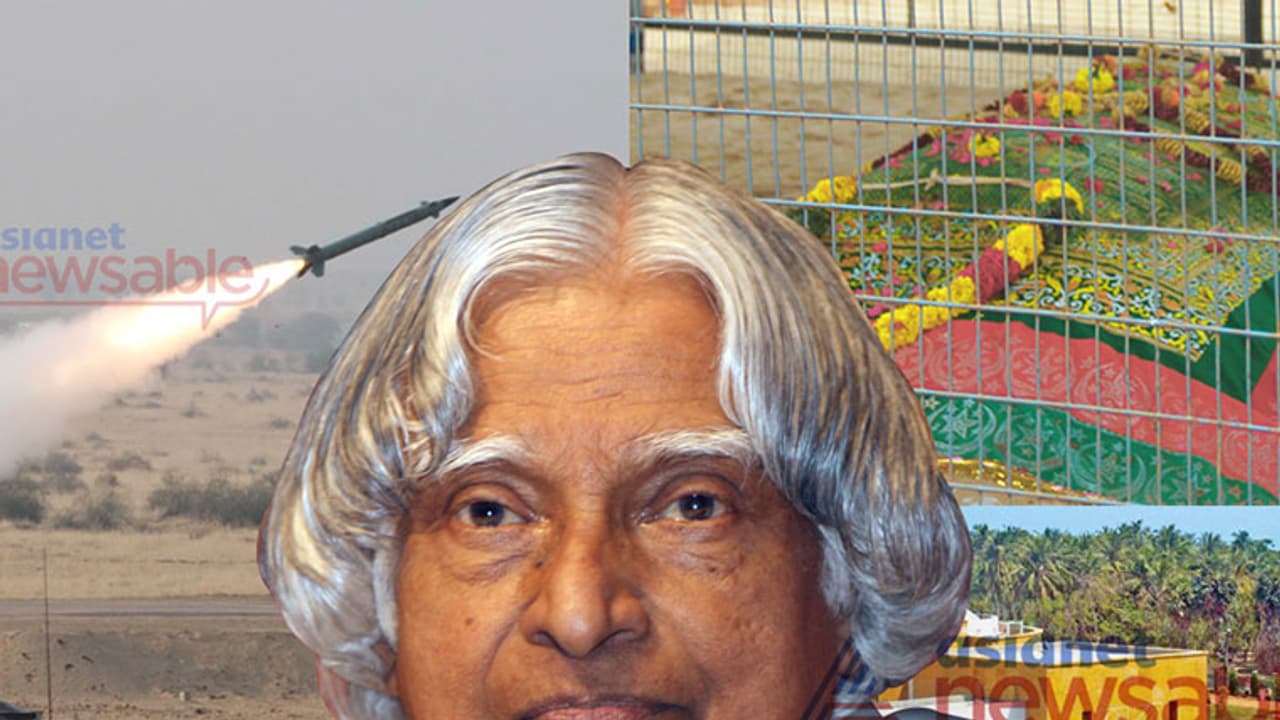
The missile man has left a legacy of honesty, hardwork, philosophy and love for others behind. APJ Abdul Kalam derived inspiration from the nature and Indian philosophy, which is reflected in his memorial too. His memorial in Rameswaram proves to unite India in a unique way through its design, layout and plan.
Prime Minister Narendra Modi will be inaugurating APJ Abdul Kalam's memorial today at Rameswaram. The PM is likely to hoist the National Flag at the memorial, which is now considered as the next unifying monument in India. Owing to the importance that Kalam had in the Indian democracy, dignitaries from across the world were shocked to know of his death. The then US President Barack Obama was heard saying, "A scientist and statesman, Dr Kalam rose from humble beginnings to become one of India's most accomplished leaders, earning esteem at home and abroad." He was also known as the People's President, given his frequent interactions with the common man of India.
His memorial is symbolical of his teachings: Kalam was an inspiration for millions. His vision and mission for a better India not just inspired youngsters, but also politicians in his own country and abroad. Needless to say, the World's Students Day is celebrated on the birth anniversary of the former President of India. And there were reasons to observe this day as it is. Apart from holding India's premier office, Kalam acted as a unifying agent for the student community of India. He loved teaching and his interactions with students and the teachers' community were invigorating and inspiring. Due to his love for students and focus on promoting education, the United Nations declared his birthday as the 'World Student's Day' in 2010. His memorial reminds one of his contributions in science and technology and propagating India's contribution in the international global forum. In 2005, Kalam visited Switzerland, following which the country declared the day as the 'Science Day' as a mark of respect for him and to honour his visit.
Memorial depicting his time and life: The memorial will party serve as a museum, depicting and preserving his memories as a scientist, a samaritan and a global personality. The awards and honours he has earned in his lifetime will continue to remind one of his importance in the history of India. In 1981, he was awarded the Padma Bhushan, Padma Vibhushan in 1990. He was also awarded the Bharat Ratna for his contributions in the field of science and research.
His lessons and quotes will continue to inspire the world: To the leaders of India, he had said, "India needs a leader who should have the courage to take difficult decisions, tread into unexplored areas for the overall development of the country, manage success and failure with equal ease, should have a strong ability in management and capable of working with integrity". His sayings insinuated the democracy that India represents when he said, "India needs a creative leadership which is the most important component for attaining success in all missions. So who is a creative leader? It is a leader who could shift seamlessly from being a commander to a coach, manager to a mentor and a director to a delegate. Youth of today want democracy. Regardless of their nationality, regardless of whether they live in democratic India, communist China or under any monarchy, the youth globally and unanimously agree that the future belongs to systems which are of the people, by the people, for the people".
Some of his other best quotes are:
"No religion has mandated killing others as a requirement for its sustenance or promotion"
"India should walk on her own shadow-we should have our own development model."
"All the scientists and technologists should work in appropriate regions, specifically the rural technologies, to transform Indian rural sector."
"Where do the evils like corruption arise from? It comes from the never-ending greed. The fight for corruption-free ethical society will have to be fought against this greed and replace it with 'what can I give' spirit."
"Dream is not something that you see while sleeping; It is something that does not let you sleep"
His humble beginnings: The missile man showed India the way to a developed nation. He left behind a legacy where caste, religion and background does not matter if one has the tenacity. Like our PM, he too belonged to a very humble background. A boat owner's son, he worked his way up from being a poor paper boy to being one of India's greatest scientists. He grew up being taught that friendship and brotherhood knows know religion. His father was a close friend of the Rameswaram temple priest. His father often quoted from the Quran to build his view of a progressive society, which going forward, reflected on his way of life and teachings.
The memorial as such: The plan and layout of the memorial itself symbolises the virtue India stands by: Unity in diversity. The design of the memorial unified science and technology and the important monuments in India. For instance, the elevation in the front resembles the India Gate, while the memorial will have replicas of the scientific projects that he was associated with. For instance, the SLV 3, which was spearheaded by him during his tenure in ISRO, will also be on display. The Agni missile is also on display. The second phase of the memorial is expected to be complete within the next 2 years. It is expected to have a library, planetarium and auditorium that will relate to his life, work and teachings.
