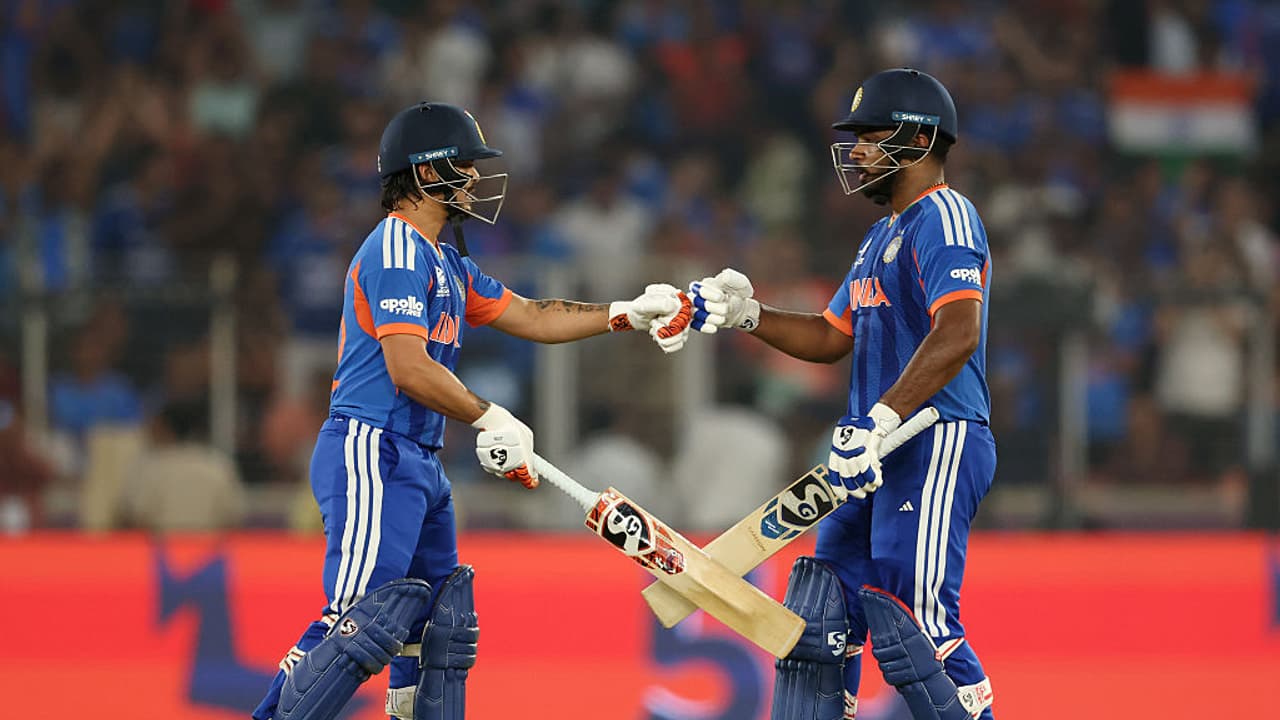
India piled up a record 255/5 against New Zealand in the T20 World Cup final in Ahmedabad, powered by Sanju Samson’s 89 and fiery fifties from Abhishek Sharma and Ishan Kishan.
Defending champions India produced a stunning batting exhibition to pile up 255 for five against New Zealand in the T20 World Cup 2026 final in Ahmedabad on Sunday, setting the highest total ever in the history of a World Cup final. Powered by explosive knocks from Sanju Samson, Abhishek Sharma, and Ishan Kishan, the Indian batting lineup dominated from the outset after being asked to bat first by New Zealand skipper Mitchell Santner.

Samson Leads India’s Batting Masterclass
The innings was built around a commanding knock from Sanju Samson, who smashed 89 runs in a fearless display of power hitting.
Samson looked completely at ease against the Kiwi attack, mixing elegant strokeplay with aggressive intent. At one stage, the in-form Sanju Samson was going strong on 89 off 45 balls as India reached 203 for one after 15 overs in the T20 World Cup final against New Zealand here on Sunday.
His innings kept India firmly in control of the contest and laid the foundation for a massive total.
Abhishek Sharma’s Blitzkrieg Start
Earlier, opener Abhishek Sharma gave India the perfect start with a whirlwind knock.
This was after Abhishek Sharma blazed away to an 18-ball fifty, the opener finding form after an indifferent run in last one week.
Abhishek attacked the bowlers from the very first over, peppering the boundaries and clearing the ropes with ease. He eventually fell for 52 off 21 balls, but by then he had already set the tone for the innings.
Together, Samson and Abhishek had launched a brutal assault on the Kiwi attack.
They raised a quick-fire 98-run stand in just 7.1 overs to provide a great platform to the following batters.
Ishan Kishan Keeps The Momentum Going
After Abhishek’s dismissal, Ishan Kishan ensured the scoring rate never dipped.
Ishan Kishan was giving Samson company on 52 off 24 balls, having reached his half-century in just 21 balls.
Kishan continued to take the attack to the New Zealand bowlers, striking boundaries regularly and maintaining the aggressive approach that defined India’s innings. He eventually scored 54 off 25 balls, keeping India on course for a towering total.
India Cross 200 In Just 15 Overs
India’s dominance was evident as the run rate kept soaring throughout the innings.
Batting with sheer authority and least respect for the Kiwi bowlers, India crossed the 200-run mark in 15 overs.
For long stretches, the Indian batters dealt almost exclusively in fours and sixes after New Zealand captain Mitchell Santner invited them to bat first.
Neesham’s Triple Strike Offers Brief Relief
Just when it looked like India might push past the 270-run mark, New Zealand managed a brief fightback.
However, New Zealand succeeded in putting the brake on the run flow by dismissing Samson, Kishan and skipper Suryakumar Yadav (0) in a space of six balls. Pacer James Neesham took all three wickets in the 16th over to somehow stop the game from slipping away.
The sudden burst of wickets slowed India momentarily.
Shivam Dube Provides Late Fireworks
Despite the mini-collapse, India still finished strongly thanks to a late flourish.
Hardik Pandya (18) did not last long but Shivam Dube (26 not out) provided a flourishing finish, creaming off 24 runs in the final over from Neesham.
India scored 52 runs in the final five overs, with Dube’s powerful hitting ensuring the defending champions ended with a daunting total.
It was the highest ever total in a final of T20 World Cup.
Team Changes And Match Context
New Zealand made one change to their playing XI for the final, bringing back pacer Jacob Duffy in place of all-rounder Luke McConchie.
India, meanwhile, retained the same eleven from the second semifinal against England in Mumbai, sticking with the combination that had carried them into the title clash.