
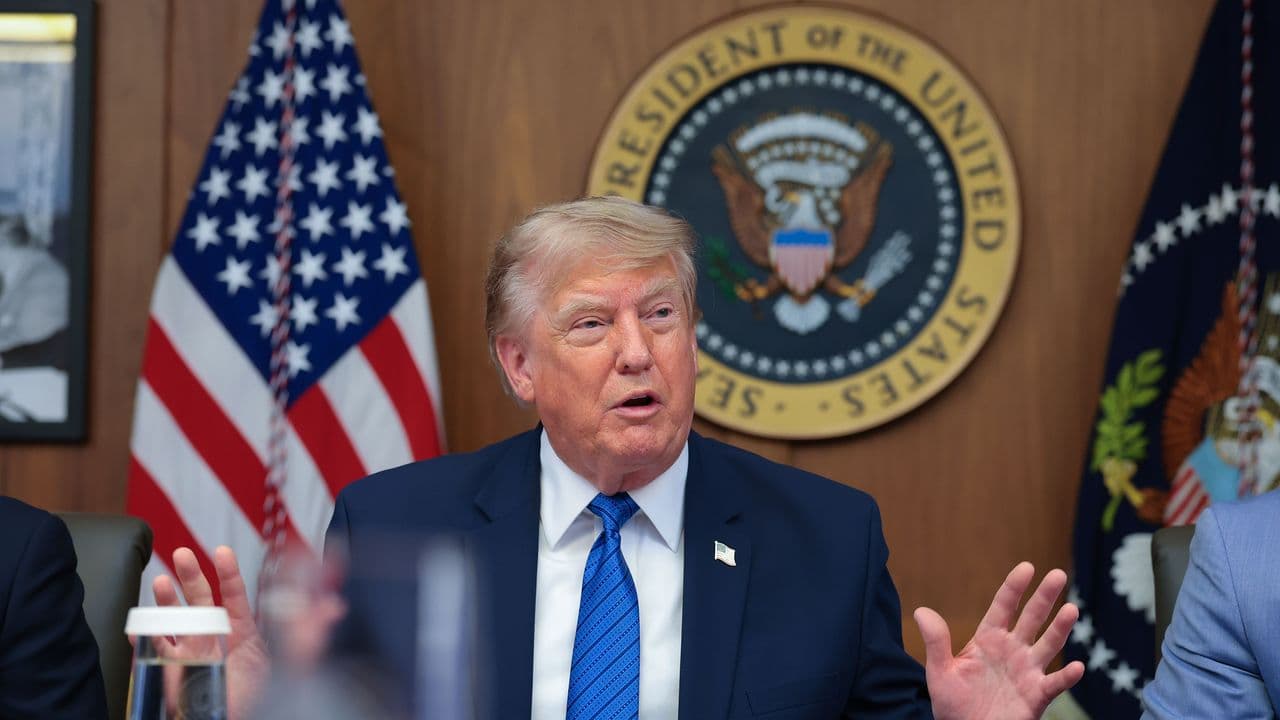
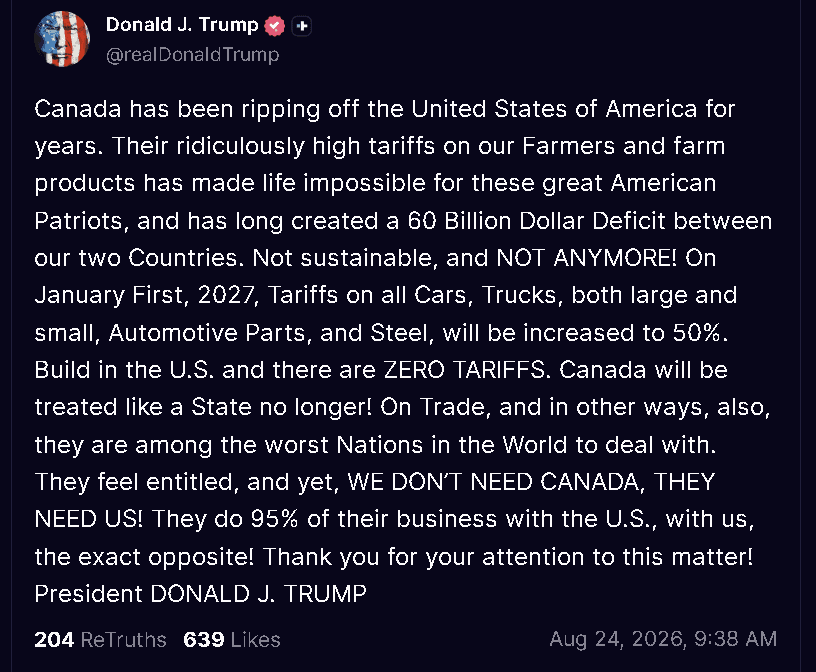
In a post on Truth Social, Trump accused Canada of “ripping off” the U.S. and running a $60 billion trade deficit.
- U.S. Trade Representative Jamieson Greer said Canada sought broader concessions after the two sides had reached a preliminary understanding.
- The dispute included Canadian demands covering additional vehicle categories, including heavy trucks.
- The collapse triggered new 50% U.S. tariffs on about $20 billion of Canadian goods, covering roughly 5% of Canada’s exports to the U.S.
President Donald Trump announced on Monday that tariffs on Canadian cars, trucks and automotive parts will rise to 50% starting in 2027, escalating the trade dispute with Canada after negotiations between the two countries broke down last week.
In a post on Truth Social, he accused Canada of “ripping off” the U.S. and running a $60 billion trade deficit. “On January first, 2027, tariffs on all cars, trucks, both large and small, automotive parts, and steel, will be increased to 50%,” he wrote.
U.S. equities traded mixed on Monday after Treasury Secretary Scott Bessent warned of an “economic D-Day” for Iran in an opinion article published by the Financial Times. Bessent said the Trump administration was preparing what he called the “single greatest financial offensive ever marshaled against an adversary,” with sanctions targeting Iran and countries that continue to support its economy.
The SPDR S&P 500 ETF (SPY) fell 0.30% in morning trade, and the Nasdaq-100 tracking Invesco QQQ Trust (QQQ) dropped over 1.3%. Meanwhile, the SPDR Dow Jones Industrial Average ETF (DIA) traded gained around 0.25%. Retail sentiment around SPY on Stocktwits remained in ‘bearish’ territory over the past day.
Why Did US-Canada Trade Talks Collapse?
In an interview with CNBC, Greer said the deal broke down because Canada asked for more than what the U.S. was prepared to provide “in the last hours.” He said Washington had already offered significant relief, including cutting tariffs on Canadian steel and aluminum “in half,” substantially reducing them on automobiles and accommodating Canada on softwood lumber.
However, Canada wanted the agreement to cover not only passenger vehicles, SUVs and pickups, but also “the heavies” and “the heaviest trucks available,” Greer said. He described heavy trucks as a sector with different economics from other vehicles and said the demand was “just one of many things that the Canadians wanted an expansion on.”
The talks ultimately collapsed late Friday, with Washington moving to impose 50% tariffs on about $20 billion of Canadian goods, covering products such as electronics, industrial machinery, dairy products, paper goods, appliances, agricultural equipment, wine and other consumer goods. Canada responded with retaliatory tariffs that are scheduled to take effect in September.
US-Canada Trade Talks Hit Another Roadblock
The U.S. has framed its tariff policy as a response to what it considers longstanding Canadian barriers to American goods. Greer cited restrictions affecting U.S. wine and spirits, automobiles and dairy products.
He said Washington had spent roughly a year asking Canada to remove those barriers before proposing tariffs covering about 5% of Canadian imports, which he stated was “pretty low in the grand scheme of things.”
He added that the measures would have little effect on the U.S. economy. The affected imports, he said, amount to only “point zero six percent” of total U.S. consumption. Greer also pointed to recent inflation data and rising real wages for manufacturing workers, saying the U.S. was “on the right trajectory.”
The trade representative did not provide a timetable for restarting negotiations with Canada. He said Washington remained open to discussions if Ottawa returned to the negotiating table without seeking additional concessions.
Read also: MSTR Stock Gains After Strategy Sets Up $1.59B ‘USD Cash’ Pool With Bitcoin Nearing $79K
For updates and corrections, email newsroom[at]stocktwits[dot]com.<
