
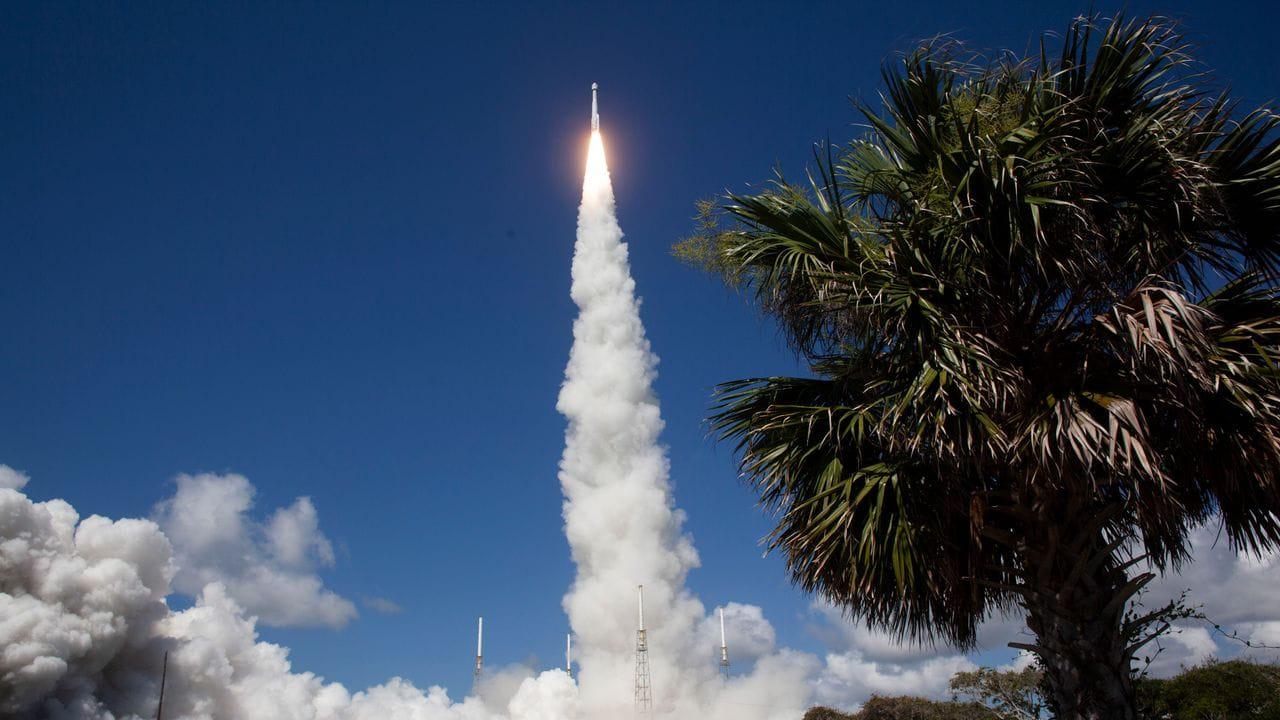
Rocket Lab completed its 100th Electron launch, and CEO Peter Beck explained how its larger Neutron rocket could approach a 50% gross margin.
- SpaceX caught Starship’s upper stage after it deployed 26 satellites and spent over 22 hours in orbit.
- Firefly booked another lunar payload and received 10 million AST shares under an engine licensing deal.
- A failed Amazon satellite launch raised questions about AST’s own launch schedule.
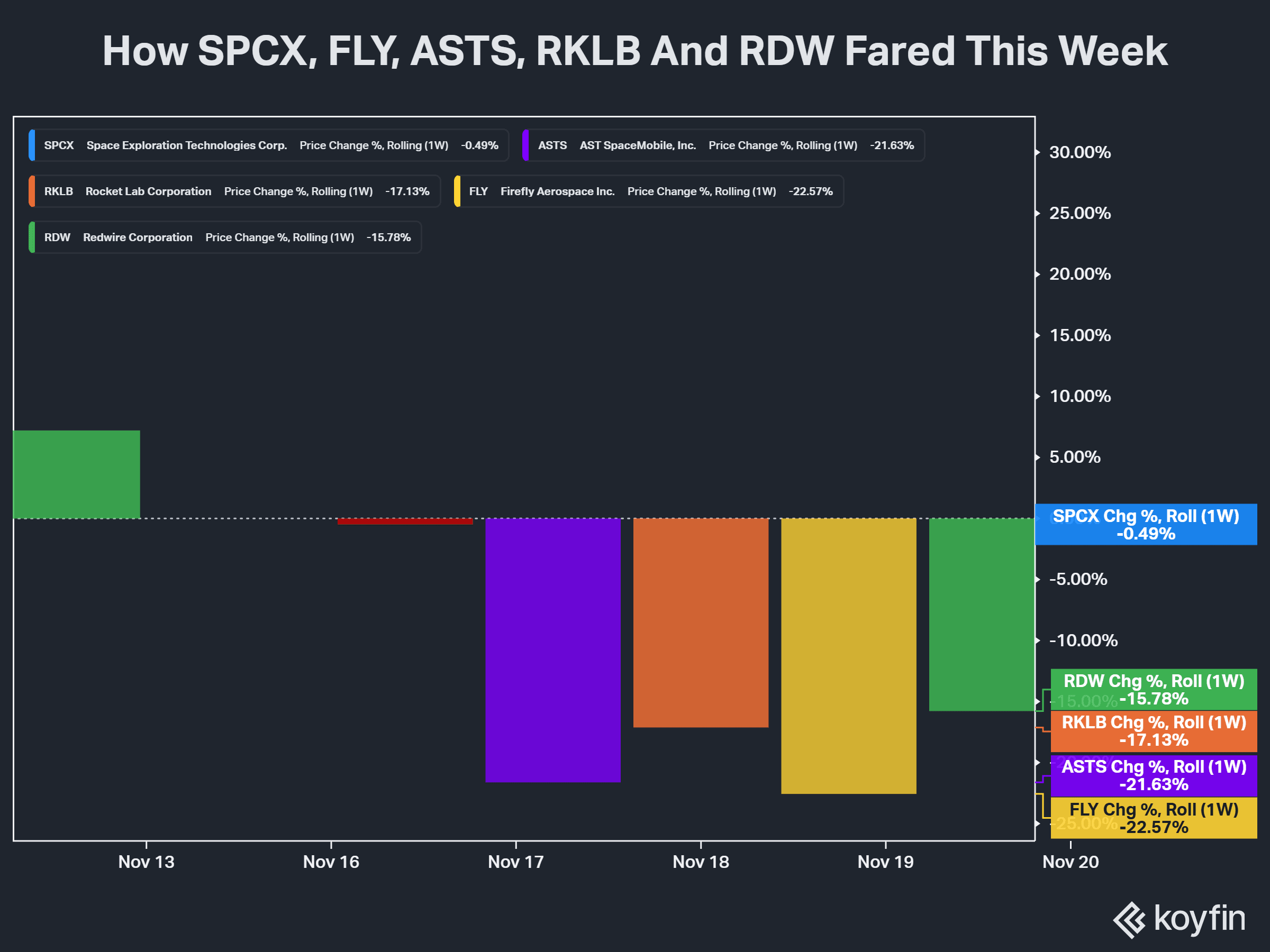
SpaceX (SPCX) caught Starship on its return from orbit on Saturday and went on to weather a selloff that cost Firefly Aerospace (FLY) and AST SpaceMobile (ASTS) more than a fifth of their value over the week through Thursday.
Firefly led the week’s losses with a 23% drop, followed by AST SpaceMobile at 22%, Rocket Lab (RKLB) at 17% and Redwire (RDW) at 16%. SpaceX held up best, slipping just 0.5%. The broader tech selloff gathered pace on Monday ahead of Nvidia’s earnings and Anthropic’s IPO. On Thursday alone, the Nasdaq Composite fell 2.3%.
FLY Wins Repeat Business For Next Moon Mission
Firefly shares fell more than 10% on Monday. On Tuesday, the company announced a new lunar mission deal with a returning customer. Italian firm QASCOM, whose instrument picked up navigation signals on the Moon’s surface during the first Blue Ghost mission, booked a ride on Firefly’s Elytra orbiter to test navigation around the Moon. The mission is slated for 2028 at the earliest and now has eight payloads, six through NASA.
Firefly also received 10 million shares from AST SpaceMobile on Tuesday as partial payment for a license to build Miranda and Vira engines for AST’s planned Blacklift rocket. The deal calls for AST to pay $400 million in cash and issue an estimated 10 million to 14 million shares in total.
Vulcan Failure Puts ASTS BlueBird Launch In Focus
AST shares fell about 12% on Monday after a failed Vulcan launch destroyed 40 Amazon satellites on Sunday. The link was Vulcan’s BE-4 engines. They also power Blue Origin’s New Glenn, which is scheduled to carry three AST BlueBirds in early 2027. On Wednesday, United Launch Alliance said early data pointed to a problem with how Vulcan delivered fuel to the engines, easing concerns that an engine defect could delay AST’s launch.
AST also registered 780,052 shares it could use to pay spectrum fees. In a separate filing on Thursday, AST said it had met with the FCC to discuss sending Ligado’s application to the National Telecommunications and Information Administration for review. Ligado is seeking approval to put L-band equipment on 96 AST satellites to expand mobile broadband coverage in rural America.
Electron Hits 100 As Neutron Awaits Liftoff
Rocket Lab marked Electron’s 100th launch by delivering a radar-imaging satellite for Japan’s iQPS. CEO Peter Beck told the Shared Lunch podcast why its larger Neutron rocket could pay off at a slower launch pace. The first stage accounts for about 70% of Neutron’s cost. If Rocket Lab can recover and reuse it, gross margins could approach 50% at fewer than 10 launches a year, Beck said.
Customers have already booked 16 Neutron missions, several at a base price of $70 million. Deposits and milestone payments help fund construction. The first flight is targeted for 2027 at the earliest as engineers work through issues uncovered in ground tests. “So we’re working through those and it’ll fly when we’re 100% ready to put it on the pad,” Beck said.
Beck said Rocket Lab’s revenue was running at more than $1 billion a year. He sees the pending Iridium acquisition as a way to expand beyond building and launching spacecraft by selling satellite services to Iridium’s 2.5 million existing customers.
Redwire Lands $15M Satellite Solar Deal
Redwire announced on Thursday that it had won a $15 million order in the third quarter to supply compact solar wings for an AscendArc communications satellite. Redwire said that the wings can deliver up to 50% more power than its traditional arrays in the same space. The announcement came after last week’s $40 million NASA award to demonstrate solar power for a future Moon base.
With profitability likely about two years away, Oppenheimer saw the risks and potential rewards as balanced and began coverage Thursday at ‘Perform.’
SpaceX Catches Starship As Musk Eyes More AI Business
SpaceX caught Starship’s upper stage in Texas on Saturday after it deployed 26 Starlink satellites and spent more than 22 hours in orbit. The Super Heavy booster missed its own catch.
With Starship back in Texas, the FAA sought public input on SpaceX’s proposal to launch it from the state up to 456 times a year. On the military side, the U.S. raised the combined ceiling on launch contracts for SpaceX, Blue Origin and United Launch Alliance by $985 million. Blue Origin also secured a commercial win: Google chose its New Glenn rocket for a 2029 orbital AI mission after SpaceX launched the first prototype.
Elsewhere, SpaceX CEO Elon Musk said at DealBook on Wednesday that Anthropic could want another 10 gigawatts of SpaceX computing power. The company secured a permit for its $24 billion Texas data center and power plant, though the county denied a tax break. Arizona’s attorney general sought to delay a vote on a separate $50 billion campus.
Monday’s filings also showed SpaceX ended September as Nvidia’s largest disclosed stockholding. Tepper’s Appaloosa added shares, Druckenmiller’s family office opened a position and Citadel trimmed its stake while adding call options. Cathie Wood’s ARK bought 378,515 shares on Monday.
Retail Traders Cool On Space Stocks
The selloff came as Deutsche Bank’s space summit highlighted a longer-term opportunity for Rocket Lab and Firefly. The summit agenda cited a forecast that the global launch market could more than double from about $12 billion in 2025 to over $24 billion by 2030 as governments and companies deploy larger satellite fleets. For AST SpaceMobile, the focus was how much revenue satellite operators could earn per user by connecting directly to smartphones.
Investors also gained two ways to trade the sector Wednesday with the launches of the Yorkville America Space Index ETF (YASX) and the KICK Space Data Center & Infrastructure Index ETF (SDC).
On Stocktwits, FLY and RKLB sentiment flipped from ‘bullish’ to ‘bearish,’ with ‘extremely low’ and ‘normal’ message volume, respectively. ASTS eased from ‘bullish’ to ‘neutral’ on ‘high’ volume, and RDW slipped from ‘neutral’ to ‘bearish’ on ‘low’ volume. SPCX held at ‘neutral’ on ‘normal’ volume.
For updates and corrections, email newsroom[at]stocktwits[dot]com.<








