
Rocket Lab executive Brian Roger said HASTE enables “low-cost, high-frequency hypersonic and missile defense testing.”
- HASTE, a suborbital version of Electron, carries test payloads at speeds above 7.5 kilometers per second.
- Rocket Lab says HASTE can carry payloads weighing up to 700 kilograms and has a 100% mission success rate.
- Rocket Lab has a $190 million deal for 20 HASTE flights under MACH-TB 2.0 and a $30 million contract for three Anduril launches.
Shares of Rocket Lab (RKLB) climbed nearly 1% overnight late Tuesday after an executive said that the company is planning 12 hypersonic test launches this year, spotlighting its role in the U.S. push to develop advanced weapons faster.
RKLB stock fell 2% on Tuesday to $64.22, logging its fifth straight session in the red.
Rocket Lab’s HASTE Takes Aim At 12 Tests
Rocket Lab’s vice president of global launch services Brian Rogers said that said HASTE enables “low cost, high frequency hypersonic and missile defense testing.” Short for Hypersonic Accelerator Suborbital Test Electron, HASTE is a suborbital test-launch vehicle derived from Rocket Lab’s Electron rocket.
It carries experimental payloads for flight testing. Rocket Lab says it can carry payloads of up to 700 kilograms and release them at speeds above 7.5 kilometers per second. The company reported a 100% success rate across HASTE flights in March.
“Rather than saying we need to be stuck in an analysis environment and then it’s a very rigorous test campaign that costs a lot of money and involves a lot of people, now you can say we’re planning 12 tests this year,” Rogers told Fox News. “We don’t have to bet the farm on any one of them, which allows us to take more risk and really move the needle in terms of technology development.”
Rocket Lab’s Test Role In Costly Arms Race
The U.S. military is replenishing its missile stockpile, while developing hypersonic weapons, but the systems are costly. Government Accountability Office estimates put the Army’s Dark Eagle missile at more than $40 million each. A Navy estimate for a hypersonic missile planned for Zumwalt destroyers is about $70 million, including development and integration costs. By comparison, a Tomahawk costs about $2.6 million and an Army Precision Strike Missile about $1.6 million.
Some startups are targeting lower prices. Castelion says its Blackbeard hypersonic weapon will cost less than $500,000 and is designed for mass production.
Rocket Lab’s HASTE Contracts Gain Momentum
Rocket Lab has secured a series of contracts for hypersonic testing. In March, it signed a $190 million deal for 20 HASTE flights over four years under the MACH-TB 2.0 program. Anduril followed in May with a $30 million contract for three HASTE test launches.
In July, Rocket Lab announced a $266 million Space Force contract for 12 suborbital launches, with options for six more. The missions will primarily launch from a new site in Kodiak, Alaska, with the first expected no earlier than the end of 2026. Rocket Lab said the award will provide high-frequency launch capacity for missile-defense missions.
How Do Retail Traders Feel About RKLB?
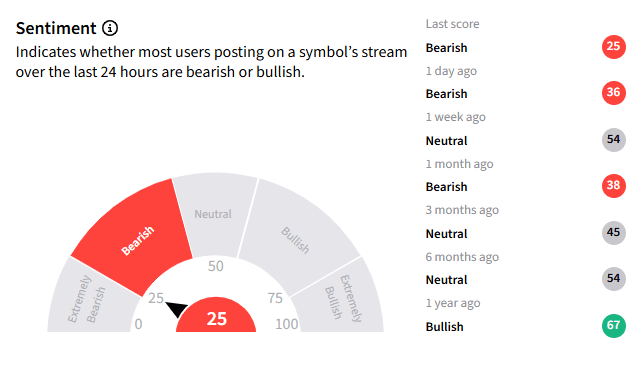
On Stocktwits, retail sentiment for RKLB slipped to ‘bearish’ from ‘neutral’ levels a week ago amid ‘low’ message volume.
One user said, “$RKLB still have 2000 shares at 4/ share but if this got below 50, I might actually have to buy some more”
View this Stocktwits post
Another user said, “$RKLB reminder that if the stage 1 tanker isn’t ready by earnings there’s no chance Neutron launches in the first half of 2027”
View this Stocktwits post
RKLB stock has declined 8% year-to-date.
For updates and corrections, email newsroom[at]stocktwits[dot]com.<
