
Guggenheim maintained its $400 price target for Oracle shares with a ‘Buy’ target, implying an upside potential of nearly 100% from Wednesday’s closing price.
- Guggenheim said the results indicate lower customer concentration and greater confidence in Oracle's growth outlook as new capacity comes online.
- Bernstein raised its price target on Oracle to $325 from $319 and maintained an ‘Outperform’ rating, saying the company continues to execute toward its FY30 targets without major issues.
- The firm noted that while the stock fell after earnings, investor concerns appeared to center on Oracle's elevated capital expenditure plans and planned FY27 capital raise.
Shares of Oracle Corp. (ORCL) are tumbling despite the company’s fourth-quarter (Q4) results beating analyst expectations, but Wall Street analysts are unfazed by the selloff.
According to TheFly, Guggenheim recommended investors to “aggressively” buy Oracle shares after its beat-and-raise quarter.
Oracle shares were down nearly 10% in Thursday’s pre-market trade. ORCL was among the top trending tickers on Stocktwits at the time of writing.
Wall Street Puzzled, But Not Unfazed By ORCL Selloff
Guggenheim maintained its $400 price target for Oracle shares with a ‘Buy’ target, implying an upside potential of nearly 100% from Wednesday’s closing price. The firm stated in its note that it sees “no apparently good reason” for the post-earnings selloff in Oracle shares.
Guggenheim said Oracle's outlook improves from here, citing first-quarter (Q1) revenue guidance that topped expectations. The firm also highlighted an $85 billion increase in remaining performance obligations (RPO) to $638 billion, driven partly by four customers with contracts of at least $8 billion each.
Guggenheim said the results point to less customer concentration and greater confidence in Oracle's growth outlook as new capacity comes online.
Bernstein raised its price target on Oracle to $325 from $319 and maintained an ‘Outperform’ rating, saying the company continues to execute toward its FY30 targets without major issues.
The firm noted that while the stock fell after earnings, investor concerns appeared to center on Oracle's elevated capital expenditure plans and planned FY27 capital raise rather than the quarter itself, which is unlikely to win over skeptics in the near term.
ORCL Will Remain Debated, Say Analysts
Analysts at Piper Sandler believe that Oracle will remain debated among investors, despite the company’s Q4 beat and an increase in its RPOs.
The firm stated that it is encouraged by Oracle’s AI-driven cloud growth, while viewing the FY27 revenue target as achievable. Piper Sandler expressed greater confidence in management's ability to protect margins amid rising costs.
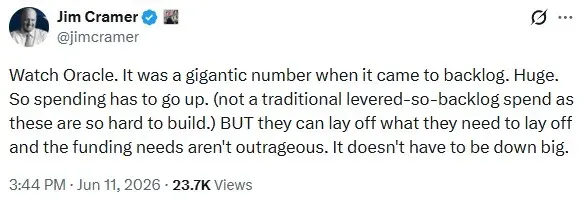
Jim Cramer highlighted in a post on X that Oracle’s reported backlog was a “gigantic number,” while adding that the company’s spendings will have to go up.
“But they can lay off what they need to lay off and the funding needs aren't outrageous. It doesn't have to be down big,” he said.
Citi called Oracle's Q4 report mixed, noting that while results topped expectations, its fiscal 2027 earnings outlook was weighed down by gross margin pressure. Still, the firm said it sees "more positives than negatives," citing Oracle's financial discipline, and reiterated its ‘Buy’ rating with a $330 price target.
ORCL Touts Cloud Infrastructure Demand For RPO, Revenue Growth
Oracle stated that the demand for cloud infrastructure drove the surge in RPO and revenue growth during Q4.
Oracle also said it plans to launch an AI-powered version of its Cerner patient care system, which it expects will help drive Oracle Health's growth into the double digits in fiscal 2027.
Oracle reported earnings per share (EPS) of $2.11 in Q4 on revenue of $19.2 billion, compared to Wall Street estimates of an EPS of $1.96 on revenue of $19.1 billion, according to Fiscal.ai data.
How Did Retail Traders React To ORCL Stock?
Retail sentiment on Stocktwits around Oracle trended in the ‘extremely bullish’ territory, with message volumes at ‘extremely high’ levels at the time of writing.
One user believes that Oracle does not have a demand problem; it has a capacity problem.
View this Stocktwits post
ORCL stock is up 3% year-to-date and 13% over the past 12 months. The S&P 500 ETF (SPY) is up 20% over the past 12 months, while the Technology Select Sector SPDR ETF (XLK) is up 47%.
The iShares Core S&P 500 ETF (IVV) is up 20% during this period, while the Vanguard Total Stock Market Index Fund ETF (VTI) is up 21%.
For updates and corrections, email newsroom[at]stocktwits[dot]com.<
