
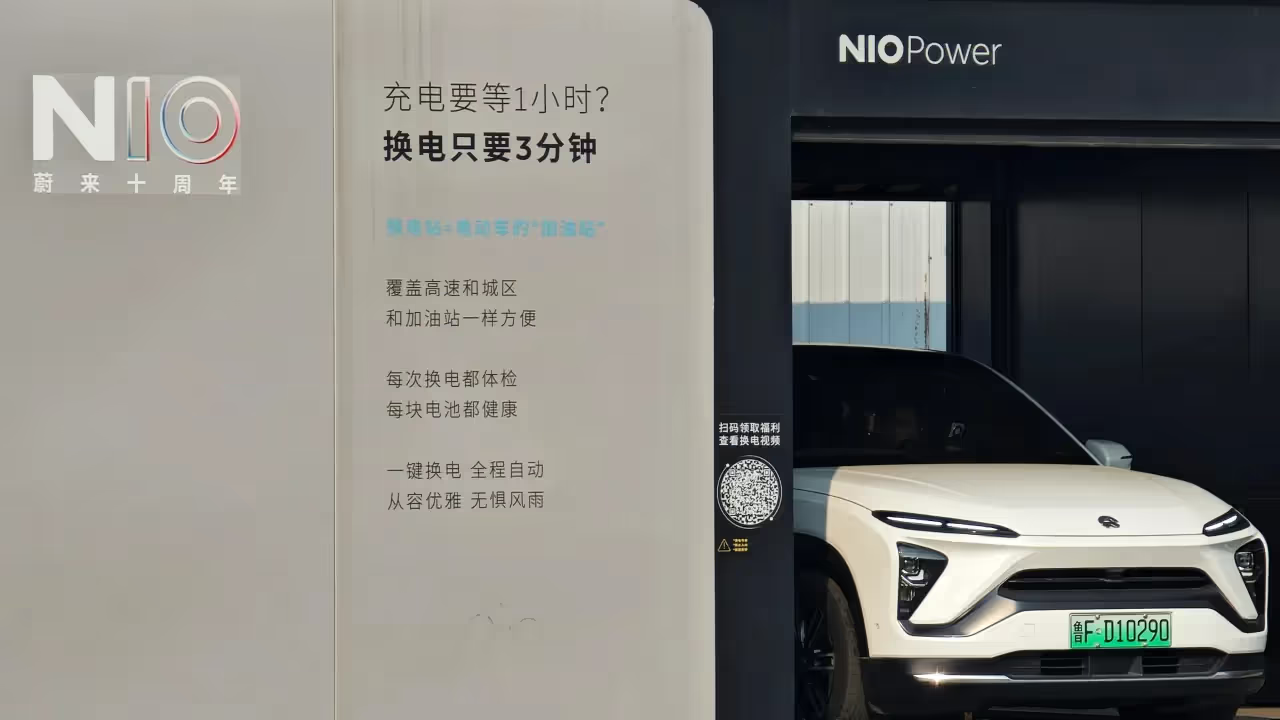
Nio has added only 341 stations toward its 1,000-plus target for 2026, with about 450 openings expected in Q4.
- Nio handed over 36 Wuhan charging and swap stations, leaving all existing local swap assets owned by state-backed partners.
- Nio and over 40 partners jointly operate more than 800 swap stations across 25 Chinese provinces and regions.
- The company’s network now includes 4,017 swap stations and has completed over 120 million cumulative battery swaps.
U.S.-listed shares of Nio, Inc. (NIO) are headed for a second consecutive weekly loss even as the Chinese EV maker expanded a state-backed ownership model in a bid to grow its battery-swap network, while limiting its own capital spending.
Nio’s U.S.-listed stock fell 2% on Wednesday to close at $4.54, extending its decline for the week to 4%.
State Partners Take Nio Swap Assets
Nio handed over 36 charging and battery-swap stations built with Optics Valley Transportation Group on Wednesday. The transfer means state-owned partners now hold all existing swap-station assets in Wuhan, where Nio Power is headquartered, EV reported.
Under the model, called by Nio as “state-capital partner holds the asset, Nio operates it,” Optics Valley owns the stations while Nio supplies the technology and runs them. Nio has now worked with more than 40 state-capital platforms and financial institutions across 25 Chinese provinces and regions to jointly build and operate over 800 swap stations, marking about one-fifth of its network and four times the total disclosed at the end of 2025.
The transfer followed the delivery of 90 partner-backed stations on Aug.5. Nio Power and Zhongan Energy agreed in June to build 500 stations within a year.
Nio Swap Target Faces Pressure
Nio aims to add more than 1,000 swap stations in China this year but had added only 341 as of Wednesday, bringing its total to 4,017. The company has slowed its self-funded construction to control spending, making its partner model critical to hitting the target. About 450 stations are now expected to open in the fourth quarter.
Nio has invested more than 20 billion yuan in its charging and swapping infrastructure. Its nationwide network includes 4,017 swap stations, 5,181 charging stations and 29,875 charging piles.
CATL Closes In On Nio’s Swap Network
Nio surpassed 120 million cumulative battery swaps last week, just six months after reaching 100 million. It also opened its first fifth-generation station, which can serve vehicles across the Nio, Onvo and Firefly brands.
Competition is accelerating. CATL also plans to operate more than 3,000 Choco Swap stations across 140 cities by year-end. Including its heavy-truck network, its Chinese swap footprint is expected to exceed 4,000 stations, approaching the scale of the network Nio has spent more than eight years building.
How Do Retail Traders Feel About NIO?
On Stocktwits, retail sentiment for NIO was ‘bearish’ amid a 28% decline in 24-hour message volumes.

One user questioned, “$NIO What is going to happen to all the millions of EVs with fixed, non-swappable batteries once the battery degrades past a certain point? Probably the scrap heap. What an environmental mess.”
View this Stocktwits post
Another user said, “$NIO As I understand it, going forward NIO is trying to not construct and own the new battery swapstations. Instead they are trying to get investors to do that, and NIO will just rent them. This alone shows the battery swap plan is suspect. And why NIO stock rarely does anything imho.”
View this Stocktwits post
Nio’s U.S.-listed stock has risen 2% over the past year.
For updates and corrections, email newsroom[at]stocktwits[dot]com.<
