
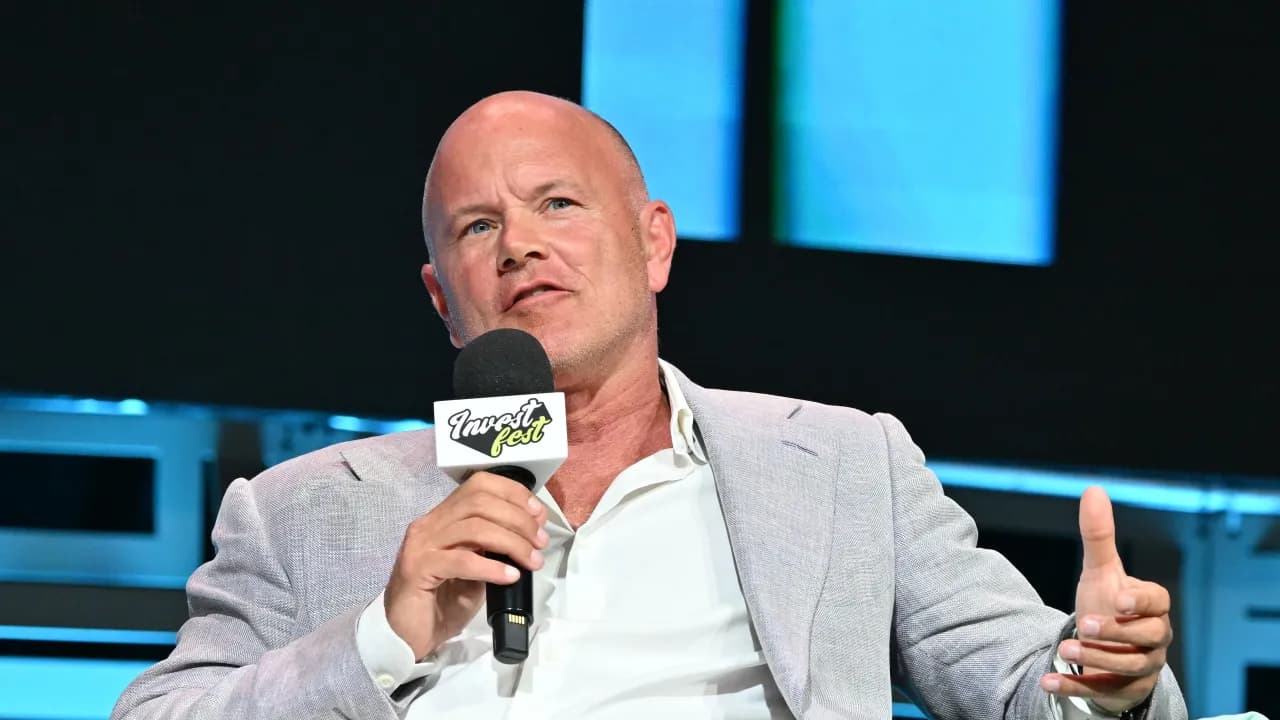
In a post on X, the Galaxy Digital CEO argued that reversing the GENIUS Act would weaken U.S. innovation and competitiveness.
- Mike Novogratz criticized efforts to revisit the GENIUS Act, arguing that reopening the legislation would introduce unnecessary regulatory uncertainty.
- His comments follow community banks' writing to the U.S. Senate earlier this week, calling for clearer limits.
- Coinbase policy chief Faryar Shirzad said Congress already resolved the issue in GENIUS and warned that revisiting it could undermine confidence in U.S. digital dollar infrastructure.
Galaxy Digital (GLXY) Chief Executive Officer Mike Novogratz warned on Wednesday that reversing the GENIUS Act would be a strategic mistake for the U.S., pushing back against renewed efforts by banks to curb stablecoin rewards.
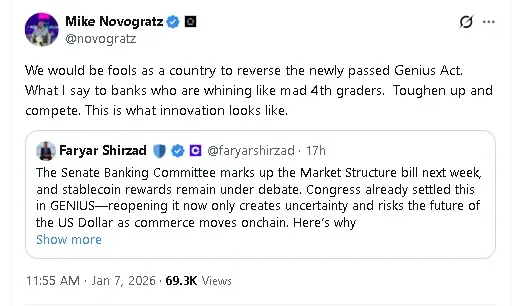
“We would be fools as a country to reverse the newly passed Genius Act,” Novogratz wrote in a post on X. “What I say to banks who are whining like mad 4th graders. Toughen up and compete. This is what innovation looks like.”
Novogratz was responding to remarks from Coinbase Chief Policy Officer Faryar Shirzad, who cautioned that reopening debate on the GENIUS Act would inject uncertainty into U.S. digital asset policy, especially as stablecoin adoption is ramping up globally.
Galaxy’s stock edged 0.36% higher after hours on Wednesday after falling more than 2% in regular trading. On Stocktwits, retail sentiment around the company remained in ‘bearish’ territory over the past day.
Banks Push Back On Stablecoin Yield Concerns
The comments follow community banks' writing to the U.S. Senate earlier this week, calling for clearer limits. The letter by the American Bankers Association argued that loopholes in the GENIUS Act could allow crypto firms to draw deposits away from local lenders.
The organization said that deposit outflows would reduce lending capacity for small businesses, farmers, students, and homebuyers. “If billions are displaced from community bank lending, small businesses, farmers, students, and home buyers in towns like ours will suffer,” the council wrote.
Dollar Dominance At Stake
In Shirzad’s opinion, opposition from large banks reflects competitive pressure rather than actual risk. He cited data showing U.S. banks earn more than $360 billion annually from interest on reserves held at the Federal Reserve and card transaction fees. He added that stablecoin rewards threaten those margins by lowering payment costs and introducing competition, not by impairing banks’ ability to lend.
Shirzad also said that the debate about stablecoin yield isn’t just about smaller banks being inconvenienced but about the dollar’s dominance on the global stage. He cited China’s recently announced interest payments to users of its digital yuan as an example of how restricting stablecoin rewards in the U.S. could ultimately support efforts to weaken the dollar’s role in global commerce.
The cryptocurrency market was in the red on Wednesday night. The overall market capitalization fell 1.8% in the last 24 hours to $3.2 trillion. Bitcoin (BTC) dipped around 2% to below $91,000. Retail sentiment on Stocktwits around the apex cryptocurrency remained in ‘extremely bullish’ territory over the past day, with chatter at ‘high’ levels. Sentiment around the leading stablecoins, USDT and USDC trended in 'bullish' territory.
Read also: Semler Outperforms Crypto Equities While Bitcoin Slips Below $91,000
For updates and corrections, email newsroom[at]stocktwits[dot]com.<
