
In a note on Friday, Kindig argued that widespread shortages across high-bandwidth memory, conventional DRAM and NAND flash continue to give memory makers significant pricing power.
- Kindig said meaningful new memory supply is unlikely to arrive until 2028, pointing to expansion timelines from Micron as well as industry commentary from Samsung, SK Hynix, and SanDisk.
- The analyst argued that memory has evolved from a cyclical semiconductor segment into one of AI's biggest bottlenecks, a shift she said has helped drive Micron's outsized gains.
- Kindig also said AI systems are becoming increasingly memory-intensive, with newer chips from Nvidia and AMD requiring significantly more HBM.
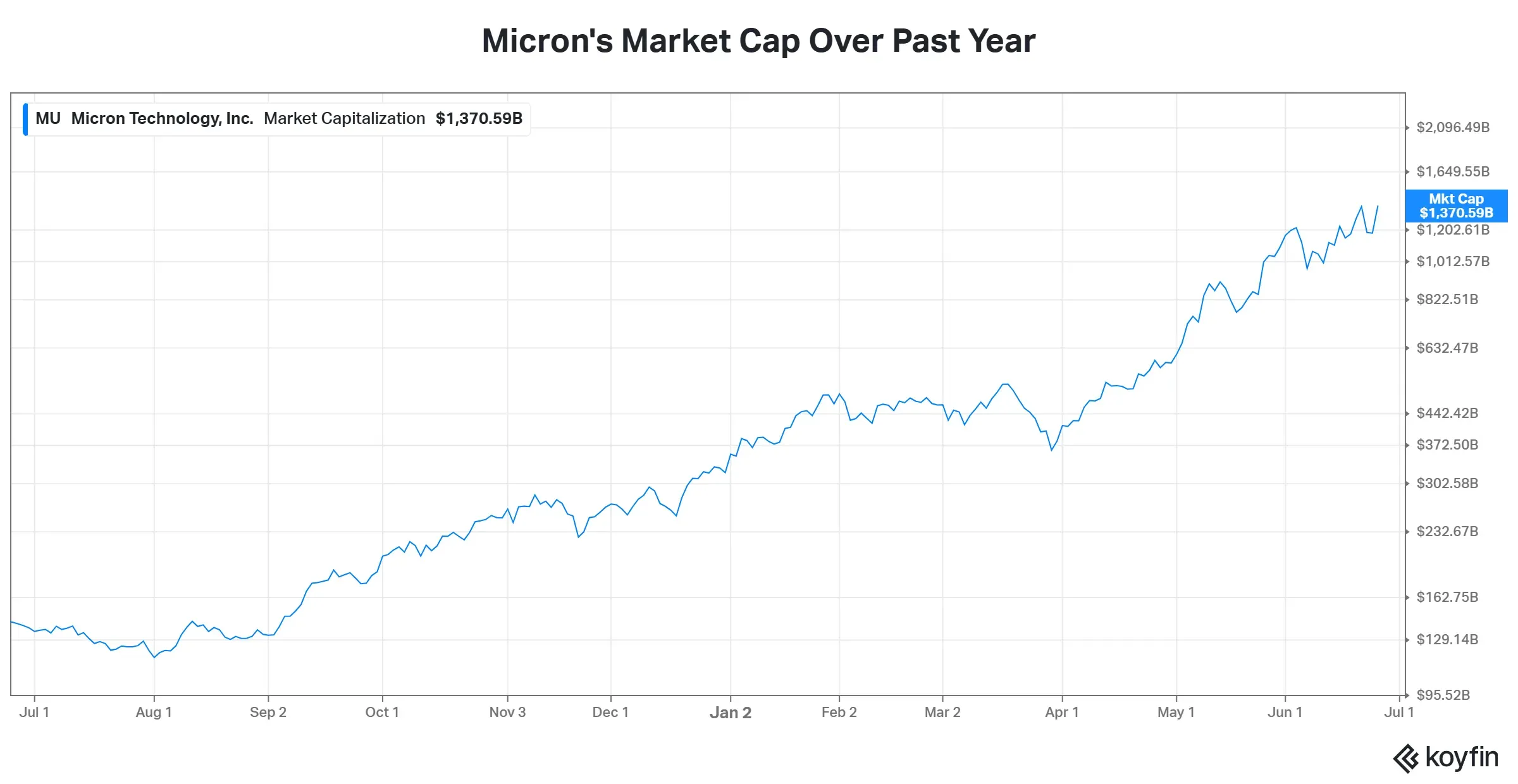
Micron Technology Inc. (MU) has added more than $1.2 trillion to its market capitalization over the past year, but IO Fund’s Beth Kindig says that the AI memory trade still has more room to run.

In a note on Friday, Kindig argued that widespread shortages across high-bandwidth memory (HBM), conventional DRAM and NAND flash continue to give memory makers significant pricing power.
Micron shares were down more than 4% in Friday’s opening trade.
Why Kindig Says The Rally Can Continue
Kindig said meaningful new memory supply is unlikely to arrive until 2028, pointing to expansion timelines from Micron as well as industry commentary from Samsung, SK Hynix Inc. (SKHY) and SanDisk Corp. (SNDK) that suggests supply will remain constrained through at least 2027. She argued that the resulting imbalance should keep pricing favorable for memory suppliers.
Kindig argued that memory has evolved from a cyclical semiconductor segment into one of AI's biggest bottlenecks, a shift she said has helped drive Micron's outsized gains.
“The question now is whether the memory trade has already run too far, or whether shortages and the upside in memory pricing support more upside,” she said, while adding that persistent supply constraints suggest the latter.
Kindig also said AI systems are becoming increasingly memory-intensive. New generations of AI chips from Nvidia Corp. (NVDA) and Advanced Micro Devices Inc. (AMD) require substantially more HBM than their predecessors, while larger AI models and longer context windows are driving demand for additional memory across GPUs, CPUs and storage.
Risks To The AI Memory Trade
Despite her bullish outlook, Kindig said investors should keep an eye on two key risks. The first is the growing use of long-term supply agreements between hyperscalers and memory makers, which could cap pricing upside even as they provide greater demand visibility.
The second is advances in AI efficiency, such as Google's TurboQuant, which aims to reduce memory requirements by compressing key-value cache data.
However, Kindig argued those concerns may be overstated, noting that Google continues to increase HBM capacity in its latest AI chips despite the technology, suggesting demand for high-performance memory remains robust.
What Do Retail Traders Think Of MU?
Retail sentiment on Stocktwits around Micron Technology trended in the ‘extremely bullish’ territory at the time of writing.
MU stock is up 307% year-to-date and 822% over the past 12 months. The S&P 500 ETF Trust (SPY) is up 20% over the past 12 months, while the Invesco QQQ Trust (QQQ) is up 30%.
The iShares Semiconductor ETF (SOXX) is up 150% during this period, while the State Street Technology Select Sector SPDR ETF (XLK) is up 45%.
For updates and corrections, email newsroom[at]stocktwits[dot]com.<
