
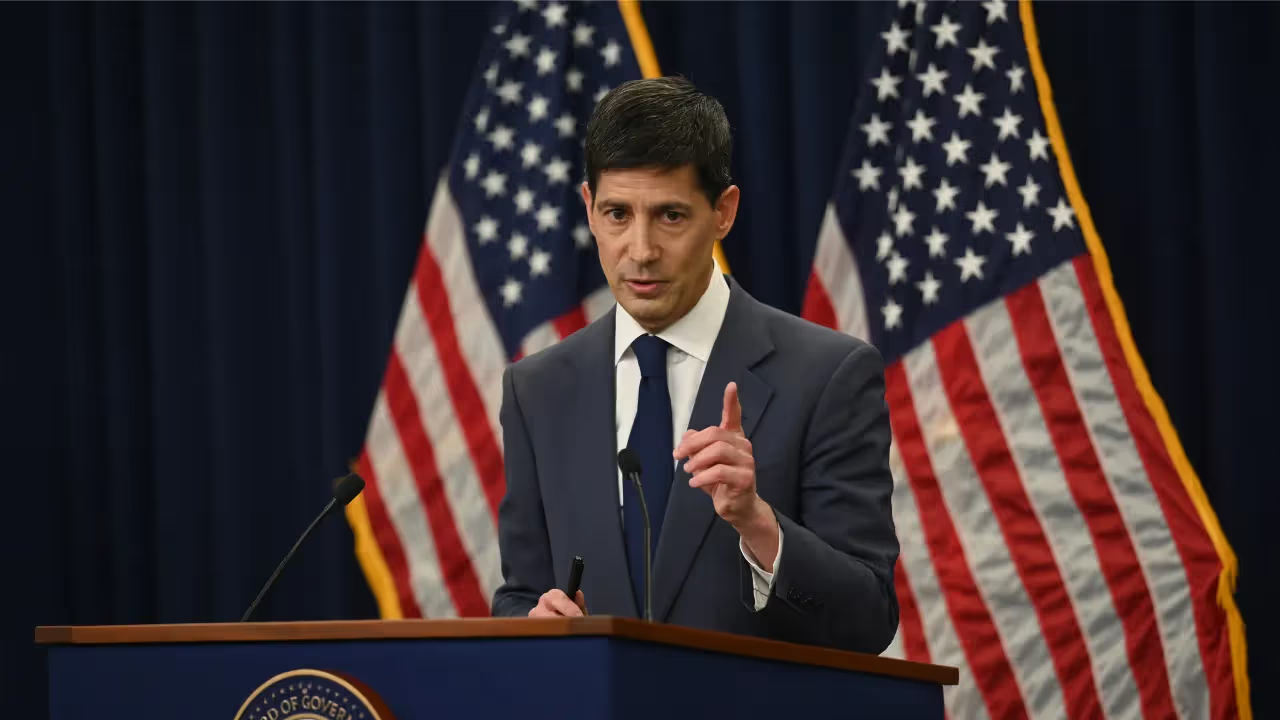
Federal Reserve Chairman Kevin Warsh is reportedly considering a reduction in the central bank’s policy-setting meetings, signaling a potential overhaul of how the Fed communicates with financial markets.
- Federal Reserve Chairman Kevin Warsh has raised the idea of scaling back the frequency of the central bank’s regularly scheduled policy meetings, moving away from the long-standing calendar of eight gatherings per year.
- The potential reduction fits into a wider push by Warsh to reform central bank operations, which includes shortening official policy statements and limiting forward-looking statements.
- Under the Banking Act of 1935, the Federal Open Market Committee is legally mandated to meet at least four times annually.
Federal Reserve Chairman Kevin Warsh is evaluating proposals to decrease the frequency of the central bank's official policy-setting gatherings, a move that would represent one of the most substantial operational changes to the institution in decades, according to a report by The New York Times.
During a meeting of the Federal Open Market Committee (FOMC), Warsh introduced the concept of altering how often policymakers gather to deliberate on borrowing costs. According to four individuals familiar with the discussion cited by The New York Times, a determination regarding a revised meeting calendar could be finalized prior to the committee's upcoming gathering in mid-September, even if any resulting schedule changes are implemented at a later date.
A Federal Reserve spokesperson declined to comment on the discussions
Recalibrating Federal Reserve Workings
The FOMC currently convenes eight times per year for two-day sessions to vote on benchmark interest rates and issue economic projections. Reducing that cadence would break from a pattern established in 1981 under former Chairman Paul A. Volcker. Critics note that fewer gatherings could lessen the Fed’s agility in responding to shifting economic conditions, inflation trends, and labor market dynamics.
The potential schedule adjustment comes after the committee voted 9-3 to keep interest rates steady, a decision that drew scrutiny from investors after Warsh refrained from detailing the rationale or specifying whether he would support future rate hikes if inflation remains stubborn.
While the Federal Reserve has already published scheduled meeting dates for the remainder of 2026 and for 2027, central bank guidelines note that meeting dates remain tentative until confirmed at the gathering immediately preceding them.
Warsh’s Reform Push
Since assuming the chairmanship in May, Warsh has pursued a campaign centered on institutional reform within the central bank. The proposal to meet less frequently mirrors other recent shifts, including significantly condensed post-meeting policy statements and a reduced emphasis on providing forward guidance to financial markets.
Warsh has also indicated that he is considering reducing the frequency of press conferences held after policy decisions, a practice that became standard after every meeting in January 2019. Furthermore, Warsh has established five internal task forces to review central bank operations, encompassing areas such as public communication, data utilization, and management of the Fed's balance sheet.
Retail sentiment on Stocktwits for SPY and QQQ was ‘bearish’ and ‘neutral’ for the DIA, with ‘high’ message volumes.
For updates and corrections, email newsroom[at]stocktwits[dot]com.<
