
Earlier this month, the Bureau of Economic Analysis reported that the U.S. economy grew at an annualized rate of 4.3%, higher than the Dow Jones forecast of 3.2%.
- The “Shark Tank” investor explained why the GDP growth number matters, adding that half of every investment dollar is still made in the U.S.
- However, he acknowledged that problems with the U.S. economy continue to persist, including high inflation.
- He also criticized the Trump administration’s tariff policies, saying that inputs not even produced in the U.S. have been included in the levies.
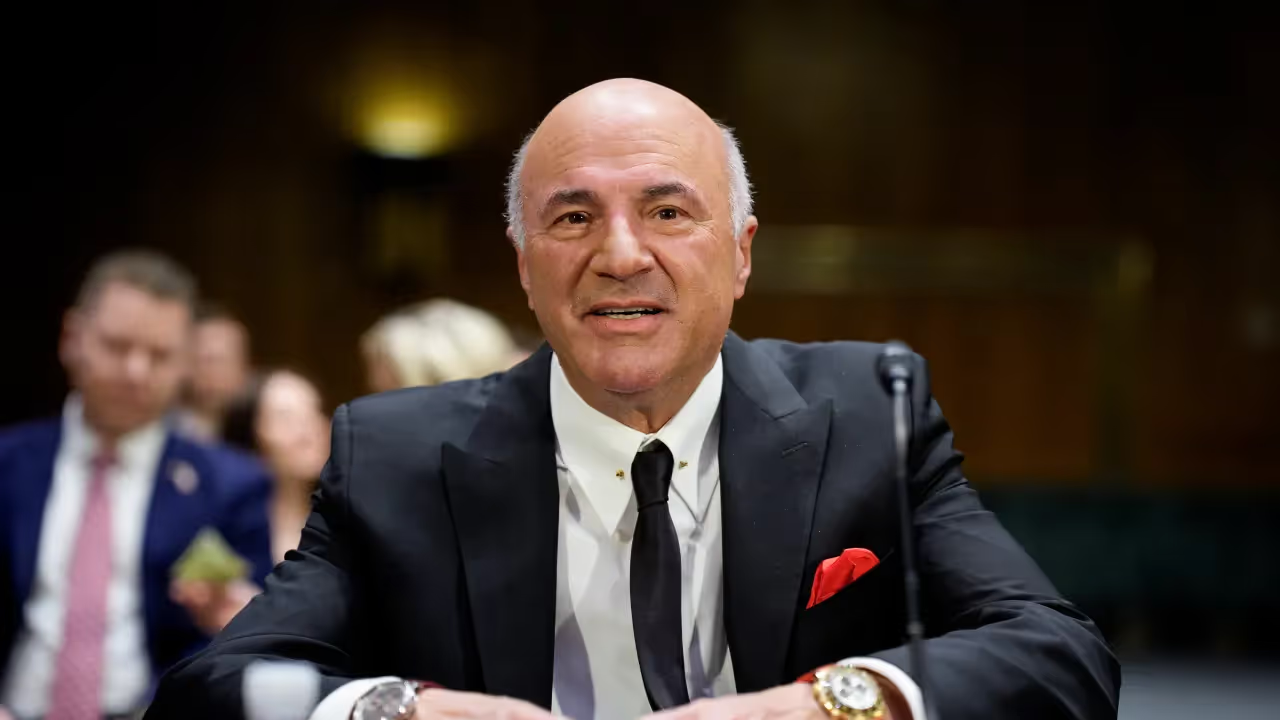
Kevin O’Leary, chairman of O’Leary Ventures and one of the investors on “Shark Tank,” on Sunday said that the Trump administration has a “pretty good scorecard” when it comes to the Gross Domestic Product (GDP).
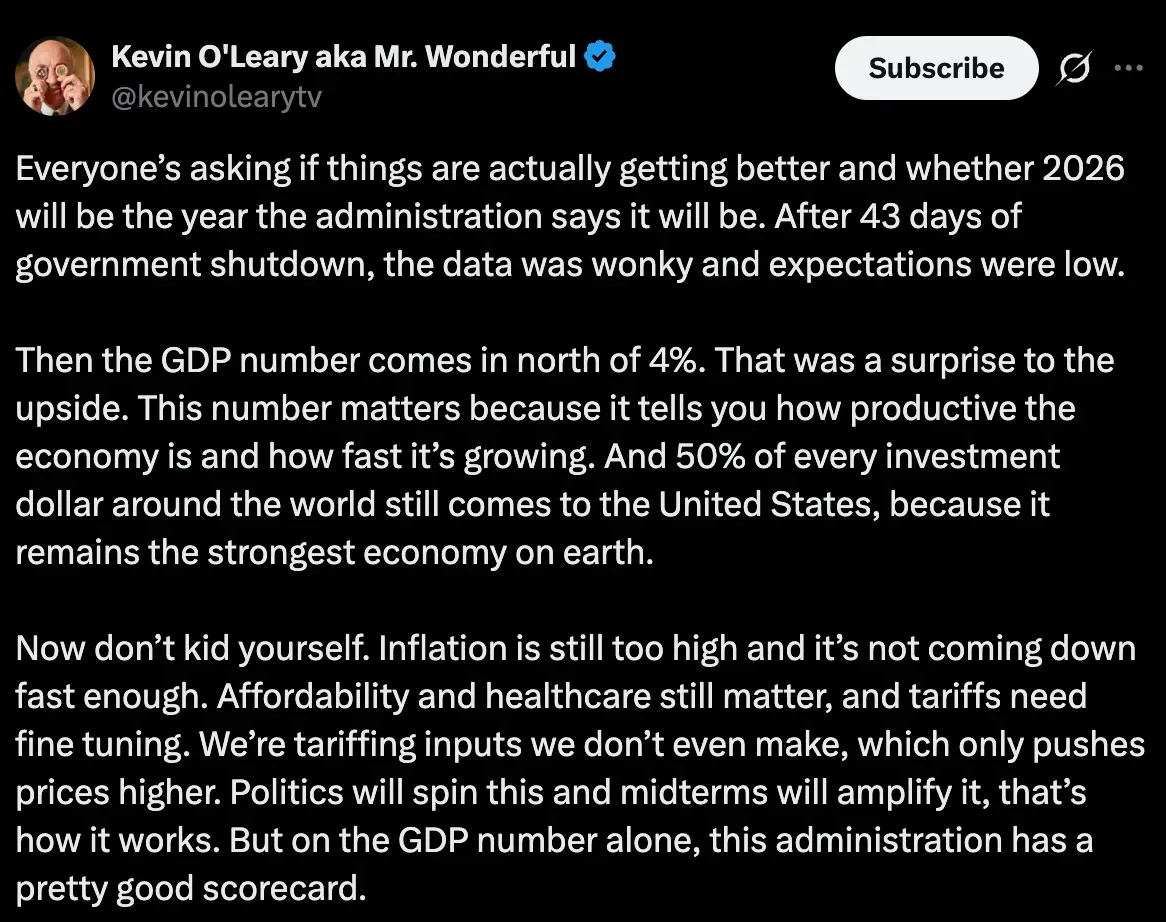
In a post on X following an interview on Fox News, O’Leary highlighted the better-than-expected third-quarter (Q3) GDP print, while explaining why it matters.
“This number matters because it tells you how productive the economy is and how fast it’s growing. And 50% of every investment dollar around the world still comes to the United States, because it remains the strongest economy on earth,” he said.
Earlier this month, the Bureau of Economic Analysis reported that the U.S. economy grew at an annualized rate of 4.3%, higher than the Dow Jones forecast of 3.2%.
Problems Persist
O’Leary acknowledged that challenges persist in the U.S. economy, including high prices and the need for further fine-tuning of the Trump administration’s tariff policies.
“Affordability and healthcare still matter, and tariffs need fine-tuning. We’re tariffing inputs we don’t even make, which only pushes prices higher,” he added.
According to the Bureau of Labor Statistics, the Consumer Price Index (CPI) rose at an annualized rate of 2.7% in November, staying above the Federal Reserve’s target of 2%.
Economist’s Take
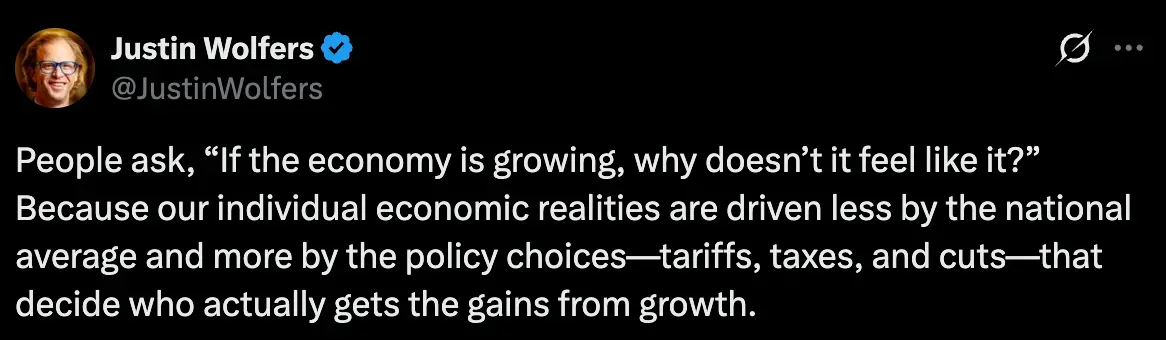
Justin Wolfers, professor of economics and public policy at the Gerald R. Ford School of Public Policy at the University of Michigan, explained why headline economic growth hasn’t translated into how many Americans feel about the economy.
“Our individual economic realities are driven less by the national average and more by the policy choices—tariffs, taxes, and cuts—that decide who actually gets the gains from growth,” Wolfers said in a post on X.
Amid growing concerns about affordability, President Donald Trump kicked off a tour earlier this month to reach out to Americans struggling with higher prices, according to a report by The Washington Post.
Growth Slowdown Likely Ahead
Analysts at ING Think stated in a recent note that they expect fourth-quarter (Q4) GDP growth to be “considerably slower,” citing the 43-day-long U.S. government shutdown. The firm also expects a slowdown in consumer spending during the quarter.
“Expectations of cooling data probably explains the relatively muted market reaction with the 10Y Treasury yield only up 3bp on the day [of GDP report release] and Fed funds rate cut expectations for 2026 still holding above 50bp,” the firm said.
Meanwhile, U.S. equities were mixed in Monday’s pre-market trade. At the time of writing, the SPDR S&P 500 ETF (SPY), which tracks the S&P 500 index, was down 0.2%, the Invesco QQQ Trust ETF (QQQ) declined 0.41%, while the SPDR Dow Jones Industrial Average ETF Trust (DIA) edged up by 0.02%. Retail sentiment around the S&P 500 ETF on Stocktwits was in the ‘bullish’ territory.
The iShares 7-10 Year Treasury Bond ETF (IEF) was up 0.09% at the time of writing.
For updates and corrections, email newsroom[at]stocktwits[dot]com.<
