
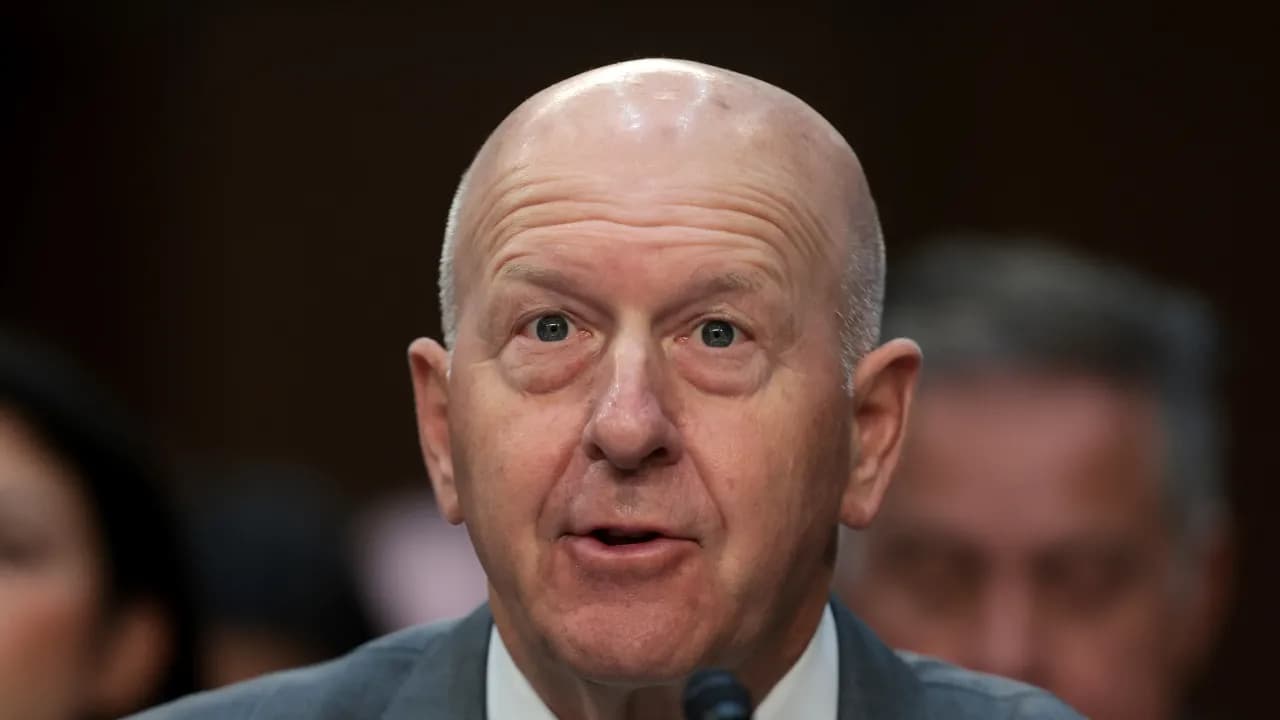
During an interview with CNBC, Solomon said that while the U.S. has more latitude than others to run deficits, it still needs to bring them under control.
- Solomon said that the only solution to the deficit problem right now is for the U.S. economy to run at a higher rate of growth than it has been running at until now.
- He added that there is now a chance, over the next couple of years, for the U.S. economy to run at a higher base growth rate.
- The Goldman CEO listed the deregulation drive, a surge in capital expenditure, and the fiscal stimulus as the factors driving growth going forward.
Goldman Sachs Group Inc. (GS) CEO David Solomon reportedly warned on Friday that the U.S. economy could face “shocks” if the deficit is not brought under control and growth does not pick up.
During an interview with CNBC, Solomon said that, given the United States' and the U.S. dollar's importance to the global economic ecosystem, the country has more latitude than others to run deficits. However, he said it still needs to ensure deficits are eventually brought under control.
“I do believe if we don’t get it [deficit] under control and don’t get our growth rate up, there will be a moment of time when we have speed bumps or shocks or things that force us to readjust our behavior,” Solomon added in the interview.
Solomon Points To The Only Way To Beat The Deficit Problem
The Goldman Sachs CEO said that the only solution to the deficit problem right now is for the U.S. economy to run at a higher rate of growth than it has been running at until now.
“I think we’re in a position now where we have a chance for the next couple of years to run at a higher base growth rate,” he added. Solomon listed the deregulation drive, a surge in capital expenditure, and the fiscal stimulus as the factors driving growth going forward.
When asked why the bond markets are not “agitated,” Solomon said they’ve been benign because there aren't many great alternatives to the U.S. economy and the dollar.
The Congressional Budget Office on Wednesday projected the deficit to be $1.9 trillion for fiscal year 2026, equal to 5.8% of U.S. gross domestic product (GDP). The CBO expects the deficit to soar to $3.1 trillion by 2036, accounting for 6.7% of the GDP. This is higher than the 50-year average of 3.8%, the CBO stated in its report.
However, Treasury Secretary Scott Bessent said during a separate interview with CNBC that he does not know what the CBO is thinking, following the release of its latest deficit projections.
“The CBO missed what went on in the last year, so if they can’t do the near year, how can they do 10 years out?” he said in the interview.
Bessent Optimistic About Economy In 2026
Treasury Secretary Scott Bessent expressed optimism about the U.S. economy this year, saying that while “2025 was about setting the table, 2026 is going to be a banquet for the American people.”
Bessent added that, unlike in financial markets, there is a lead time required to set up infrastructure, such as factories. Citing the rise in construction jobs and commitments to build factories, the Treasury Secretary stated in the interview that he expects a “lot of factory completions” in 2026.
Bessent also said that the bond markets have been tame because the U.S. government is getting its fiscal house in order.
Meanwhile, U.S. equities gained in Friday’s opening trade. At the time of writing, the SPDR S&P 500 ETF (SPY), which tracks the S&P 500 index, was up by 0.19%, the Invesco QQQ Trust ETF (QQQ) rose 0.18%, while the SPDR Dow Jones Industrial Average ETF Trust (DIA) gained 0.2%. Retail sentiment around the S&P 500 ETF on Stocktwits was in the ‘bearish’ territory.
The iShares 7-10 Year Treasury Bond ETF (IEF) was up by 0.37% at the time of writing.
For updates and corrections, email newsroom[at]stocktwits[dot]com.<
