
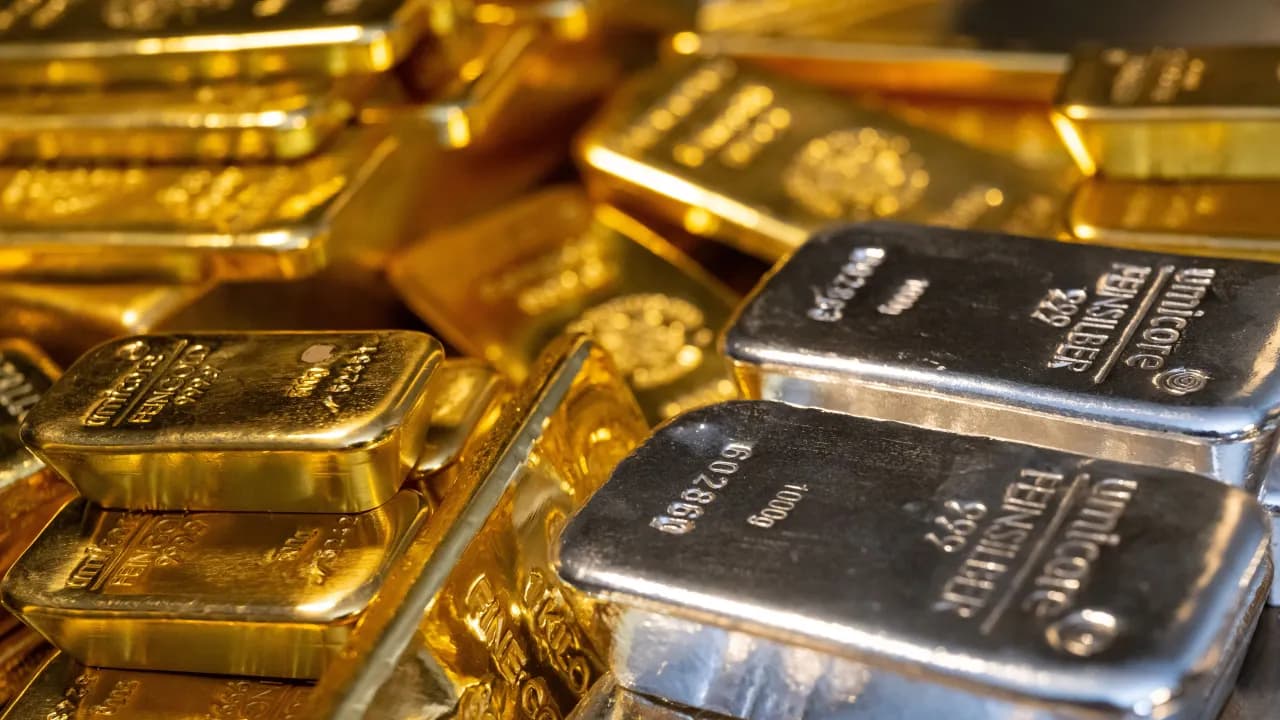
The U.S. struck Iran late Tuesday in a retaliatory operation for the downing of an American Apache combat helicopter near the Strait of Hormuz, sending prices of precious metals lower.
- Spot gold prices lost more than 2%, and silver spot prices declined more than 2.5% in the overnight session.
- Citi lowered its gold price forecast on Monday, saying the precious metal could drop to $3,500 per ounce if the Strait of Hormuz remains shut through the summer.
- Meanwhile, long-term gold bull Peter Schiff said that while gold and silver prices are under pressure because of the war, the long-term bullish case remains intact.
Gold and silver prices declined more than 2% each in the overnight session on Tuesday, even as the U.S. launched fresh strikes on Iran, dashing hopes for a peace deal between the two countries.
Spot gold prices fell below $4,200 an ounce, their lowest level since late March. Meanwhile, spot silver fell below the key $64-an-ounce level. Oil prices were on the climb amid the escalating tensions in the Middle East.
US-Iran Tensions Rise
The U.S. struck Iran late Tuesday in a retaliatory operation for the downing of an American Apache combat helicopter near the Strait of Hormuz. In a post on X, U.S. Central Command said the “self-defense strikes” were ordered by President Donald Trump and were intended as “a proportional response to unjustified Iranian aggression.”
Earlier in the day, Trump said on Truth Social that the two pilots aboard the helicopter were unharmed but stressed that “the United States must, of necessity, respond to this attack.”
According to reports, the strikes targeted locations along Iran's southern coastline near the Strait of Hormuz, a critical global energy shipping route.
Iran quickly signaled that it would retaliate. Foreign Minister Abbas Araghchi wrote on X, “Despite its defeats on the battlefield, the U.S. opted to test our determination. Our Powerful Armed Forces will leave no attack or threat unanswered. Leave our region if you want to be safe.”
Iranian state media later reported that Tehran had launched retaliatory attacks against U.S. assets in the region. The reported targets included American military bases and the U.S. Fifth Fleet in Bahrain, with drones allegedly used in some of the operations. Iranian officials also claimed that a U.S. military base in Jordan was targeted with long-range missiles.
Citi Cuts Gold Target Amid Hormuz Concerns
Citi lowered its gold price forecast on Monday, saying the precious metal could drop to $3,500 per ounce if the Strait of Hormuz remains shut through the summer.
As per a CNBC report, the bank expects a prolonged closure of the strategic waterway to weaken global gold demand and drive prices back toward late-2025 levels.
“The near-term risk skew therefore looks negative, and dip buying here makes sense only with a strong view of no re-escalation,” the analyst reportedly wrote.
A stronger-than-expected U.S. jobs report has added to the headwinds by boosting expectations for higher interest rates, the bank said, which tends to reduce the attractiveness of non-yielding assets such as gold.
Citi has also lowered its three-month gold price target to $4,000 per ounce from $4,300. While the bank remains constructive on gold over the longer term, it cautioned that the metal faces significant near-term risks. “Longer term, we maintain a bullish gold view, but we believe it is extremely high-risk in the near-term for anyone without very wide stops and longer-term investment horizons,” the analyst said.
Meanwhile, long-term gold bull Peter Schiff said that while gold and silver prices are under pressure because of the war, the long-term bullish case remains intact. “But the bullish case for precious metals actually got much better because of the war, and the longer it lasts the better it gets,” he said in a post on X.
How Are Markets Reacting To Iran Crisis?
U.S equities were on the decline at the time of writing. The SPDR S&P 500 ETF (SPY), which tracks the S&P 500 index, was down 0.33% in the overnight session on Tuesday, while the Invesco QQQ Trust ETF (QQQ) fell 0.54%. The SPDR Dow Jones Industrial Average ETF Trust (DIA) edged 0.15% lower.
Meanwhile, the SPDR Gold Shares ETF (GLD), which tracks the spot price of gold, fell nearly 2%, while retail sentiment around it declined from ‘bullish’ to ‘neutral’ territory over 24 hours.
One user said, “Looks like gold is no longer the safe haven it used to be.”
View this Stocktwits post
The iShares Silver Trust (SLV) was down more than 2.2% in the overnight session amid ‘bearish’ sentiment.
Markets are closely watching the May Consumer Price Index (CPI), scheduled for release on Wednesday, with some expecting a print of around 4.2%, the highest reading in three years.
For updates and corrections, email newsroom[at]stocktwits[dot]com.<
