
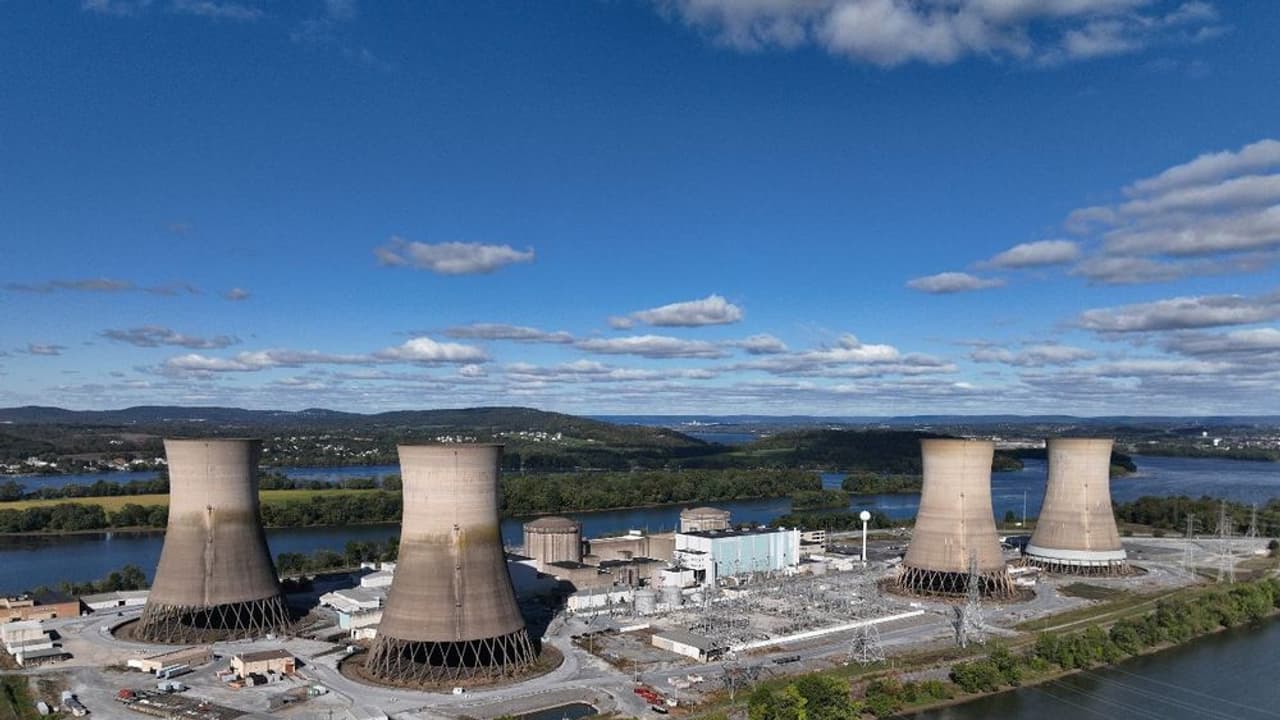
Constellation and Google announced two contracts on Tuesday, totaling about 3,590 megawatts, sparking buying in CEG, as well as peers VST and TLN.
- Data-center demand is outrunning new power lines, and PJM — the grid serving about 67 million people across 13 states — is short of capacity.
- Vistra and Talen sell into the same market as Constellation, so a Google bid for firm power is read as support for their fleets.
- Other stocks to gain on the news include OKLO, NNE, SMR, BE and FCEL.
Nuclear and power stocks jumped on Tuesday after Google (GOOG, GOOGL) agreed to buy electricity from Constellation Energy (CEG), the largest U.S. nuclear operator, sparking optimism across the sector.
Constellation shares rose as much as 15%, touching $309. Peers Vistra (VST) gained about 10% and Talen Energy (TLN) about 11%. Oklo (OKLO) and NANO Nuclear Energy (NNE) each rose about 8%, NuScale Power (SMR) about 5%, and the VanEck uranium and nuclear ETF (NLR) about 6%.
Fuel-cell names, including Bloom Energy (BE) and FuelCell Energy (FCEL), also traded 4% and 15% higher, respectively.
What Google Bought From Constellation
Constellation and Google announced two contracts, not one. A 20-year power-purchase agreement will pay for upgrades at 11 Constellation reactors in Illinois, Pennsylvania, and New Jersey. Those upgrades at plants already in operation are meant to add 890 megawatts of firm, carbon-free power to the PJM grid. Constellation said it will invest more than $4.3 billion.
The first extra output is expected in 2028, with the full 890 megawatts online before the end of 2032. The companies said the work should support about 4,400 existing jobs and create roughly 7,200 temporary construction jobs.
A second, 15-year supply agreement covers another 2,700 megawatts. That power is not tied to a specific plant or fuel. Constellation also runs gas plants, so the contract is a long-term revenue commitment, not a second nuclear order.
Together, the two deals total about 3,590 megawatts. The announcement follows a smaller Constellation contract with Amazon last week, centered on a 190-megawatt expansion at Calvert Cliffs in Maryland.
Why Peers VST, TLN Moved
Only Constellation is a party to the Google contracts. The rest of the group is trading on the signal.
Data-center demand is outrunning new power lines, and PJM — the grid serving about 67 million people across 13 states — is short of capacity. Google just locked in two decades of around-the-clock supply and agreed to fund the upgrades itself.
Vistra and Talen sell into the same market as Constellation, so a Google bid for firm power is read as support for their fleets. Oklo, NANO Nuclear, and NuScale are still trying to build their first commercial reactors. Their stocks rose because a tech buyer is paying for nuclear megawatts at all, which investors treat as demand for the next wave of projects.
Fuel-cell shares moved for a related reason; if large customers will pay for power that does not wait on the grid, on-site generation looks more valuable too.
How Did Retail Traders React?
On Stocktwits, retail sentiment around CEG, VST, and OKLO stock was in 'extremely bullish' territory at the time of writing, while sentiment around TLN, FCEL, and NLR was 'neutral.'
Sentiment around BE, SMR, and NNE, however, was 'bearish.'
For updates and corrections, email newsroom[at]stocktwits[dot]com.
