

CFTC Chairman Michael Selig said they were proposing their first crypto market rules, Regulation CTX and Regulation CAM.
- The Treasury's Financial Crimes Enforcement Network withdrew a proposed rule from December 2020.
- It would have required banks and money services businesses to report and keep records of crypto transactions involving self-custodied wallets.
- Had it taken effect, reports would have been filed on transactions above $10,000 involving unhosted or otherwise covered wallets.
As Bitcoin (BTC) held above $85,000 on Monday, Washington moved both ways on crypto: the Treasury withdrew its self-custody wallet reporting proposal, while the CFTC proposed its first crypto market rules.
The Treasury Department's Financial Crimes Enforcement Network (FinCEN) has withdrawn a proposed rule that would have required banks and money services businesses to report and keep records of cryptocurrency transactions involving self-custodied wallets. This was published in a notice filed with the Federal Register.
The proposal, first published in December 2020, covered transactions that involved convertible virtual currency or digital assets with legal tender status held in unhosted wallets, or in wallets hosted in a jurisdiction identified by FinCEN.
Inside The Withdrawn Proposal
Had it taken effect, banks and money services businesses would have filed a report with FinCEN when a counterparty to a transaction used an unhosted or otherwise covered wallet and the amount exceeded $10,000, or when multiple transactions aggregated to more than $10,000 within 24 hours. Record-keeping and customer identity verification would have applied to transactions above $3,000.
The notice defined an unhosted wallet as one in which a financial institution was not required to conduct transactions on the wallet. Otherwise covered wallets were those held at a financial institution not subject to the Bank Secrecy Act and located in a foreign jurisdiction identified by FinCEN. "FinCEN will not take any further action on this notice of proposed rulemaking (NPRM)," the notice said.
Bitcoin’s price traded flat during the past 24 hours. On Stocktwits, retail sentiment around BTC remained in the ‘neutral’ zone, while chatter around it shifted to ‘normal’ from ‘low’ levels over the past day.
The Policy Basis
FinCEN tied the decision to a wider policy direction rather than to any objection raised about the rule itself. According to the notice, the agency was acting as stated in the report issued by the President's Working Group on Digital Asset Markets, which was established by Executive Order 14178, "Strengthening American Leadership in Digital Financial Technology." It described the withdrawal as part of the Trump administration's ongoing efforts to ensure that digital asset regulations are fit for purpose.
The notice cited the working group's report, published in July 2025, and the executive order, issued in January 2025. It was signed by Jimmy L. Kirby, FinCEN's deputy director, and is scheduled for publication on Tuesday.
A Second Withdrawal
FinCEN filed a second notice the same day, withdrawing a proposal published on October 23, 2023, that would have designated international convertible virtual currency mixing as a class of transactions of primary money-laundering concern. In that notice, the agency said the expansive definition of mixing in the proposed rule could have a chilling effect on legitimate activity and place a large reporting burden on covered financial institutions. It added that while illicit actors misuse mixing services, lawful users rely on them for financial privacy on public blockchains.
CFTC Proposes Its First Crypto Market Rules
The second catalyst came from the CFTC itself. In a Wall Street Journal op-ed, CFTC Chairman Michael Selig said the agency was proposing its first round of regulations for crypto markets, Regulation Crypto Asset Transactions (CTX) and Regulation Crypto Asset Markets (CAM), aimed at closing gaps in crypto market oversight after the Senate failed to advance the Digital Asset Market Clarity Act (CLARITY Act) last month.
On X, Selig said, “The lesson from FTX’s failure should have been obvious.”
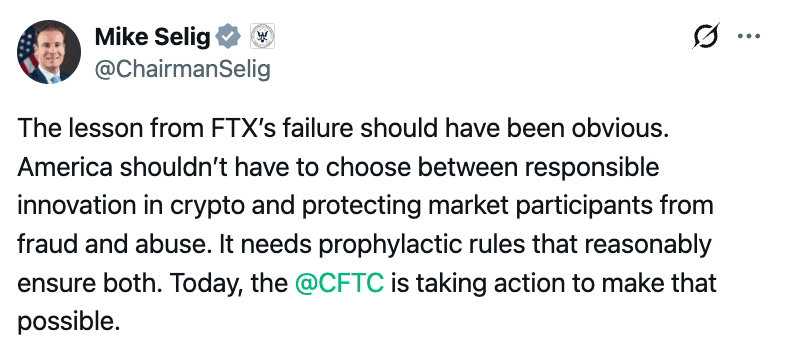
Selig said the new rules would establish requirements for CFTC-registered exchanges offering crypto assets for trading, including Bitcoin and Ethereum (ETH), which the CFTC and US Securities and Exchange Commission (SEC) had earlier jointly clarified fall outside securities law.
Unlike the stalled CLARITY Act, the rules wouldn't require crypto assets to trade exclusively on CFTC-registered platforms, but would allow exchanges that choose to register to offer retail customers margined and leveraged trading under a single federal regulatory scheme.
Read also: BMNR Stock Gains Alongside Ethereum After Tom Lee's BitMine Makes One Of Its Smallest Ethereum Purchases Ever
For updates and corrections, email newsroom[at]stocktwits[dot]com.<
