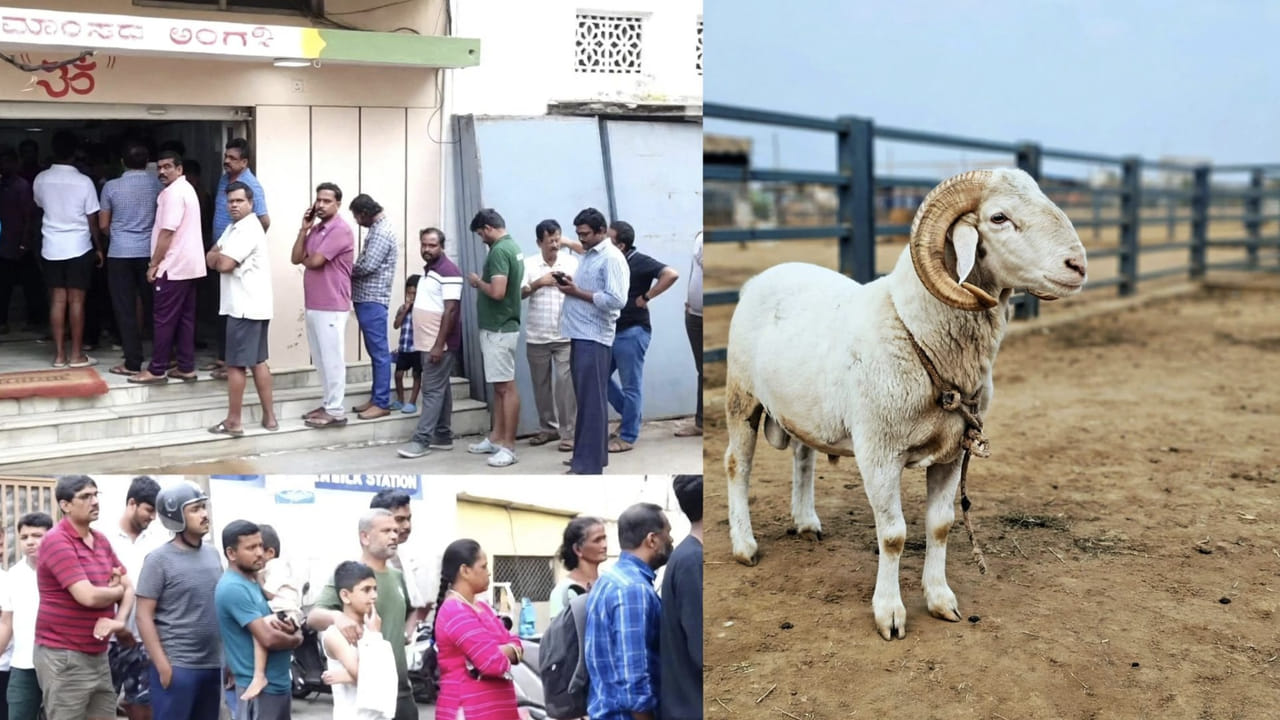
Bengaluru’s Papanna Mutton Stall on Mysore Road has served customers since 1957. Known for its selective sourcing, fresh mutton and long queues, the family-run shop continues to attract loyal customers from across the city.
In Bengaluru, the name Papanna has become closely associated with mutton, particularly among customers who have been visiting the family-run Papanna Mutton Stall on Mysore Road for generations. Located opposite the Gali Anjaneya Swamy Temple in Byatarayanapura, the establishment has a history spanning nearly seven decades. Started by Papanna in 1957, the shop has grown from a small family venture into a well-known mutton outlet in the city. Today, it is managed by his son, Manickam, popularly known as Mani, along with members of the next generation of the family. Despite the passage of time and changes in Bengaluru’s food landscape, the business continues to operate from its original location, with the family maintaining the practices that have kept customers returning over the years.
From Small Family Venture To A Bengaluru Institution
Papanna originally hailed from Deevatige Ramanahalli, now known as Deepanjali Nagar. In the early days, he sourced sheep from the Cantonment area and distributed the meat among four or five families.
As demand grew among residents in the surrounding areas, he decided to establish a shop in 1957. The business gradually expanded, with significant growth reported between 1985 and 1990.
Related Articles

The establishment has continued to operate without opening any other branches. During the COVID-19 pandemic, the family arranged additional space by constructing another building nearby to facilitate social distancing and manage the customer rush.
Following Papanna’s death in 2010 at the age of 84, his family continued the business. Manickam, who chose to work alongside his father instead of pursuing a different career, now manages the shop with his nephew.
An Educated Family That Continued The Mutton Business
Despite the family’s involvement in the meat trade, several members pursued professional careers in other fields.
Manickam’s brothers served as government officials in the IT and CTO departments, while his two daughters are a doctor and an engineer, respectively.
Manickam, however, remained closely involved in the family business and worked alongside Papanna to develop the shop. He continues to oversee its operations, ensuring that the business remains within the family.
The family’s continued involvement has helped preserve the establishment’s history and maintain its connection with long-time customers.
Focus On Quality And Selective Sourcing
Papanna Mutton Stall exclusively sells mutton and does not offer chicken or fish. According to the family, approximately 98% of the meat sold at the shop comes from male sheep, locally known as tagaru, and male goats, referred to as vaata.
The livestock is sourced through agents from Gauribidanur. The family follows a strict selection process, rejecting animals that do not meet its quality standards.
The emphasis on sourcing and selection is intended to ensure that the meat has relatively low fat content and meets the standards maintained by the establishment.
The shop offers a variety of cuts, including leg pieces, chops, liver and machine-minced meat, commonly known as keema.
Mutton is priced at ₹900 per kg, while the head and trotters are sold at ₹350 per kg.
Early Mornings And A Team Of 25 Staff Members
The shop’s daily operations begin well before sunrise. A team of approximately 24 to 25 staff members starts work at 3.30 am, while the counter opens to customers at 5 am.
The establishment employs experienced butchers, some of whom are reportedly capable of processing up to 500 kg of meat a day.
On a typical Sunday, the shop sells between 100 and 150 sheep, reflecting the demand for mutton during the weekend.
The early opening hours and the volume of work require close coordination among the staff, from preparing the meat to serving customers at the counter.
Long Queues During Festivals And Family Feasts
The shop experiences a significant increase in demand during festivals and special occasions such as Ugadi, Ayudha Puja and beegara oota, the traditional post-wedding feast.
On some of these occasions, queues have reportedly stretched up to half a kilometre.
Business is comparatively slower on days such as Ekadashi, Amavasya and Purnima, when some customers avoid purchasing meat.
The family follows a queue system, with every customer required to wait for their turn, regardless of their familiarity with the staff.
Large Orders And Customers From Across Bengaluru
Over the years, Papanna Mutton Stall has reportedly handled several large orders. The shop supplied 1,000 kg of mutton to actor Ravichandran and 12,000 kg of meat, sourced from 800 sheep, for an event organised by MLA ‘Layout’ Krishnappa.
The establishment also attracts customers from different parts of Bengaluru. Some travel from areas such as Whitefield, Sadashivanagar and Kengeri to purchase mutton from the shop.
Customers from Whitefield, which is around 20 km away, have reportedly travelled to the outlet, sometimes using the NICE Road and paying toll charges along the way.
The shop also has long-standing customers, including people in their 80s who have been visiting for decades. For some families, visiting the outlet has become a tradition passed down through generations.
From its beginnings as a small meat distribution venture in 1957 to its present-day operations on Mysore Road, Papanna Mutton Stall remains a family-run business shaped by its history, customer relationships and continued presence in Bengaluru’s food landscape.