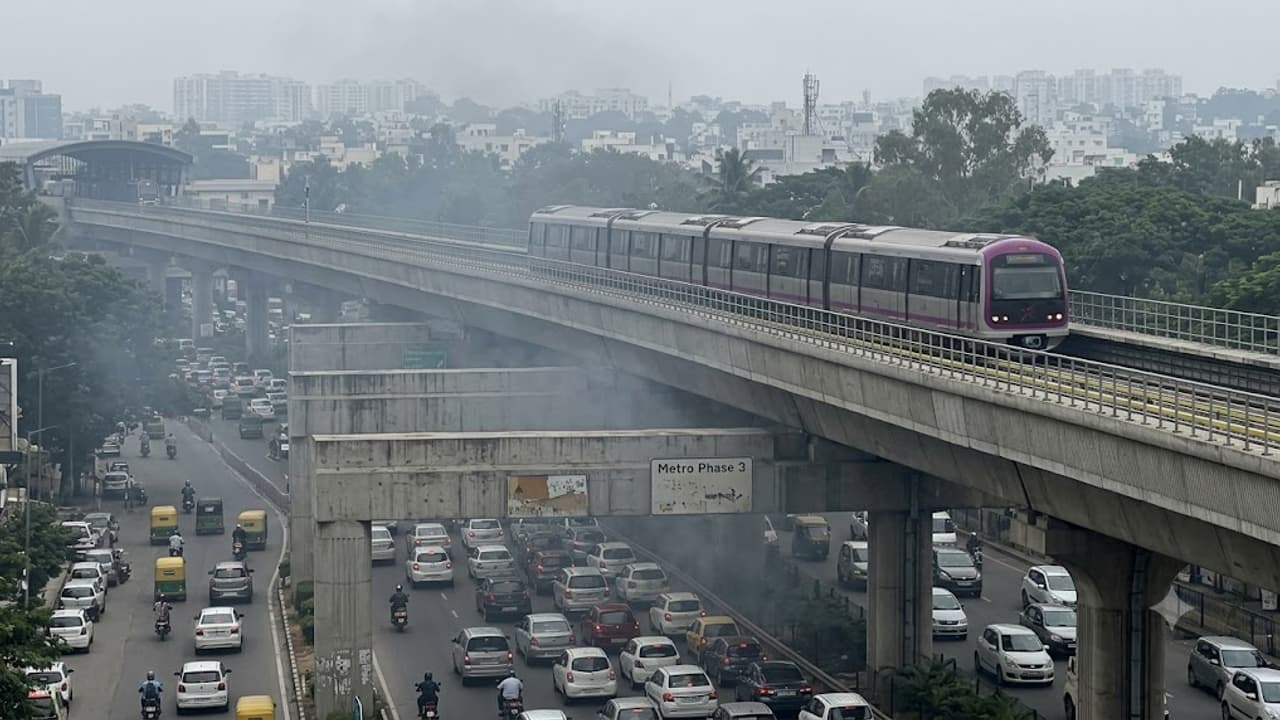
An IISc study has questioned the economic and environmental benefits of Bengaluru's proposed double-decker road integrated with Namma Metro Phase 3. The report says the project would deliver lower economic returns, reduce Metro ridership and encourage greater use of private vehicles.
Bengaluru's ambitious plan to build a double-decker road integrated with Namma Metro Phase 3 has come under fresh scrutiny after a new study by the Indian Institute of Science (IISc) questioned its long-term economic and transport benefits. The technical report, prepared by Prof. Ashish Verma of the IISc Sustainable Transportation Lab, as quoted by NDTV suggests that combining an elevated road with the Metro corridor could reduce the overall value of the project and weaken the purpose of investing in mass public transport.
Metro Performs Better Without Elevated Road
According to the report submitted to the Ministry of Housing and Urban Affairs (MoHUA), the Economic Internal Rate of Return (EIRR) for the integrated project is estimated at only 9.07 per cent. This is well below the generally accepted benchmark of 14 per cent for such infrastructure investments.
However, the study found that if the elevated road component is removed and the Metro project is considered on its own, the EIRR increases sharply to 18 per cent.
Related Articles

The findings differ from the government's earlier estimate, which projected an EIRR of 16.5 per cent for the combined project.
Study Predicts Shift Towards Private Vehicles
The report argues that adding more road space may encourage people to use private vehicles instead of public transport.
Researchers estimate that by 2041, bus travel could fall by 6.4 per cent, while Metro usage may decline by 1.4 per cent if the double-decker road is built.
At the same time, car travel is expected to rise by 3.8 per cent. Two-wheeler trips could increase by 1.28 per cent, while travel by auto-rickshaws and taxis may grow by 2.8 per cent.
According to the researchers, this shift goes against the main objective of Metro systems, which are designed to reduce dependence on private vehicles.
Daily Metro Ridership May Fall
The study also projects a slight decline in Metro ridership.
Daily passenger numbers on Bengaluru's Phase 3 corridors are expected to fall from 8.09 lakh under a Metro-only system to 7.98 lakh if the double-decker road is introduced.
Although the difference appears small, researchers say it reflects a gradual shift towards personal transport that could become more noticeable over time.
Environmental Impact Also Highlighted
Apart from transport patterns, the report warns of higher pollution and fuel consumption.
It estimates that the proposed corridors would generate an additional 17,012 kilograms of carbon dioxide every day. Daily emissions would also include around 85.9 kg of carbon monoxide, 12.6 kg of nitrogen oxides, 19.5 kg of hydrocarbons and 1.1 kg of PM2.5 particles, according to the Hindu.
Fuel consumption is expected to increase by more than 7,000 litres each day, adding over ₹6.45 lakh in daily fuel costs.
Debate Over Bengaluru's Future Transport Continues
The findings are likely to add momentum to the ongoing debate over Bengaluru's transport planning.
Urban mobility experts and citizen groups have repeatedly argued that future investments should focus on improving public transport instead of expanding road capacity for private vehicles.
With the IISc study now raising concerns over economic returns, Metro ridership and environmental impact, the future of the proposed double-decker model is expected to remain a key topic of discussion as the project moves forward.