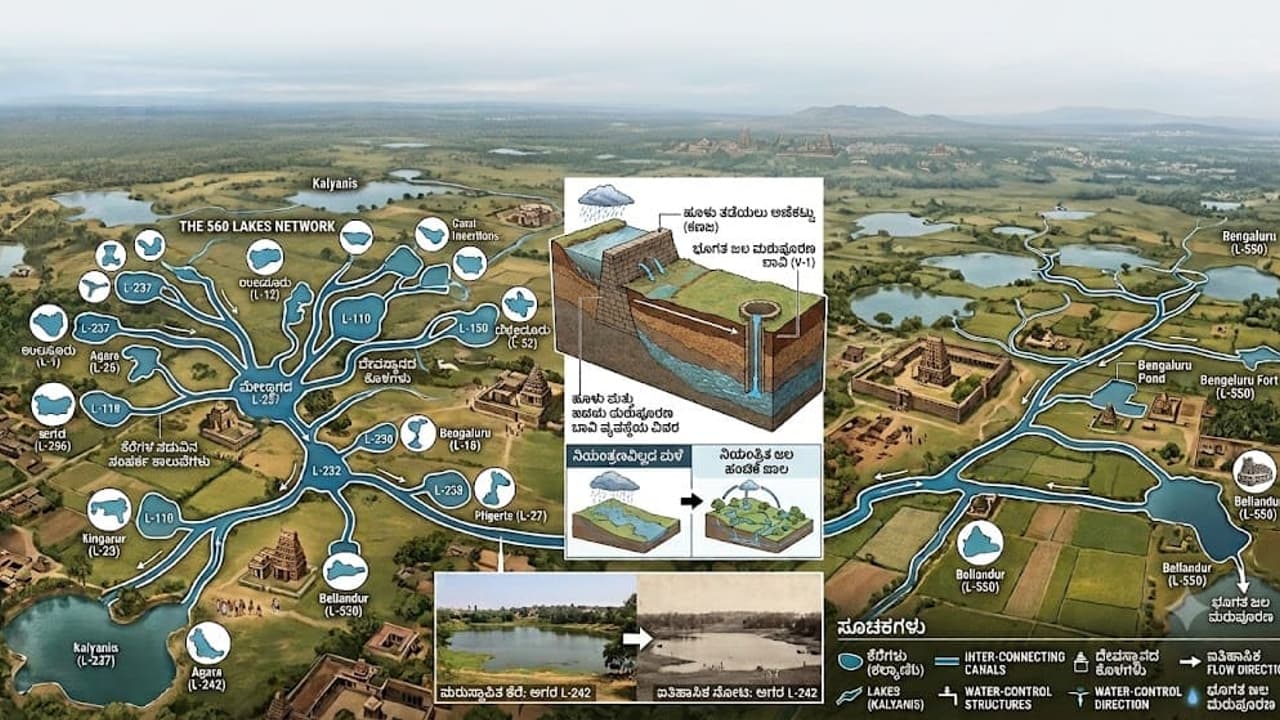
Bengaluru had around 560 lakes and water bodies in 1960, forming an interconnected network that supported rainwater collection and groundwater recharge. Rapid urbanisation disrupted the system, increasing the city's dependence on Cauvery water.
Bengaluru is known today as a rapidly growing technology hub, but the city once had a very different and largely decentralised water system. Historical records and reports indicate that the Bengaluru region had around 560 lakes and water bodies around 1960. These interconnected water bodies formed an extensive network that helped collect and store rainwater while supporting groundwater recharge. However, as the city expanded, much of this traditional system was gradually disrupted by urbanisation.
A Water Network Built Centuries Ago
Bengaluru does not have a major river flowing directly through the city. As a result, lakes, tanks and bunds played an important role in collecting and storing rainwater.
Historical records indicate that around 80 water bodies were created around Bengaluru approximately 500 years ago. The traditional system took advantage of the city's natural terrain, particularly its slopes and elevation differences, to connect the water bodies and facilitate the movement of water.
Related Articles

Water Flowing From One Lake To Another
In the traditional system, water first accumulated in an upper lake. Once the lake reached capacity, excess water flowed through channels into a lower lake. This process continued across the interconnected network.
The system helped reduce the loss of rainwater by allowing it to move through a series of lakes and tanks. It also supported groundwater recharge, making the network an important part of Bengaluru's traditional water management system.
City Growth Changed The Ground Reality
Bengaluru's population and geographical area expanded rapidly over the decades, placing increasing pressure on its traditional water infrastructure. The city's population reached around 10 lakh in 1970 and rose to approximately 20 lakh during the following decade.
The city continued to expand rapidly in the years that followed, leading to significant changes in its landscape and water systems.
Broken Lake Links And Concrete Growth
As Bengaluru urbanised, buildings, roads and other infrastructure increasingly replaced open spaces and natural drainage channels. This expansion disrupted the natural flow of rainwater and severed links between several lakes and water bodies.
Research has documented how rapid urbanisation and changes in land use contributed to the degradation and fragmentation of Bengaluru's interconnected lake system.
Heavy Dependence On Distant Water Sources
As the city's traditional lake and groundwater systems deteriorated, Bengaluru became increasingly dependent on water brought from distant sources.
Today, the Cauvery is a major source of drinking water for the city. The British Geological Survey has noted that Cauvery water is pumped from more than 100 kilometres away to supply Bengaluru, highlighting the scale of the city's dependence on water transported from outside its immediate catchment.
Why Do The Old Lakes Matter Today?
Bengaluru's water history highlights the importance of its lakes beyond their recreational and aesthetic value. These water bodies can help collect rainwater, support natural drainage, facilitate groundwater recharge and reduce pressure on the city's water resources.
As Bengaluru continues to grow, the traditional interconnected lake system has once again become an important subject of discussion among citizens, researchers and water experts seeking more sustainable ways to manage the city's water needs.