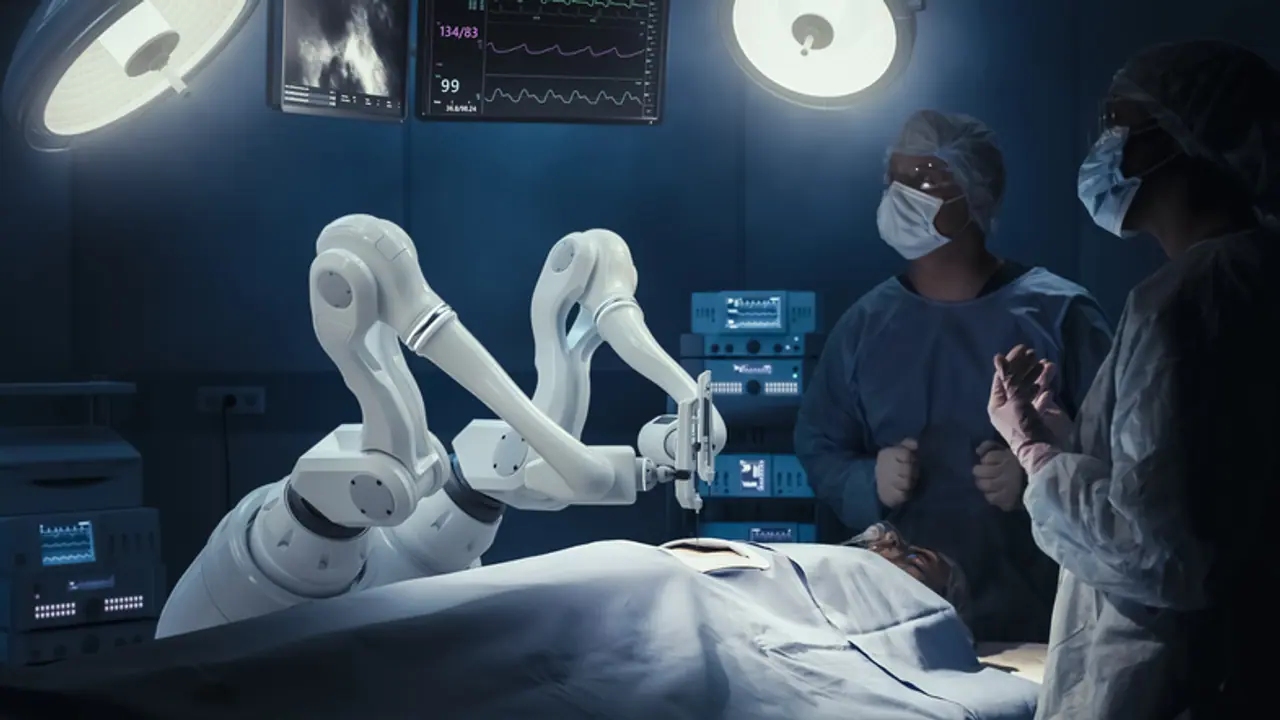
A Johns Hopkins-led team has achieved a medical breakthrough by developing a robot that performed fully autonomous gall bladder surgeries with 100% accuracy on human tissue.
In a quiet lab at Johns Hopkins University, a surgical robot has just done what many thought was still science fiction—it performed a gall bladder surgery all on its own. No surgeon guiding its hands. No pause for human corrections. Just a machine, acting with the precision of an expert, and a mind powered by artificial intelligence.
The operation, carried out on human gall bladders outside the body, was completed with 100% accuracy, according to a new study published in Science Robotics. The research team believes this could be a game-changer for the world of medicine.
A Robot That Doesn’t Just Do, But Thinks
The robot, called the Surgical Robot Transformer-Hierarchy, or SRT-H, is no ordinary machine. It’s been trained on hours of video footage showing surgeons operating on pigs. But it didn’t just learn to copy movements—it learned to understand the procedure.
Related Articles

“This advancement moves us from robots that can execute specific surgical tasks to robots that truly understand surgical procedures,” explained Axel Krieger, a medical roboticist and one of the lead researchers on the project.
“This is a critical distinction that brings us significantly closer to clinically viable autonomous surgical systems that can work in the messy, unpredictable reality of actual patient care," he added.
It’s a bold claim, but the team has the evidence to back it up. The SRT-H successfully carried out eight surgeries on ex vivo human gall bladders—real human tissue, but not inside living patients. Each time, it worked independently, without any human assistance, and with textbook precision.
Learning Like a Junior Doctor
What makes the SRT-H stand out is its ability to learn on the job. Much like a surgical resident shadowing a mentor, the robot responds to voice cues and adjusts its technique based on what it encounters mid-procedure.
That’s a huge leap forward. In earlier trials with other robots, surgeries only succeeded under ideal lab conditions, with special markers guiding the machine’s every move. This time, the robot operated in a far less predictable environment, adapting to different tissue structures and even correcting itself when things didn’t go as planned.
“We propose a hierarchical framework for performing dexterous, long-horizon surgical steps,” the researchers wrote in their paper. “Our method achieves a 100 per cent success rate across eight different ex vivo gallbladders, operating fully autonomously without human intervention.”
Still Slower Than a Human—But Just As Good
Speed isn’t SRT-H’s strength—yet. Compared to human surgeons, it takes longer to complete the procedure. But what it lacks in pace, it makes up for in precision. The team found that the robot’s results were on par with those of experienced surgeons.
And the implications go far beyond the operating room. Ji Woong Kim, lead author and former postdoctoral researcher at Johns Hopkins, sees it as a sign of what’s to come.
“This work represents a major leap from prior efforts because it tackles some of the fundamental barriers to deploying autonomous surgical robots in the real world,” he said. “Our work shows that AI models can be made reliable enough for surgical autonomy—something that once felt far-off but is now demonstrably viable.”
A Glimpse Into the Future of Surgery?
For now, this robotic surgeon remains in the experimental stage. But its success has stirred the medical community and sparked questions about how far we’re willing to let machines take the lead in healthcare.
Picture this: a rural hospital without a single trained surgeon, yet complex operations still being performed with absolute precision. Or disaster zones, where timing is critical and human expertise can’t reach fast enough. Even space missions—months away from Earth—where a machine like this could mean the difference between life and death.
Of course, nobody’s saying surgeons are about to be replaced. That’s not the point. What this robot represents is a new kind of teammate in the operating room—one that doesn’t get tired, doesn’t tremble, and can learn faster than any intern ever could.
And if the success of this experiment is anything to go by, that future isn’t science fiction anymore. It’s already knocking on the door.