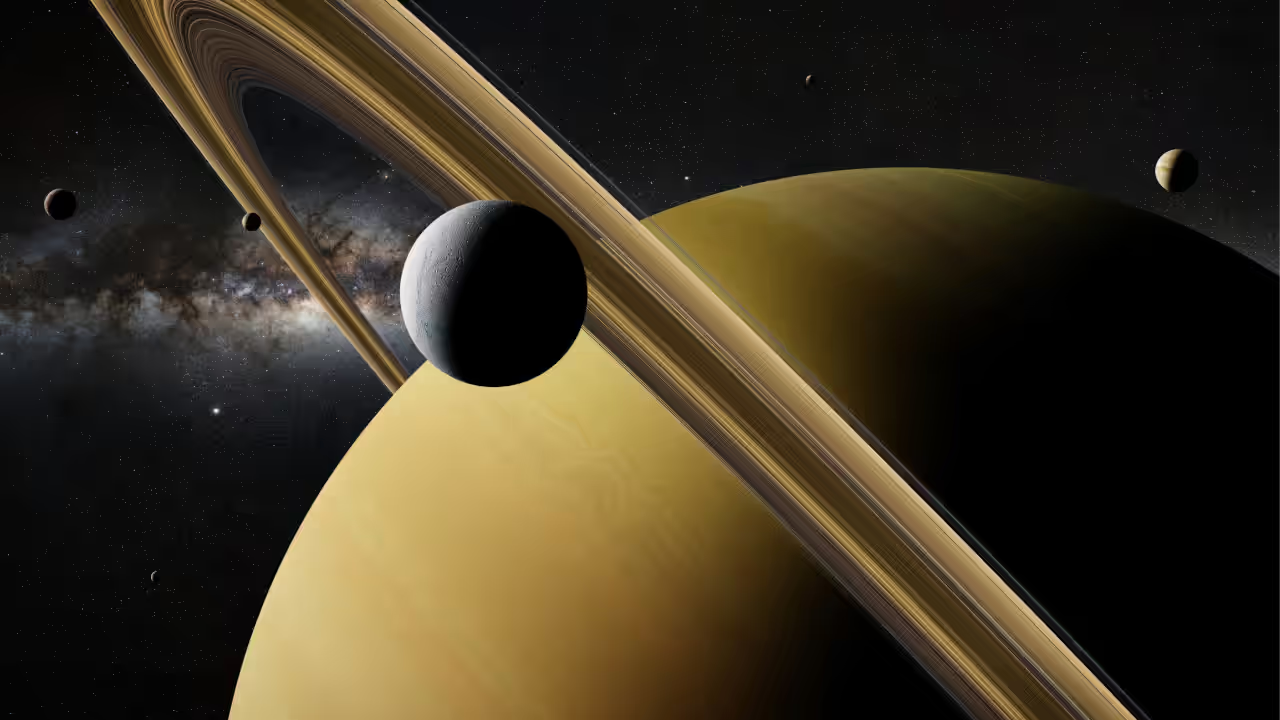
Discover how new research on Saturn's moon Titan challenges the idea of a global ocean. Learn why its slushy interior with warm water pockets is a new hope for alien life.
Titan, the largest moon of Saturn, has always intrigued scientists. Despite its thick, golden atmosphere and its distant location from the Sun, it might not seem like a likely candidate for life. Yet, recent research shows Titan might be hiding something remarkable under its frozen surface: icy tunnels mixed with water that could support living organisms.
New Insights from Data
A recent study conducted by scientists from NASA and the University of Washington has re-examined data gathered by the Cassini spacecraft. Cassini spent almost two decades exploring Saturn and its moons, including over 100 close encounters with Titan. Using updated techniques, researchers now believe Titan’s interior is more complex than previously thought.
For many years, scientists thought Titan had a vast global ocean beneath its icy crust, similar to what is believed to exist beneath Jupiter’s moon Europa. This idea was based on how Titan slightly changes shape as it orbits Saturn. Because its orbit isn’t perfectly circular, Saturn’s strong gravity causes the moon to stretch and compress as it moves closer and farther away.
Related Articles

In 2008, this movement was taken as strong evidence for a deep ocean. However, the new study suggests this may not be the full story.
A Mixed Interior
Instead of a large ocean, scientists now believe Titan has a thick layer of high-pressure ice mixed with pockets of liquid water, like slush. Professor Baptiste Journaux, one of the study’s authors, explains that Titan’s interior may resemble Arctic sea ice on Earth or underground water sources rather than a single, vast ocean.
In simpler terms, Titan might be filled with icy tunnels and water-rich areas rather than one large body of liquid.
Clues From Gravity
The key clue came from how Titan responds to Saturn's gravity. When researchers closely examined the timing of Titan’s shape changes, they found something unexpected. The moon does not flex immediately when Saturn’s pull is strongest. Instead, there is a delay of about 15 hours. This delay shows how energy moves through Titan’s interior and offers important clues about what lies beneath its surface.
Warm Water Pockets
The amount of energy lost during this flexing turned out to be much greater than expected. If Titan had a large underground ocean, this energy loss would be much lower. According to NASA scientist Flavio Petricca, this was the “smoking gun” that shows Titan’s internal structure is different from earlier models.
Based on their findings, researchers believe Titan’s rocky core is surrounded by ice that slowly melts into pockets of fresh water. These pockets could exist at surprisingly warm temperatures, up to 20°C. On Earth, this is considered an ideal temperature for life to thrive.
Hope for Life
This discovery brings new hope in the search for alien life. While a vast ocean once seemed promising, smaller pockets of water may actually increase the chances of life forming. In a smaller volume of water, nutrients and energy sources are more concentrated, making it easier for simple life forms to survive. Even basic microbes could potentially live in these slushy, water-rich areas.
More answers may come from NASA’s upcoming Dragonfly mission. This robotic lander is designed to explore Titan’s surface and its chemical properties in detail. Scheduled to launch in July 2028, it will take about six years to reach Titan, arriving in 2034.
Cassini's Legacy
Meanwhile, scientists are still uncovering new insights from Cassini’s extensive data. Even years after the mission ended in 2017, its findings continue to change our understanding of Saturn and its moons. In 2019, Cassini data revealed that one of Titan’s lakes is over 300 feet deep and rich in methane.
Titan remains a mysterious and intriguing world. With its slushy underground layers and potential for warm water pockets, it may yet prove that life can exist in places far stranger than we ever imagined.