The biotech company that stunned the world by resurrecting the long-extinct dire wolf is now building what it calls a “modern-day Noah’s Ark” to shield Earth’s most vulnerable species from vanishing forever.
The biotech company that stunned the world by resurrecting the long-extinct dire wolf is now building what it calls a “modern-day Noah’s Ark” to shield Earth’s most vulnerable species from vanishing forever. Colossal Biosciences on Tuesday unveiled a sweeping partnership with the United Arab Emirates (UAE) to create a high-security BioVault, designed to store cryogenically frozen tissue samples from endangered and threatened species. The facility will be housed inside a new World Preservation Lab to be built in Dubai.
In its first phase, the BioVault will preserve genetic material from 100 carefully selected species. The selection process will be guided by conservation partners and global authorities such as the International Union for Conservation of Nature (IUCN), the world’s leading body on biodiversity protection. By safeguarding genetic diversity in frozen form, the vault aims to act as a last line of defense against extinction.
Colossal said the futuristic facility will rely on advanced robotics and artificial intelligence, allowing for ultra-precise monitoring and management of samples. Ultimately, the Dallas-based firm plans to store over one million samples representing more than 10,000 species, creating one of the most ambitious conservation efforts ever attempted.
Related Articles

With scientists warning that nearly half of all species could disappear by 2050, Colossal and the UAE say the BioVault could offer humanity a genetic lifeline, one capable not only of preserving endangered life but potentially restoring species lost to extinction.
Colossal Biosciences co-founder and CEO Ben Lamm said, 'We are losing species at an alarming rate, and the world urgently needs a distributed network of global BioVaults – a true backup plan for life on Earth. The scientists have likened the BioVault to the biblical story of Noah, who built a massive ark that held a pair of each species, saving them from a catastrophic flood that swallowed all life on Earth.
'Colossal is now creating the world's first Colossal BioVault: an unprecedented global resource, a modern-day Noah's Ark for protecting and restoring life on our planet. We are excited to build on this relationship and pioneer bold new solutions to safeguard biodiversity for generations to come,' Lamm said.
Colossal shot into the global spotlight in April 2025 when it announced the world’s first successful de-extinction of an animal species, bringing the dire wolf back into existence after more than 12,000 years.
The company revealed it had birthed three dire wolves—Romulus, Remus and Khaleesi—a nod to both ancient legend and pop culture, inspired by the fearsome predator immortalized in HBO’s Game of Thrones.
The white-coated dire wolf once dominated vast stretches of North and South America before disappearing, likely driven to extinction by the loss of its prey. Colossal scientists extracted DNA from fossilized remains and merged it with genetic material from the gray wolf, the dire wolf’s closest living relative.
'Our team took DNA from a 13,000-year-old tooth and a 72,000-year-old skull and made healthy dire wolf puppies,' Lamm said at the time.
Using somatic cell nuclear transfer, researchers cloned high-quality cell lines and transferred embryos into surrogate mothers. In October 2024, the effort culminated in the birth of three healthy pups—proof that extinction may no longer be irreversible.
Colossal says that scientific breakthrough now underpins its broader mission to prepare for future biodiversity collapse.
Colossal Chief Animal Officer Matt James said, 'The BioVault is our commitment to safeguard the present diversity of life and our promise to secure a resilient future.'
The ambitious conservation partnership is backed by nine-figure funding, according to the announcement. The UAE has also pledged $60 billion in investment, led by Crown Prince Sheikh Hamdan bin Mohammed bin Rashid Al Maktoum, pushing Colossal’s total funding to $615 million.
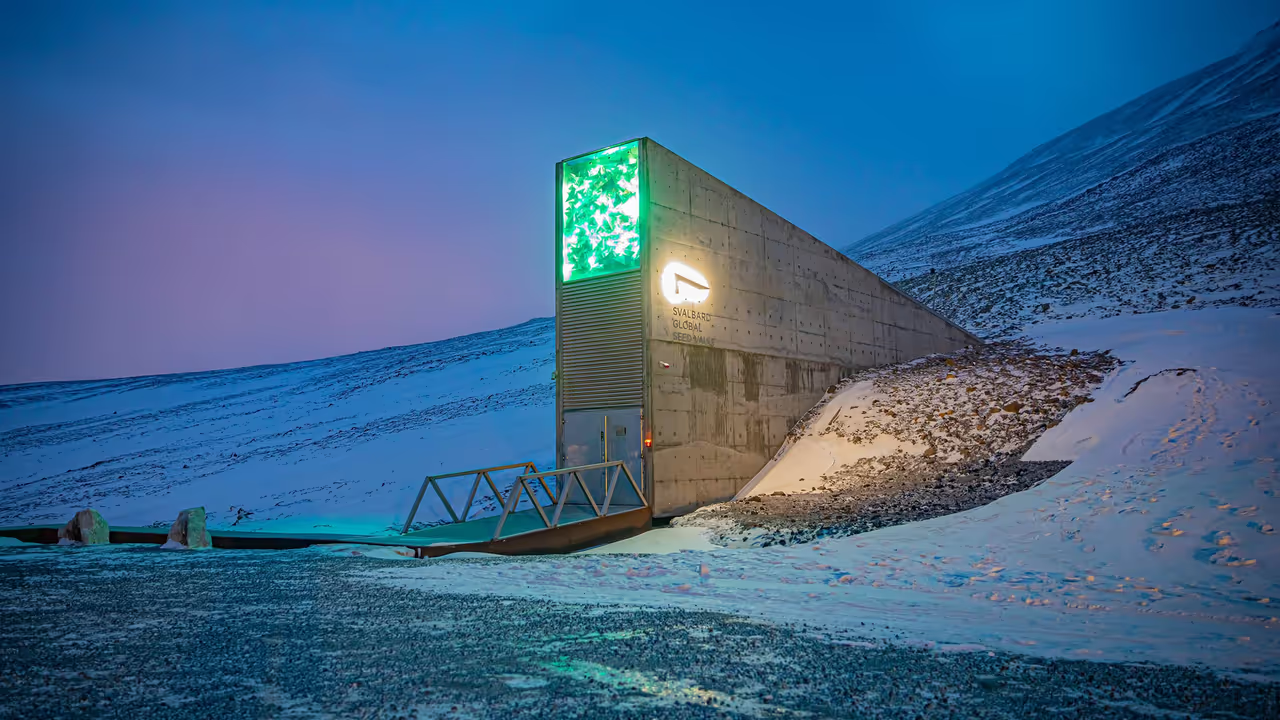
The BioVault draws comparisons to the Svalbard Global Seed Vault, often called the “doomsday vault,” which preserves crop diversity deep inside a frozen Arctic mountain. Seeds there are stored at around −18°C (−0.4°F), with surrounding permafrost and rock ensuring preservation even during power failures.