
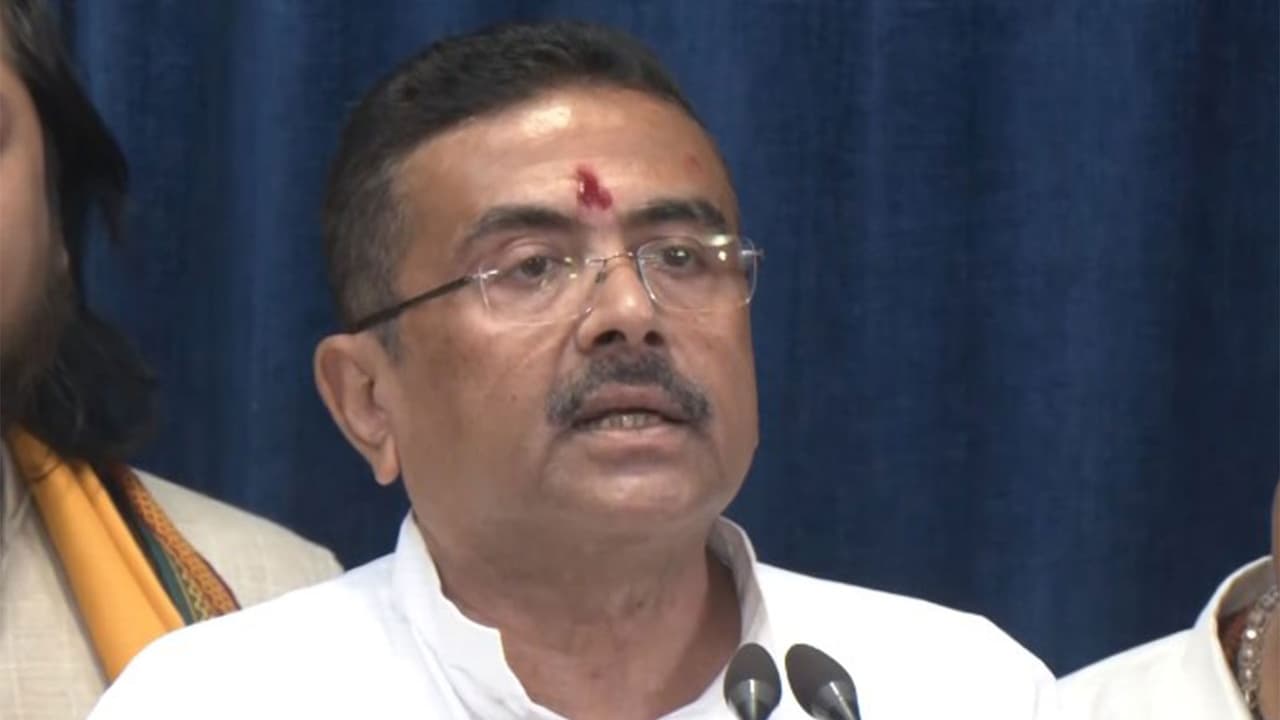
West Bengal government has sanctioned the Enforcement Directorate (ED) to prosecute RG Kar Medical College's ex-principal, Sandip Ghosh, for financial irregularities and money laundering, Chief Minister Suvendu Adhikari announced.
West Bengal government has sanctioned the Enforcement Directorate (ED) to prosecute RG Kar Medical College and Hospital's former principal, Sandip Ghosh, Chief Minister Suvendu Adhikari has said. The official government order released by CM Adhikari on Monday clears the deck for ED to prosecute Ghosh for alleged financial irregularities and money laundering.
CM Adhikari Vows Justice, Slams Previous Govt
"As Chief Minister, I consider myself fortunate to have taken a noble and positive step. In connection with the brutal rape and murder of our sister, 'Abhaya,' at R.G. Kar Medical College and Hospital on August 9, 2024, the 'Sanction of Prosecution' has been formally accorded to the ED (Enforcement Directorate) to take legal action and prosecute the then-Principal of R.G. Kar, the notorious Sandip Ghosh, in accordance with legal procedures," Adhikari said in a X post.
Expressing strong disapproval of the previous TMC government's handling of the situation, Adhikari claimed, "The previous Trinamool Congress government had forcibly and unethically stalled the investigation process of this case for a long time. But we believe that no one is above the law. Truth cannot be suppressed forever."
"I want the real culprits behind the tragedy of sister Abhaya to be identified quickly, receive the harshest possible punishment, and for the people of Bengal to witness justice being served. I pray for the eternal peace of sister Abhaya's soul," he said.
Governor's Order for Prosecution
The order states that after an examination of the FIRs, case records, and facts, West Bengal Governor RN Ravi, being the competent authority, was satisfied that "prima facie he has considered that the said Sandip Ghosh, the then Principal of RG Kar Medical College & Hospital, Kolkata, should be prosecuted in the court of law."
"The Hon'ble Governor of West Bengal being the competent authority under Section 218 of Bharatiya Nagarik Suraksha Sanhita (BNSS), 2023 does hereby accord sanction under Section 61 of BNS, read with Section 318 of BNS and Section 7 of the Prevention of Corruption Act, 1988 (as amended by the Prevention of Corruption Act, 2018) which are scheduled offences as defined under Section 2(1)(y) of the Prevention of Money Laundering Act, 2002 for prosecution of Shri Sandip Ghosh, the then Principal of R.G. Kar Medical College & Hospital, Kolkata, under Section 3 of the PMLA Act, 2002 for the said offences and for any other offences punishable under the provisions of law in respect of the aforesaid Acts and for taking cognizance of the said offences by a court of Competent Jurisdiction," the order said.
The RG Kar Rape and Murder Case
The case pertains to the rape and murder of a trainee doctor whose body was discovered on August 9 in the hospital's seminar room, triggering widespread protests. Shortly after the incident, Sanjay Roy, a civic volunteer at the hospital, was arrested in connection with the crime.
Parallel CBI Probe and Subsequent Bail
Meanwhile, on November 29, 2025 the CBI filed a chargesheet concerning financial irregularities at RG Kar Medical College and Hospital. The chargesheet named Sandip Ghosh and others, including Dr. Ashish Kumar Pandey, Biplab Singha, Suman Hazra, and Afsar Ali Khan, for their involvement in financial misconduct. This investigation was initiated following an order by the Calcutta High Court.
In addition to the corruption case, Sandip Ghosh faced questioning regarding the murder case. As part of the probe, the CBI conducted polygraph tests on him. Follwoing that, the Sealdah Court in West Bengal granted bail to former officer-in-charge of Tala Police Station, Abhijit Mondal, and Sandip Ghosh. The bail was granted after the Central Bureau of Investigation (CBI) failed to file the chargesheet within the 90-day period required by law. (ANI)
(Except for the headline, this story has not been edited by Asianet Newsable English staff and is published from a syndicated feed.)