
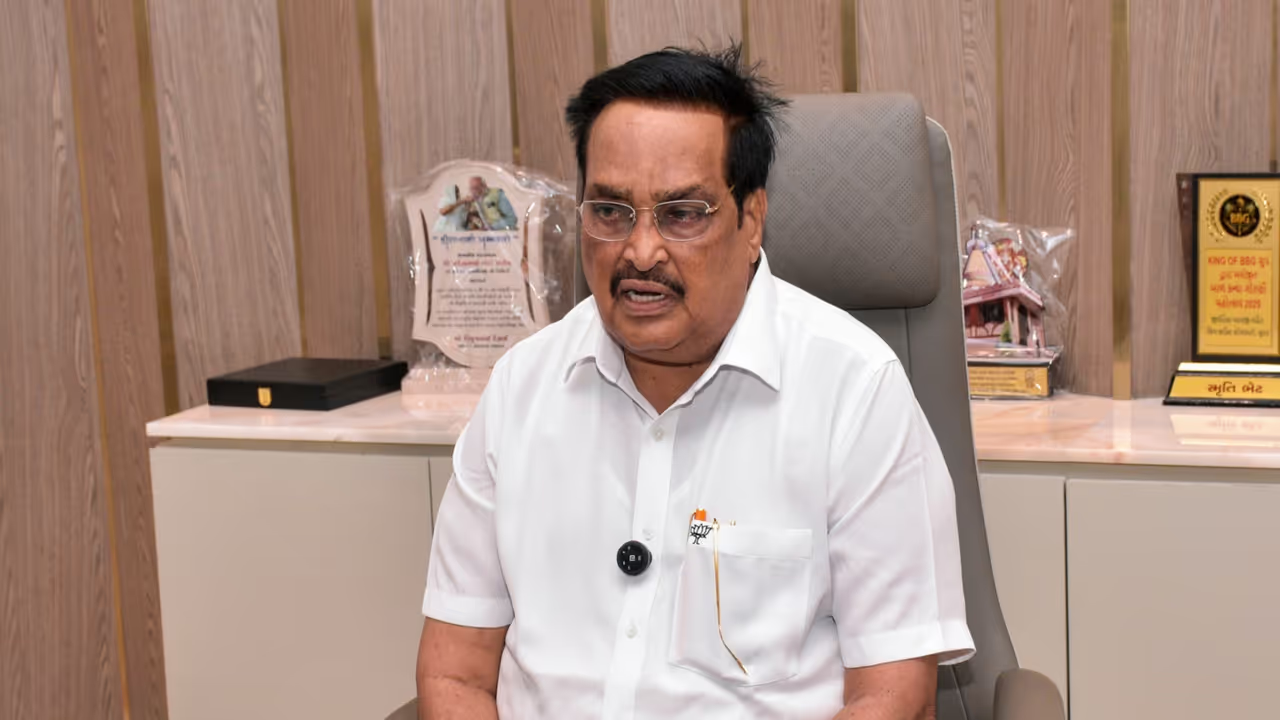
Union Minister CR Patil chaired the 15th Narmada Control Authority meeting with state Chief Ministers to enhance inter-state water cooperation and implement efficient strategies for managing surplus monsoon water and agricultural irrigation.
15th Narmada Control Authority Review Committee Meeting
Jaipur (Rajasthan) [India], October 27 (ANI): The 15th meeting of the Narmada Control Authority Review Committee was held on Tuesday under the chairmanship of Union Minister for Jal Shakti, CR Patil. Rajasthan Chief Minister Bhajanlal Sharma, Maharashtra Chief Minister Devendra Fadnavis, Madhya Pradesh Chief Minister Mohan Yadav, and Gujarat Chief Minister Bhupendra Patel, along with senior officials, participated in the meeting via video conference, according to a press release.
Patil stated that under the leadership of Prime Minister Narendra Modi and the guidance of Union Home Minister Amit Shah, new dimensions have been established in long-pending inter-state water cooperation. The agreement reached on July 7, in New Delhi, in the presence of the Chief Ministers of Rajasthan, Gujarat, Madhya Pradesh, and Maharashtra, is being effectively implemented by the Narmada Control Authority Review Committee. He noted that decades-old water agreements have finally taken concrete shape through mutual consensus, coordination, cooperation, and trust.
Strategic Water Management and Future Initiatives
Utilization of Surplus Monsoon Water
Addressing the meeting, Chief Minister Bhajanlal Sharma stated that the state government is working with full commitment to utilise surplus water available during the monsoon period, as per the 1979 Narmada Water Disputes Tribunal. A Detailed Project Report (DPR) is being prepared for the storage of this surplus water. Our objective is to conserve the excess water that otherwise flows away wastefully during the monsoon, in order to meet the growing demands of the state’s water-scarce regions, he said.
The Chief Minister remarked that, under the Prime Minister’s guidance, improved coordination between the Central government and neighbouring states has opened new avenues for inter-state water cooperation. Landmark agreements, such as the 'Ramjal Setu' link project and the Yamuna water agreement, have instilled new hope for water-stressed areas. Furthermore, Rajasthan, Madhya Pradesh, Gujarat, and Maharashtra have taken commendable steps under the Narmada project, embodying the spirit of cooperative federalism, the release said.
Narmada Canal Project and Irrigation Efficiency
The Chief Minister highlighted that Rajasthan has established a unique model of water efficiency through the Narmada Canal Project. In the remote areas of the Jalore and Barmer districts, this project has mandated the use of a sprinkler irrigation system across the entire command area. This micro-irrigation technique has rendered water wastage negligible. Furthermore, the target of 40 per cent irrigation intensity, set for a cultivable command area of 2.46 lakh hectares, is being efficiently achieved. Farmers are witnessing a significant increase in their crop yields. This initiative serves as an excellent model for efficient water conservation and utilisation for the entire nation, the release said.
He stated that water management is not merely a present-day necessity; it is the foundation for a secure future for generations to come. In a desert region like Rajasthan, water is not just a natural resource; it is the lifeline for development, the economy, agriculture, animal husbandry, and daily life. Ensuring the availability of water for drinking and irrigation, particularly in Western Rajasthan, remains one of the state government’s top priorities. The Chief Minister expressed his gratitude to the Union Minister of Jal Shakti, as well as to the states of Gujarat, Madhya Pradesh, and Maharashtra, for their positive cooperation. (ANI)
(Except for the headline, this story has not been edited by Asianetnews Editorial staff and is published from a syndicated feed.)
