
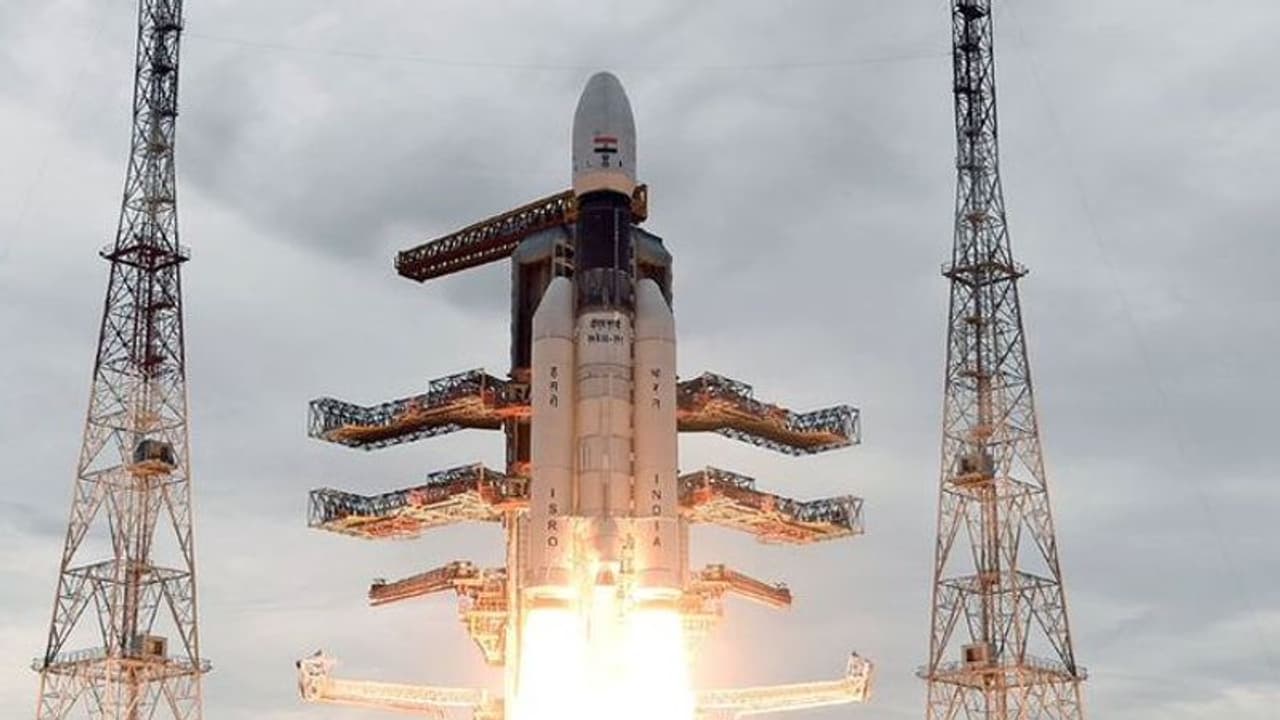
Chandrayaan 3 launch update: While the loss of Chandrayaan-2 was undoubtedly a setback, the unwavering commitment showcased by ISRO emphasizes its dedication to the pursuit of space exploration and signifies its readiness to achieve even greater milestones in the future, says defence and aerospace analyst Girish Linganna.
Many would probably still remember the very poignant image of Indian Space Research Organisation (ISRO) Chairman K Sivan breaking down, and Prime Minister Narendra Modi hugging the space scientist to console him for the loss! Not a personal loss, but a loss for all Indians!
The scene of Modi giving Sivan his inimitable bear hug, which went viral on social media worldwide, hours after the Chandrayaan-2’s Vikram moon lander lost signal with the earth station, provoked unnecessary controversy over the purely personal gesture. Some questioned why an ISRO chief should cry over a technical glitch.
Early on September 7, Vikram lander, while on its descent to attempt a soft landing on the Moon’s south polar region -- with its uncharted surfaces, especially those areas that have not seen the light of day for several billion years -- apparently lost control and crash-landed, snapping all communication links with Earth.
The lander spun more than 410 degrees in a deviation from its calibrated spin of 55 degrees before making a hard landing on the Moon, ISRO scientists revealed. The incongruity, which cropped up in the second phase of four phases of the landing process, was transmitted to the computer systems in the mission control room.
ISRO scientists failed to rectify the abnormality as the lander was on autonomous mode, running on data already fed into its system before the powered descent began.
Humans have long been fascinated by the Moon -- from its romantic appeal to its scientific mysteries. The Moon has survived billions of years of bombardment from space rocks and, yet, its story of origin and evolution is still unfolding. We are going back to the Moon to learn more about its history and its potential for future exploration.
India has been exploring the Moon for over a decade, ever since its first lunar mission, Chandrayaan-1, in 2008. Chandrayaan-1 found evidence of water on the Moon, a major discovery that has implications for future human exploration of the Moon.
Ambitious Chandrayaan-3 Mission
ISRO is now preparing to launch the ambitious Chandrayaan-3 mission to the Moon in the second or third week of July 2023. The Chandrayaan-3 probe, which is currently in Sriharikota, is being integrated with the rocket as part of its launch process in July 2023.
The mission is scheduled to launch from the Satish Dhawan Space Centre in Sriharikota, Andhra Pradesh. Although ISRO has not yet announced the official launch date, it is expected to do so soon. With the successor of the Chandrayaan-2 mission, ISRO aims to go beyond the Moon’s orbit and land on the lunar surface.
Mission to the Far Side of the Moon
ISRO plans to launch Chandrayaan-3 as a mission to explore the far side of the Moon. The mission will attempt to soft land on the lunar surface and will build on the lessons learned from the Chandrayaan-2 mission failure.
The primary objective of Chandrayaan-3 is to demonstrate India’s soft landing capability on the Moon. If successful, India will become only the fourth country in the world to have this ability. The three other countries that have achieved this feat are the erstwhile Soviet Union, the United States and China.
Chandrayaan-3 will be similar to Chandrayaan-2 in terms of its science objectives, mission architecture, and overall goals. ISRO stated that the mission’s ChaSTE will measure the thermal conductivity and temperature of the lunar surface, while the ILSA will measure the seismicity around the landing site.
The Langmuir Probe (LP) will measure the density of the plasma and its variations. The mission also includes a passive Laser Retroreflector Array from NASA for lunar laser ranging studies.
The lander will be able to softly touch down on the surface of a designated Moon site and put the rover into operation. The rover will then conduct an in situ chemical analysis of the Moon’s surface as it moves around.
The Chandrayaan-2 mission failed, but the orbiter is still in orbit and collecting data. "We have investigated the cause of the failure and are certain that it was a software error. We are taking steps to correct the error and ensure that it does not recur," ISRO said in a statement.
Act as a Confidence Booster for ISRO
In addition to its scientific goals, Chandrayaan-3 will also serve as a confidence booster for ISRO. The loss of Chandrayaan-2 was a setback, but the engineers and scientists at ISRO have worked tirelessly to get Chandrayaan-3 launch-ready, demonstrating that ISRO is committed to its mission of space exploration and poised to make further advances in the years to come.
The Moon is a hotbed of activity, with many countries vying to dominate the lunar exploration scenario. India is a leading contender and is in direct competition with China. China has approved the fourth phase of its lunar exploration programme, which will include the Chang’e-6, Chang’e-7 and Chang’e-8 missions. It is also planning to construct a lunar research station.
Not to be outdone, India is planning its own missions to the Moon. The US and Europe are preparing to send humans to the Moon on the Artemis missions. NASA has announced the names of the four astronauts who will orbit the Moon, over 50 years after the Apollo missions ended.
India, on its part, will look to bolster its position in the new lunar race as it continues to explore space, and Chandrayaan-3 will be a key part of that effort. The race to the Moon is on and it will be interesting to see who emerges victorious.
