
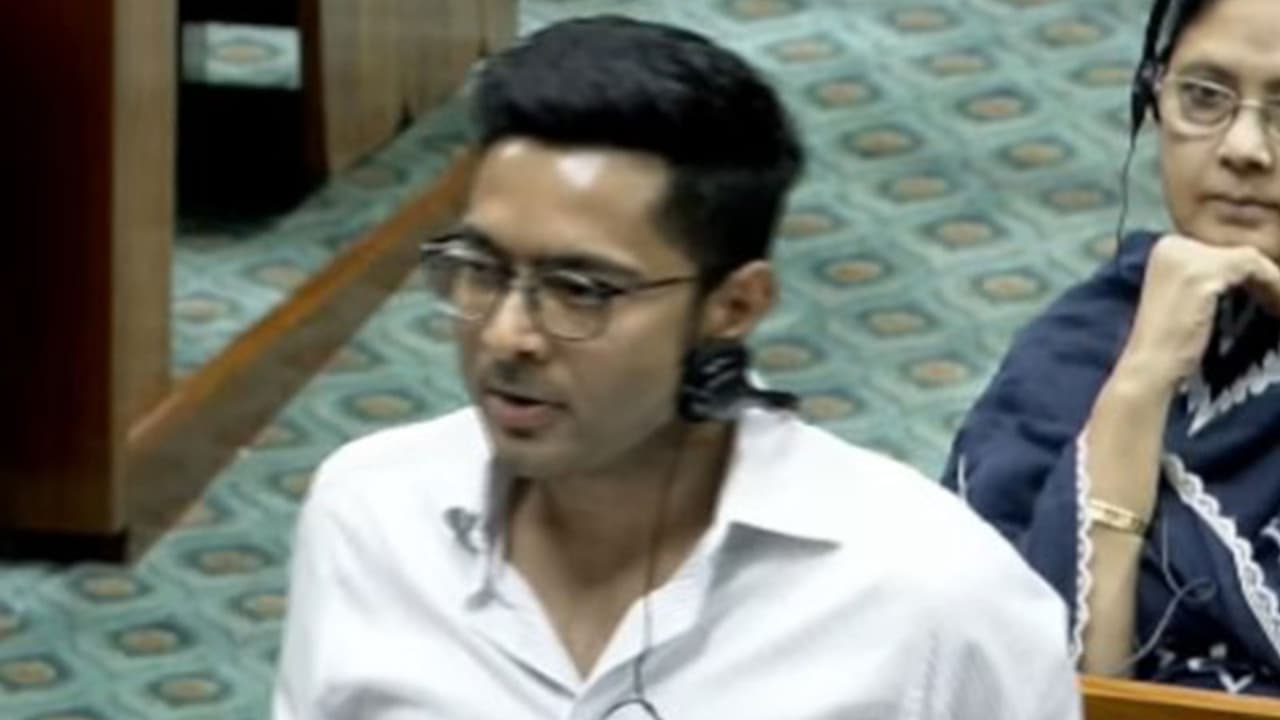
TMC MP Abhishek Banerjee, while supporting the Public Examinations Bill, 2026, slammed the Centre for '12 years of incompetence'. He said the law is an admission of failure and cannot substitute for accountability in repeated exam irregularities.
'Bill is an admission of government's failure': Abhishek Banerjee
Trinamool Congress (TMC) MP Abhishek Banerjee on Tuesday alleged that the Public Examinations (Prevention of Unfair Means) Amendment Bill, 2026, could not erase "12 years of incompetence" and the government's failure, even as he extended his party's support to the proposed legislation during a debate in the Lok Sabha.
Participating in the discussion on the Bill, Banerjee said while the TMC supported the legislation to ensure fair examinations, it should not be seen as an endorsement of the Centre's handling of examination irregularities. He alleged that merely strengthening the law could not substitute accountability for repeated failures in protecting the integrity of public examinations.
"We support this bill, but I want to make it very clear in the beginning that just because we support this bill doesn't mean or the government should expect us to applaud those who set the world on fire because they turn up with a bucket of water. We support this bill and the amendment because no responsible political party--every student deserves the assurance that examinations should be fair; every parent deserves the confidence that success is determined by hard work, talent, and integrity, not by money, influence, or organised criminal syndicates. But support for this bill cannot be a substitute for accountability," Banerjee said.
He further said, "A stronger law is necessary, yes, but by itself is not sufficient if examinations continue to be compromised by systematic failures. No amendment, however stringent, will restore the faith that million students have lost. That is the question before this house today."
Targeting the BJP-led government, Banerjee alleged that the amendment itself reflected the Centre's failure to safeguard the examination system. "But let me also say this: the bill that is being discussed is not the solution; rather, it's an admission. It is an admission that the NDA and the BJP government have failed. It failed to protect the examinations; it failed to protect the merits. And today, after the failure was exposed and exploded across the country, it wants Parliament to believe that increasing punishment would erase 12 years of incompetence," said Abhishek Banerjee.
The TMC MP further accused the government of repeatedly changing laws instead of addressing governance failures. "This government has mastered one art: whenever governance fails, they change the law; whenever administration collapses, they increase punishment; whenever institutions fail, they announce another committee. Governance is not done by headlines; governance is measured by outcomes," Banerjee asserted.
'Milestone legislation to safeguard students': Jitendra Singh
Earlier, Minister of State in the Prime Minister's Office Jitendra Singh moved the Public Examinations (Prevention of Unfair Means) Amendment Bill, 2026, for discussion in the Lok Sabha against the backdrop of widespread protests over the NEET-UG paper leak. He affirmed the government's commitment to the welfare of students and described the Public Examinations (Prevention of Unfair Means) Amendment Bill, 2026, as a "milestone legislation."
The Union Minister said, "This bill, which was introduced yesterday, is, in fact, an amendment to the earlier Bill--Public Examinations Prevention of Unfair Means Act 2024, which was also brought by this government. And not only was it brought, but it was also perhaps the first of its kind in the history of independent India. The earlier Bill and the amendment today are, in a way, a reaffirmation of this government's deep commitment to safeguard the welfare of the students and the youth of this country."
"At the same time, it is also a reiteration of Prime Minister Modi's resolve--not to allow anyone to compromise with the future of the children of Mother India. Therefore, this bill can be described, in a way, as a milestone legislation in the history of the Indian Parliament," he added.
Stricter penalties and fast-track courts
Describing the provisions of the Bill, he noted that the amendment aims to "make the law more stringent and to ensure speedy justice so that the credibility of all these exams gets enhanced and gets reinstated." The Bill, he said, proposes to enhance the punishment for persons resorting to unfair means by increasing the term of imprisonment to not less than five years, extendable up to ten years, as against the existing provision of imprisonment for a term of not less than three years, extendable up to five years. The maximum fine is also proposed to be enhanced from Rs 10 lakh to Rs 50 lakh.
For service providers found involved in offences, the Bill proposes to increase the maximum fine to Rs 5 crore and extend the period of debarment from conducting any public examination from four years to eight years. For organised examination-related crimes, the Amendment Bill proposes to increase the minimum term of imprisonment from five years to seven years, extendable up to ten years, while enhancing the maximum fine from Rs 1 crore to Rs 10 crore.
The Bill also empowers the Centre to constitute a Special Task Force for probing the paper leak and examination-related offences and proposes a new Section 12A providing for completion of investigation within two months, designation of Courts of Session as Special Fast Track Courts for day-to-day trial of offences under the Act, completion of trial within three months from the date of filing of the charge sheet, and appointment of Special Public Prosecutors for every Special Fast Track Court.
"The most important thing which the Prime Minister also mentioned through the video is to ensure speedy justice. We will have special fast-track courts established only for the cases dealing with unfair means in examinations. We have set a time limit in that also. The investigation has to be completed within a span of two months regardless of whether it is a central agency or a special task force," he told the Lower House.
Minister recalls paper leaks under UPA government
Further, Jitendra Singh also recalled the paper leaks under the Congress-led UPA governments. Amid an attack on the National Testing Agency (NTA) over the paper leaks, he said that the Congress government had recommended establishing a common national testing agency and the NTA was eventually formed in 2017. He said, "In 2009--Railway Recruitment Board; 2011--All India Engineering Entrance Examination; 2012--AIIMS New Delhi entrance paper leak; 2013--Maharashtra Secondary Certificate Examination. If I keep listing them, I won't be able to discuss the Bill itself... 2010--B.Ed. Entrance Examination, Uttar Pradesh; 2012--Tamil Nadu Public Service Commission. 2009--West Bengal Joint Entrance Exam. Therefore, this government realised the need for dedicated legislation."
"There are four major recruitment agencies under the Government of India--UPSC, Staff Selection Commission, Railway Recruitment Board, and the Institute of Banking Personnel; and similarly, for higher education admissions, the National Testing Agency. NTA was also constituted in 2017 by this very government. In 1992--for the first time--a recommendation was made to the Government of India, led by the Congress party, to establish a common national testing agency. Then, in 2010, during the UPA's tenure, a committee suggested the same thing; I do not know why it was not given due consideration, for whatever reasons or vested interests. So, I think you must compliment Prime Minister Modi and this government. It has completed a task--an unfinished task--that you should have accomplished yourselves," the minister added.
Lok Sabha took up the Public Examinations (Prevention of Unfair Means) Amendment Bill for discussion at 2 pm today. Union Parliamentary Affairs Minister Kiren Rijiju said the leaders of various parties, including the Congress, Samajwadi Party, DMK, and NCP, had agreed to extend the scheduled six-hour discussion by two hours. (ANI)
(Except for the headline, this story has not been edited by Asianet Newsable English staff and is published from a syndicated feed.)