The press conference began by showcasing visuals of the attacks India faced and the retaliatory strikes the nation delivered.
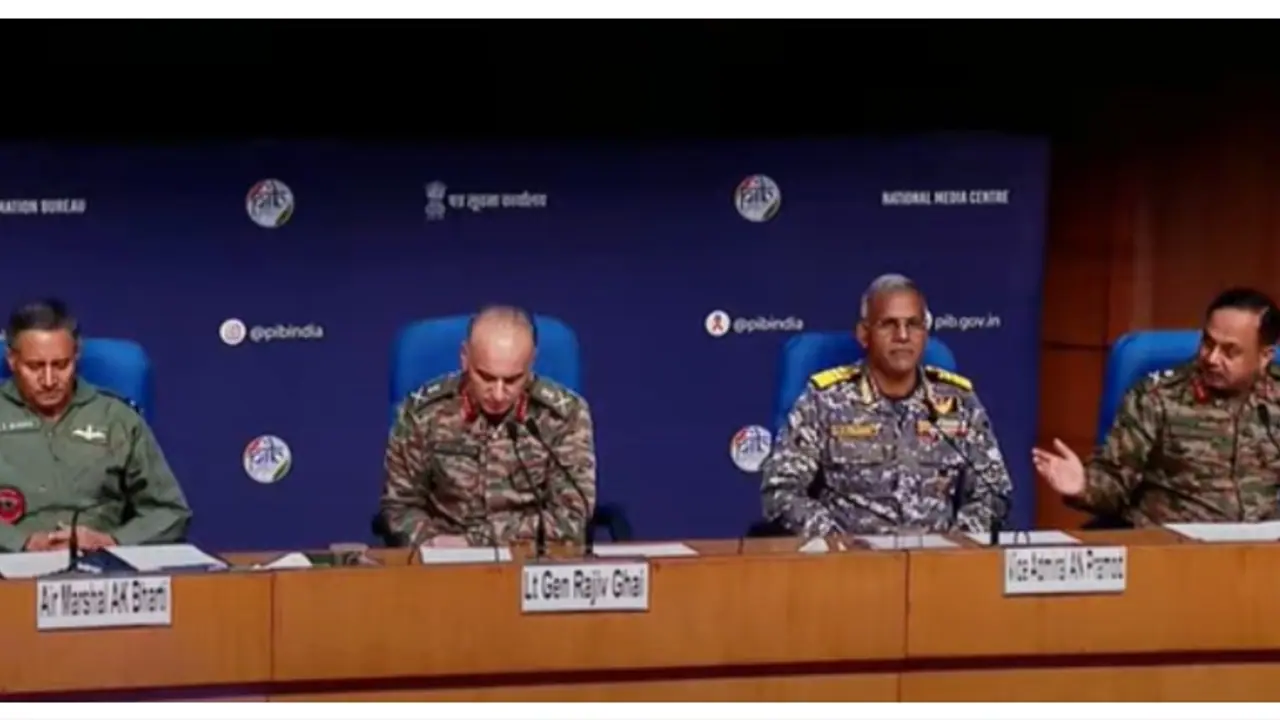
Delhi: Five Indian Army personnel were killed during Operation Sindoor, Director General of Military Operations (DGMO) Lieutenant General Rajiv Ghai said at a press conference on Sunday. He said that Pakistan tried to attack multiple Indian airfields and ammunition dumps in waves, but were thwarted. The conference commenced with a display of visuals depicting the attacks India endured and the subsequent retaliatory strikes executed by the nation.
Paying tributes to the martyrs, Ghai said, “Our hearts go out to the bereaved families...Their sacrifices shall always be remembered...We have thus far exercised immense restraint and our actions have been focused, measured and non-escalatory. However, any threat to the sovereignty, territorial integrity and safety of our citizens will be met with decisive force.”
The decision to retaliate came after attacks on army personnel and innocent tourists. The army's response was a targeted strike against terrorists. A meticulous cross-border operation was planned to attack terror camps. A list of terror camps across the border was prepared and scrutinized. Some of these camps were found abandoned, anticipating retaliation. India targeted and attacked nine terror camps located in Pakistan-occupied Kashmir and Pakistani Punjab, including key hideouts in Bahawalpur and Muridke. The Defense Forces highlighted the significance of targeting the Lashkar camp in Muridke, where Ajmal Kasab and David Headley were trained.
Post-attack visuals, including those of the camps, were released. The attack took place at 7 am. The two-story Bahawalpur training camp was completely destroyed. Visual evidence confirmed that there were no casualties in civilian areas. The terrain and construction of each terror camp were meticulously analyzed to provide precise vectors to the aircraft for targeted strikes. Footage of the attack carried out past midnight on the 7th was released earlier. The aim was to eliminate 100 terrorists, including those on India's most-wanted list. Yusuf Azhar, Abdul Malik Rauf, and Mudassir Ahmed were among the key figures eliminated. These individuals were involved in the Kandahar hijacking and the Pulwama attack. Following the attack, a panicked Pakistan retaliated by targeting civilian areas and places of worship within India's borders. The Air Force effectively neutralized each of these attacks using precision munitions.
Related Articles

Operation Sindoor did not target military installations. The attack on the 7th spared military and civilian areas. Subsequently, all drones sent by Pakistan were destroyed. The Air Force's objective was to destroy these two camps. Only terror camps were destroyed, not buildings belonging to the Pakistani army or civilians. The difference lies in India targeting terror camps while Pakistan targeted civilians. The army confirmed the elimination of terrorists behind the Pulwama attack and the Kandahar hijacking.
Air Marshal RS Bharti highlighted the significance of the Bahawalpur and Muridke camps among the nine targeted. Air-to-surface missiles were used for each strike. Each attack was a precision-targeted operation. Bharti emphasized the need to avoid escalating the conflict, stating that the attack was directed against terrorists, not the Pakistani army. Visuals of the destruction of terrorist launchpads in the Jammu sector were also released.
Attacks occurred from Srinagar to Naliya. The army released images of the damage caused by the airstrikes in Pakistan. Images of Muridke and other locations before and after previous attacks were released. Visuals of each missile strike, including those in Bahawalpur, were also released.
India was prepared to thwart drone attacks. There was no damage to military installations or civilian lives. Following the drone attacks, Pakistani military installations were targeted. The targeted terror camp in Bahawalpur was extensive, necessitating high-impact weapons for complete destruction. There was no damage to any of the Indian locations targeted by Pakistan. Pakistan used civilian aircraft, including international flights, as cover. No attacks were directed at civilian aircraft. Initially, India did not target Pakistani military installations. The Indian army effectively countered the attacks on India. Some attacks reached Indian soil but failed to cause significant damage. Pakistan's targeting of civilian areas prompted India to attack their radar system in Lahore.
Immediately after Operation Sindoor, the Pakistani DGMO was warned against retaliation. However, Pakistan's stance indicated imminent counter-attacks, and the Indian army was prepared. Pakistan's surveillance radars and military installations were destroyed. Drone attacks were attempted on May 9 and 10, targeting strategic locations. All attempts failed. On May 8, major Indian airbases were targeted by drone attacks, which were neutralized by air defense systems. On the nights of May 8 and 9, Pakistani drones and other aircraft violated Indian airspace, primarily targeting Indian military bases. The Pakistani army reported 35-40 casualties among its soldiers.
Extensive and continuous airstrikes occurred from Srinagar to Naliya on the same day. Pakistan reported 35-40 casualties among its soldiers between May 7 and 10. Pakistan targeted several airbases using drones and other means, including Jammu, Udhampur, Pathankot, Amritsar, Bhatinda, Dalhousie, Thoise, Jaisalmer, Phalodi, Uttarlai, and Naliya. All drones were destroyed by the AD system. Firing occurred along the Line of Control and the International Border. It was deemed necessary to respond appropriately, hence the targeted strikes on sensitive locations. Major airbases in the western sector were attacked. Consequently, India retaliated by targeting military installations. Pakistan allowed civilian aircraft, including international flights, to operate, using them as cover to prevent Indian retaliation. Reliable information indicates that 35-40 Pakistani soldiers were reportedly killed. The Rahimyar Khan airfield, Sargodha airbase, and Islamabad airbase were destroyed.
Pakistan targeted 11 Indian airbases: Jammu, Udhampur, Pathankot, Amritsar, Bhatinda, Dalhousie, Thoise, Jaisalmer, Uttarlai, Phalodi, and Naliya. In response, India targeted Pakistani military installations, airbases, and air defense systems. This led to the decision to target their airbases along our western border with precision. Initially, the Pakistani army was not the target; only terrorists were. However, continuous night attacks necessitated retaliation. Airbases, command centers, military camps, and air defense systems were targeted. Following the Pahalgam attack, the Navy had made preparations, targeting Karachi among other locations.