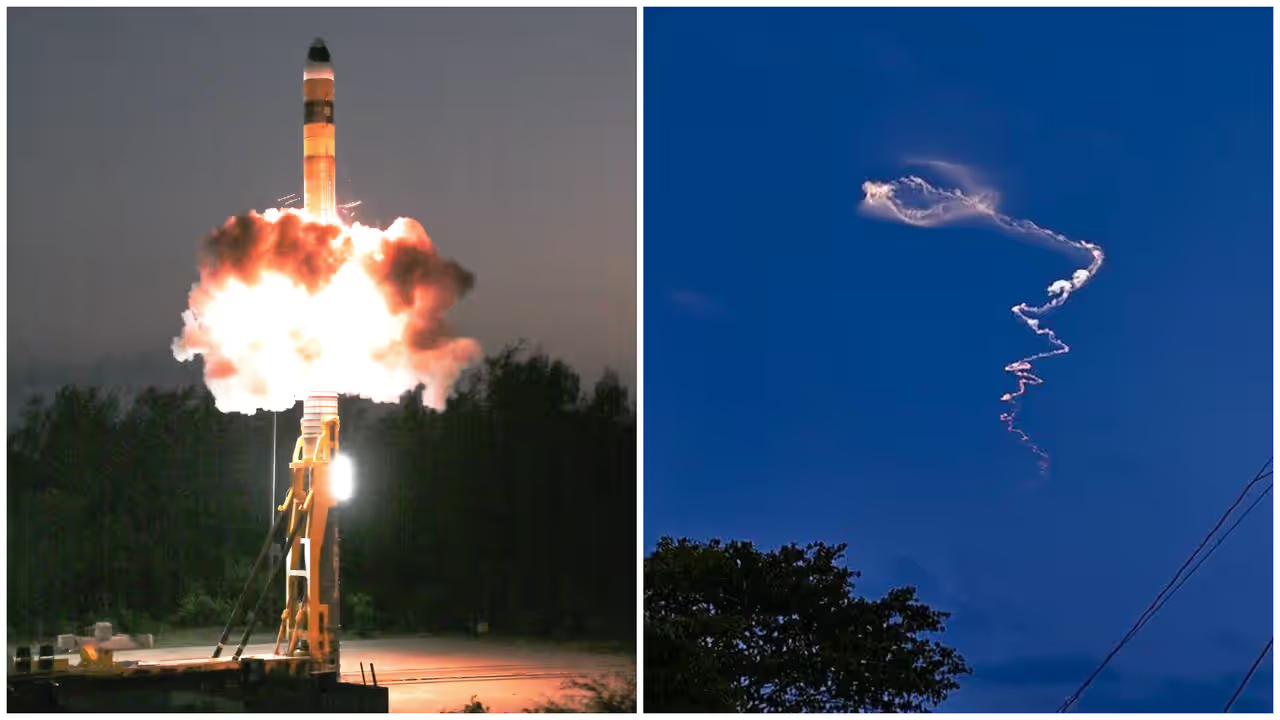
A powerful long-range missile roared into the air from the Odisha coast, leaving behind a glowing trail that was seen by thousands of people across Odisha, West Bengal, and even faraway Bangladesh.
On the evening of May 8, something extraordinary happened in the skies over eastern India. A powerful long-range missile roared into the air from the Odisha coast, leaving behind a glowing trail that was seen by thousands of people across Odisha, West Bengal, and even faraway Bangladesh. Within hours, defence experts across the world started talking about it, governments in Beijing and Islamabad went on high alert, and one big question began echoing everywhere — was this India's mysterious Agni-6 making its first appearance in the shadows?
The launch took place from the Integrated Test Range near Chandipur and Abdul Kalam Island, which has long been India's main testing ground for the Agni-series missiles. But this was not a normal test. The Indian government, DRDO, and Ministry of Defence stayed completely silent. No press release, no photographs, no official briefing. This silence itself became the loudest message. In the world of strategic warfare, sometimes saying nothing speaks louder than a thousand statements.
What made experts immediately sit up was the unusually huge restricted zone declared over the Bay of Bengal. The danger area stretched almost 3,500 to 3,560 kilometres deep into the sea. Such massive zones are never declared for normal short-range or battlefield missile tests. They are only used when India is testing long-range strategic ballistic missiles meant for nuclear deterrence missions. In simple words, this missile was built not for small skirmishes but for sending a serious warning to powerful enemies.
Related Articles

To understand why this is important, let us look at what people actually saw in the sky. Eyewitnesses from Sitakunda, Cox's Bazar, and several parts of eastern India reported long white smoke lines, called contrails, at very high altitudes. Some videos even showed the missile slightly changing direction while moving at extreme speed. The glowing effect in these videos is usually linked to hypersonic or advanced ballistic missiles re-entering the atmosphere at speeds above Mach 5 — meaning more than five times the speed of sound. To put it simply, the missile was travelling so fast that it was lighting up the air around it like a fireball falling from space.
This is where the hypersonic angle becomes very exciting. Modern hypersonic missiles are not just about extreme speed. They are about unpredictability. Unlike old missiles that travel in a fixed curved path, hypersonic glide vehicles can change direction during flight. This makes them almost impossible to detect, track, or intercept by enemy radar and missile defence systems. Many defence analysts strongly believe that India may have quietly tested technologies connected to its future hypersonic glide vehicles or maneuverable warheads during this launch.
The big debate now is whether this was an upgraded version of the famous Agni-5 or an early secret test of the much-awaited Agni-6 programme. The Agni-5 already gives India the ability to strike deep inside China from safe locations within Indian territory. But the Agni-6 is expected to be in a completely different league. Open-source discussions suggest it may have a range of 8,000 to 10,000 kilometres, which means it can reach almost any corner of Asia, parts of Europe, and even beyond. Some Indian political and military figures have hinted that most of the technology is already ready, and only the final government approval is pending.
What makes Agni-6 especially powerful is the MIRV technology. In simple words, MIRV means one single missile can carry multiple nuclear warheads, each capable of hitting a different target. So one Agni-6 launched from India can attack many cities or military bases at the same time. Combined with maneuverable re-entry systems, this gives India a strong second-strike capability — meaning even if India is attacked first, it can still hit back with devastating force. This is the ultimate insurance policy in modern warfare.
The timing of the launch was also no accident. It happened during the first anniversary period of Operation Sindoor, India's bold joint military operation carried out on May 7, 2025. During that operation, the Indian Army, Navy, and Air Force together carried out precision strikes on terrorist camps inside Pakistan and Pakistan-occupied Kashmir, following the brutal Pahalgam terror attack in April 2025 in which 26 innocent civilians were killed. By testing a powerful long-range missile during this anniversary, India sent a clear message that its precision strike capability is now fully backed by long-range strategic deterrence power.
Prime Minister Narendra Modi's recent statement that terrorism and peaceful talks cannot go together added more weight to this message. The May 8 missile test was therefore not just a technical event. It combined political messaging, military deterrence, and defence modernization into one carefully timed strategic move. Pakistan is the immediate target audience because India can now strike important targets deep inside Pakistan from safer launch locations within its own territory.
But the bigger picture goes far beyond Pakistan. The real strategic focus is China. For years, Indian defence leaders have warned about the growing risk of a two-front war, where India might have to face both China and Pakistan at the same time. China is rapidly expanding its nuclear arsenal, building its own hypersonic weapons, and increasing its naval presence in the Indian Ocean through warships, surveillance ships, and dual-use infrastructure projects. In such a situation, long-range Agni missiles give India the power to strike major Chinese cities and military bases even from deep within Indian territory.
The development of MIRV-capable and maneuverable missiles makes life extremely difficult for China's missile defence planners. Multiple warheads moving in unpredictable paths overwhelm any layered defence system. No matter how advanced the shield, some missiles will always get through. This is exactly the kind of psychological pressure India wants to create.
By keeping all technical details secret, India has cleverly built what experts call strategic uncertainty. Rival nations do not know the missile's exact range, payload, maneuverability, or survivability. So they are forced to prepare for the worst-case scenario. This uncertainty itself becomes a powerful weapon, because fear of the unknown is often stronger than fear of known weapons.
The global hypersonic race is heating up fast. Countries like the United States, Russia, and China are pouring billions into hypersonic weapons because these systems reduce decision-making time during a war and make traditional missile defences almost useless. With the May 8 launch, India has clearly signalled that it is no longer just a regional player but is stepping into the league of top global military powers.
For Indians, this event matters more than it appears. It means our borders are safer, our deterrence is stronger, and our neighbours will think ten times before any misadventure. The glowing trail seen over Odisha that evening was not just hot gas and smoke. It was the burning signature of a rising India — quietly, confidently, and unmistakably announcing that the age of Agni has fully arrived, and the Indo-Pacific will never be the same again.