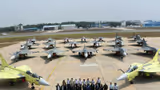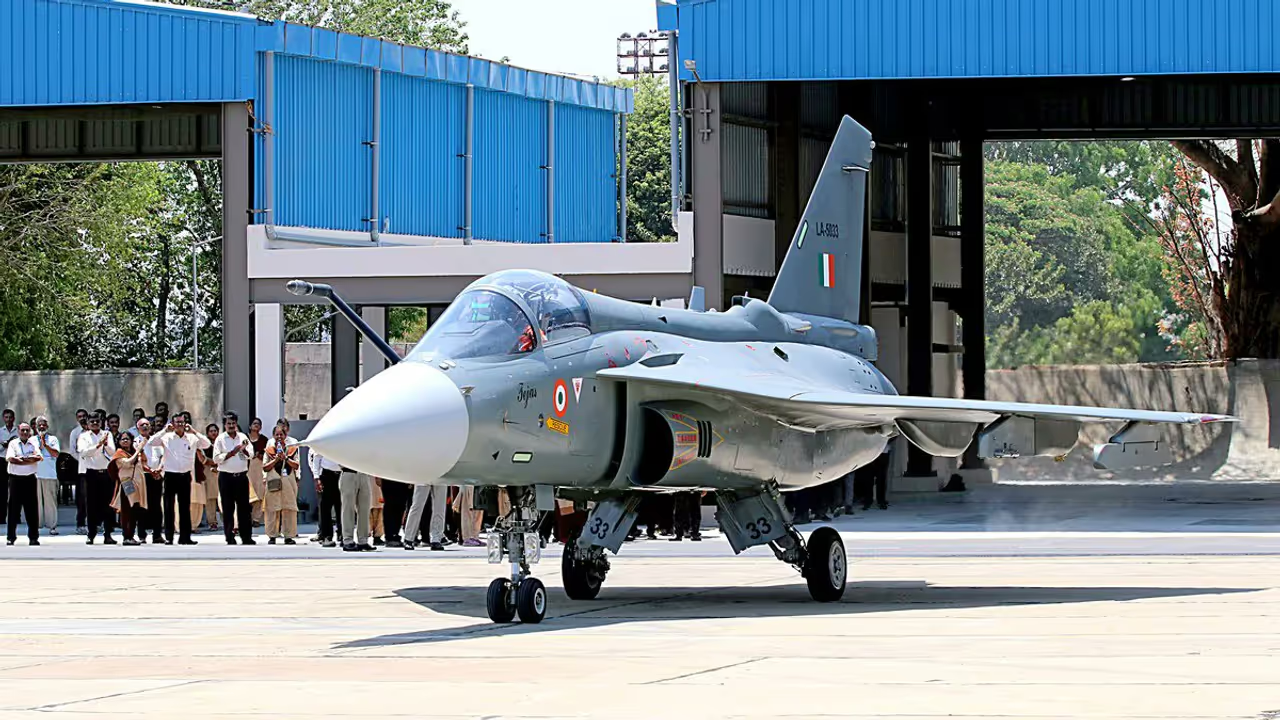
With no aircraft delivered more than two years past the original deadline, Hindustan Aeronautics Limited’s new chief has promised the Indian Air Force that the first Tejas-Mk1A jets will arrive by August or September 2026.
New Delhi: The newly appointed chairman and managing director of Hindustan Aeronautics Limited (HAL), Ravi Kota, met the chief of the Indian Air Force (IAF), Air Chief Marshal AP Singh, to present a revised delivery schedule for the long-delayed Tejas-Mk1A light combat aircraft.
According to sources in the defence establishment, the meeting, held recently in New Delhi, underscored the urgency that now surrounds a programme that has missed successive milestones since a landmark 2021 contract was signed. HAL has committed to beginning deliveries between August and September this year. Under the original schedule, the IAF was to have had two fully equipped squadrons of Tejas-Mk1A jets by now.
The delay stands at over two years, and not a single aircraft has been handed over to the force as of mid-May, despite HAL reportedly holding more than 20 airframes and six GE F404 engines in inventory.
Related Articles

New Chief, Old Problem
Kota is widely known within the defence establishment as the “LCA Man” for his long association with the Tejas programme. Yet his elevation to the top post at HAL comes with an immediate credibility test: the organisation he now leads has failed to deliver on commitments made to the country’s primary air arm for the better part of three years.
A formal programme review between senior HAL and IAF officials – including the vice chief of air staff, Air Marshal Nagesh Kapoor, and test pilots – is rescheduled for June 2026. The meeting was scheduled to take place last month.
The agenda will centre on the integration of the active electronically scanned array (AESA) radar with the aircraft’s electronic warfare suite, the completion of missile-firing trials, and validation of the full weapons package. The IAF has made clear that none of these can be treated as optional: all must be certified before any aircraft is accepted into operational service.
How Deadline Kept Slipping
The IAF signed a ₹48,000-crore contract in February 2021 for 83 Tejas-Mk1A fighters – the largest indigenous defence procurement in India’s history at the time. Deliveries were to begin by March 2024. The first slip came when supply disruptions at General Electric held up delivery of the F404-IN20 engines, pushing the start date to March 2025.
Software validation challenges and incomplete radar trials caused a second slip, moving the target beyond March 2026. Full delivery of the 83-unit order has now been extended to 2031. Engine availability remains a live concern. GE missed a key delivery milestone for the F404-IN20 batch due in March 2026, directly affecting HAL’s production line.
Compounding this, engineers encountered significant software integration problems between the aircraft’s radar system and the indigenous Astra beyond-visual-range missile, requiring extensive rework before flight trials could resume.
IAF’s Shrinking Combat Edge
The delays carry a strategic cost that is difficult to overstate. The IAF currently operates just 29 fighter squadrons against a sanctioned strength of 42 – a shortfall that defence planners describe as a serious operational gap given India’s two-front security environment.
The force has decommissioned ageing MiG-21 variants in recent years without adequate replacements entering service, leaving it increasingly reliant on platforms such as the Sukhoi-30MKI and the Dassault Rafale to maintain its deterrent posture.
The IAF has been categorical that it will not accept aircraft that do not meet all mandatory operational benchmarks. The force’s insistence on full certification before induction is non-negotiable, according to sources familiar with its position.
Indigenous Radar
On the technology development front, flight trials of the indigenously developed Uttam AESA radar are actively underway. The current Tejas-Mk1A production batch is equipped with the Israeli Elta EL/M-2052 AESA radar, which provides advanced target-detection and tracking capability. Plans exist, however, to switch to the Uttam system in future production lots, a move that defence planners regard as essential for reducing India’s dependence on foreign avionics suppliers.
The Defence Research and Development Organisation (DRDO) has described the Uttam programme as being at an advanced stage of maturation, though integration with a production aircraft remains a step away.
Larger Tejas Road Map
The IAF has separately placed an order for 97 Tejas-Mk1 with trainer variants in a deal that is also being processed. The original single-engine Tejas LCA, which entered limited service with No. 45 Squadron and No. 18 Squadron of the IAF, demonstrated that the platform could fly and fight – but also exposed the yawning gap between a prototype-led development culture and the discipline of series production.
The Tejas-Mk1A sits in the middle of a broader, more ambitious road map. HAL is simultaneously developing the Tejas-Mk2, a heavier and more capable variant powered by the GE F414 engine, which is intended to fill the medium-weight fighter role. The IAF has separately placed an order for 97 Tejas LCA Mk1A variants in a deal that is also being processed.