
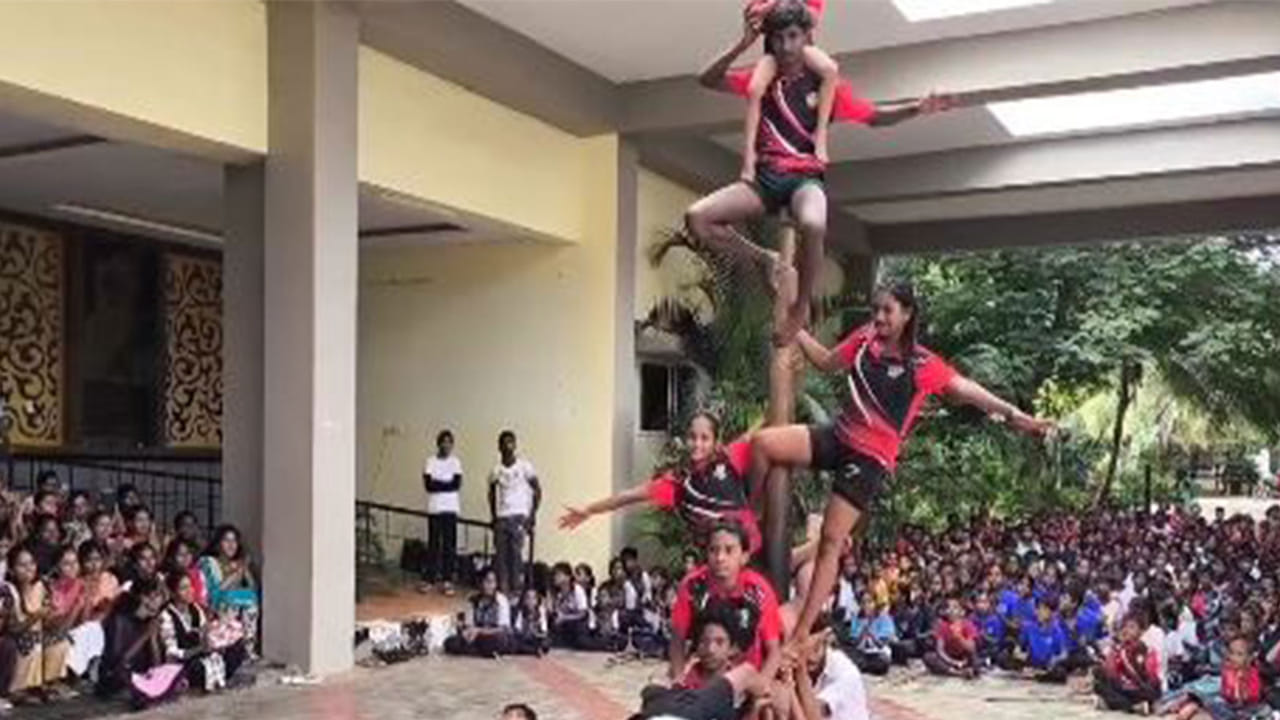
Over 600 students gathered in Tamil Nadu for a state-level Silambam and district-level Mallar Kambam competition, promoting traditional sports through various athletic categories and displaying exceptional talent and core strength.
Tamil Nadu Hosts Vibrant State Level Silambam and Mallar Kambam Meet
Rameswaram (Tamil Nadu) [India], November 18 (ANI): State-level Silambam and district-level Mallar Kambam competitions were successfully organised at Nammalwar Agricultural Technical College in Kamuthi, Ramanathapuram district, to promote traditional sports. More than 10 groups participated in the district-level Mallar Kambam competition and showcased their talents in the traditional sport. Meanwhile, more than 600 students from various districts, including Ramanathapuram, Madurai, Sivaganga, Virudhunagar, Thoothukudi and Pudukkottai, enthusiastically participated in the state-level Silambam competition. The competitions were conducted in various categories, including single-rod Silambam, double-rod Silambam and Silambam duel. Students displayed their valour and talent in the competitions and emerged victorious in their respective categories. Certificates were awarded to the winners in recognition of their performances. Peraiyur Police Inspector Jagatheesan, Nammalwar Agricultural Technical College Principal Ahmed Yasin and College Principal Thiruveni were present at the event and felicitated the winners.
Understanding Mallar Kambam
Mallar Kambam, also known as Mallakhamb, is a traditional Indian sport where athletes perform aerial yoga postures, wrestling grips and acrobatic feats on a vertical wooden pole, a hanging pole, or a suspended rope. The name comes from malla, meaning wrestler, and khamb or kambam, meaning pole — literally, the "wrestling pole". Its roots go deep into history. It began in the Indian subcontinent as physical conditioning and agility training for wrestlers and warriors, with stone carvings in Tamil Nadu dating back to the 7th century. In the 18th century, Balambhatta Dada Deodhar, a physical trainer in Maharashtra, revived and popularised the discipline as a structured competitive sport. Much later, in 1961, physical education teacher Ulagadurai introduced structured Mallakhamb training in Villupuram district, earning recognition as the "Father of Mallakhamb" in Tamil Nadu. The sport even reached the global stage when it was showcased as a demonstration sport at the 1936 Berlin Olympics. The first-ever World Mallakhamb Championship was held in Mumbai in 2019, featuring participants from 17 nations.
Competition and Training Standards
Competitive Mallakhamb is divided into three main apparatus categories, with routines typically lasting 90 seconds. Pole Mallakhamb uses a stationary, tapered vertical pole made of teak or sheesham, polished with castor oil to reduce friction, and is primarily practised by men. Hanging Mallakhamb uses a shorter wooden pole suspended from a hook or chain, requiring athletes to balance while the pole swings, also primarily practised by men. Rope Mallakhamb uses a thick, suspended cotton rope on which athletes perform aerial poses, twists and climbs without tying knots, primarily practised by women. Judges score athletes on the difficulty of postures, smooth transitions between combinations, balance and overall execution. Training develops extreme core strength, flexibility, grip endurance and mental focus. Madhya Pradesh declared Mallakhamb its official state sport in 2013, and more than 20 Indian states have since followed suit. In July 2024, a mass event in Villupuram, Tamil Nadu set a Guinness World Record with 1,000 participants performing simultaneously.








