A British traveller exploring India has gone viral after publicly challenging the stereotypes and negative narratives about the country that often dominate social media.
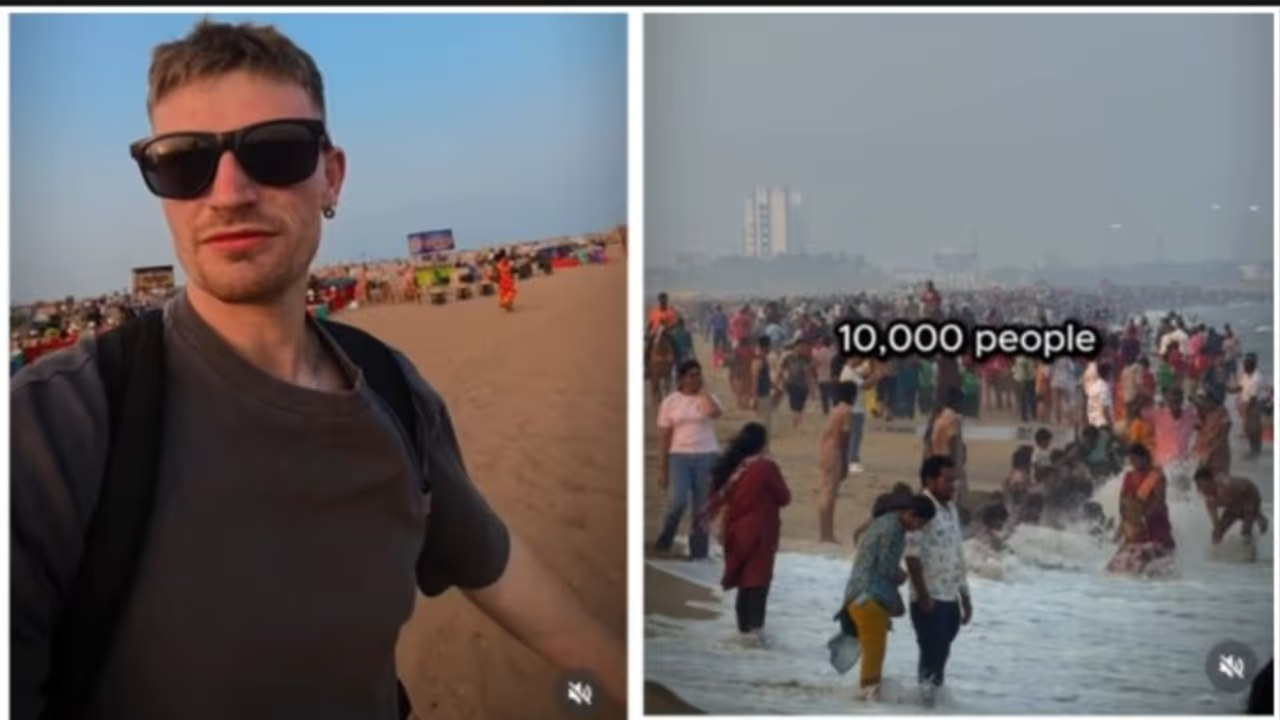
A British traveller exploring India has gone viral after publicly challenging the stereotypes and negative narratives about the country that often dominate social media. In an Instagram video titled 'Social media completely lied to me about India,' digital creator Jack Heaton documented his visit to Chennai's iconic Marina Beach in Tamil Nadu, regarded as the world's second-largest urban beach.
Expressing surprise at the beach's condition, Heaton pointed out that Marina Beach appeared remarkably clean despite attracting thousands of visitors daily. According to him, the experience directly contradicted claims frequently seen on social media that public spaces in India are overwhelmingly littered and unhygienic.
"We are at the second-largest beach in the entire world. Would you believe that it is in India?" Heaton can be heard saying in the now-viral clip. "It actually looks really clean. There's barely any rubbish. There are a few little bits, but not a lot at all," he added.
Related Articles

The content creator also highlighted the sheer scale of the crowd at the beach, saying it was astonishing to see such a massive gathering while finding very little waste scattered around.
Describing the scene as "insanity," Heaton remarked that nearly 10,000 people appeared to be present at the beach at the time.
"I don't know if you can see that, but up there, there are probably 10,000 people. That's actually insanity," said Heaton.
He was equally impressed by the condition of the water, claiming it looked cleaner than what he typically encounters along England's coastline.
"But the water, boys, that is cleaner than the water on the coast of England. I mean, don't get me wrong. I'm not going to tell you it's crystal clear blue. It's not the Maldives, guys, but it's not bad."
As the video gained millions of views and sparked widespread discussion, many social media users argued that online content often amplifies negative aspects of India because such posts generate higher engagement.