
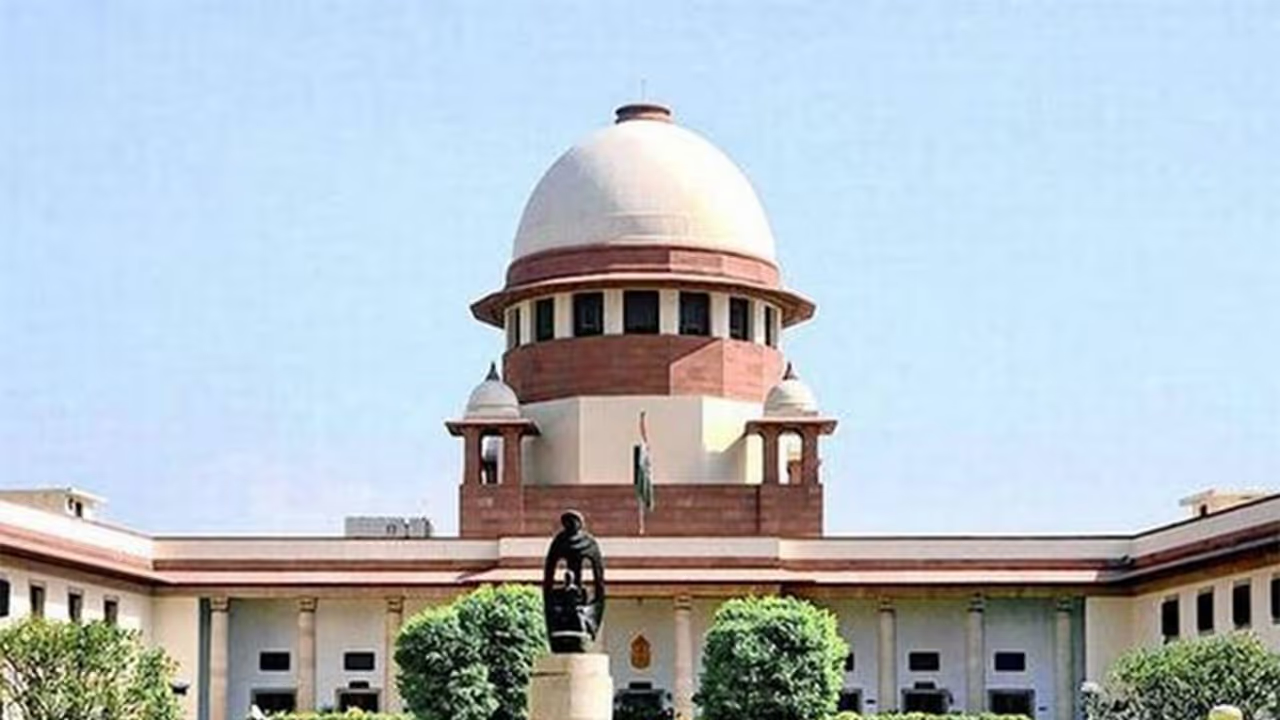
The Supreme Court has sought responses from the Centre, States, and Law Commission on a PIL. The plea demands that land disputes be heard by legally trained judicial officers instead of revenue officials to ensure fair and consistent adjudication.
The Supreme Court on Thursday issued notice to the Central and State governments on a public interest litigation (PIL) seeking directions to ensure that land disputes are adjudicated by legally trained professionals, instead of revenue officials without formal legal education.
A bench of Chief Justice of India Justice Surya Kant and Justice Joymalya Bagchi also sought response from the Law Commission of India on the plea. The top court acknowledged the significance of the issue raised, however, also flagged institutional concerns, saying, "Point is very interesting also, but they will say it is for legislature."
Plea Seeks Dedicated Revenue Judicial Service
The plea filed by advocate Ashwini Kumar Upadhyay told the bench that the issue also raises concerns of separation of powers, as executive officers continue to exercise quasi-judicial functions affecting civil rights.
The plea sought creation of a dedicated Revenue Judicial Service and uniform minimum qualifications for officials deciding disputes relating to title, succession, inheritance and possession of land.
The petitioner highlighted persistent delays and systemic issues in land adjudication at the grassroots level, stating that he frequently encounters grievances during his visits to districts.
The plea also urged the apex court to direct the Centre and States to establish a Revenue Judicial Service cadre, mandate minimum legal qualifications and judicial training for officers adjudicating land disputes. It further asked to declare adjudication of such disputes by non-legally trained officials as impermissible and ensure supervision by High Courts over these adjudicatory mechanisms.
Systemic Flaws and Fundamental Rights Violations
The existing system of land dispute adjudication, primarily handled by revenue and consolidation officers, suffers from structural deficiencies due to the lack of formal legal training among such authorities, the petition pointed out.
"Nearly 66 per cent of the civil cases are related to land disputes. The key lacuna is that land disputes are adjudicated by the officers lacking formal legal education and training like PCS-J, resulting in erroneous and inconsistent decisions. This also increases the burden on the judiciary due to frequent challenges," it added.
It further said that this framework results in arbitrariness, inconsistent outcomes and systemic delays, thereby violating fundamental rights.
The PIL added, "The present system causes widespread and continuing injury to citizens by subjecting the adjudication of land disputes to revenue officers without legal background, resulting in arbitrary, inconsistent, erroneous decisions. This leads to prolonged uncertainty over property rights, restricts the use and transfer of land, increases litigation and costs, and denies effective access to justice, thereby infringing the fundamental rights guaranteed under Articles 14 and 21 of the Constitution."
Concerns Over Impartiality of Revenue Officers
Revenue officers, drawn from diverse academic backgrounds and often burdened with administrative duties such as law and order, lack the time, training and institutional independence required for judicial decision-making, stated the PIL, adding that frequent transfers disrupt continuity in hearings and contribute to delays, while exposure to local pressures and executive control raises concerns about impartiality.
Call for Nationwide Uniformity
It sought a nationwide uniformity in the adjudicatory framework, saying that divergent practices across States undermine equality before law.
"Land disputes across India involve similar questions of title, succession, limitation, adverse possession, and interpretation of property laws. Since the nature of these disputes is uniform, the standards governing the competence and independence of adjudicators must also be uniform. Allowing different States to follow divergent approaches in matters affecting identical civil rights results in inconsistency, unpredictability, and unequal protection of laws," the petition stated. (ANI)
(Except for the headline, this story has not been edited by Asianet Newsable English staff and is published from a syndicated feed.)
