
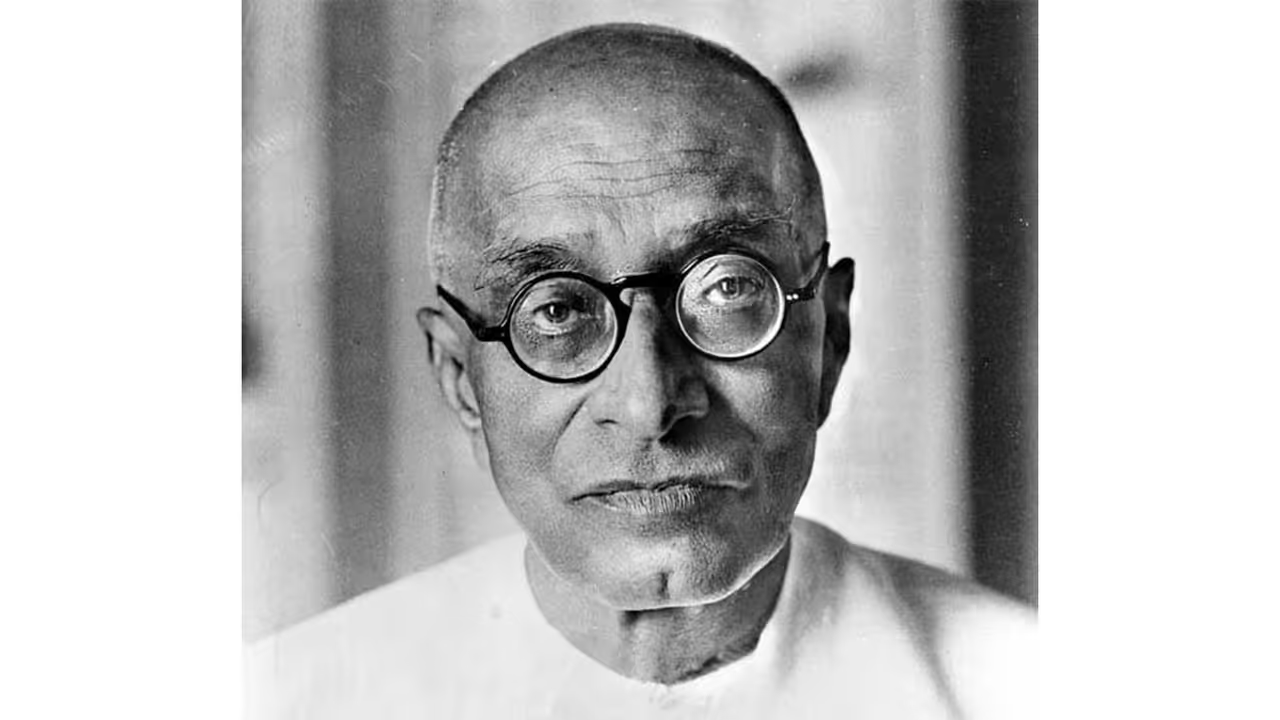
PM Modi announced the 'Rajaji Festival' will be held at Rashtrapati Bhavan on Feb 23. The event will feature the unveiling of a statue of C. Rajagopalachari, India's first Indian Governor-General, and an exhibition in his honor.
PM Modi Announces 'Rajaji Festival'
Prime Minister Narendra Modi on Sunday announced that "Rajaji Festival" will be celebrated in Rashtrapati Bhavan on February 23 with the unveiling of the statue of Chakravarti Rajagopalachari, the first Indian Governor-General of independent India.
During the 131st 'Mann Ki Baat' episode, PM Modi said that the nation is leaving the symbols of slavery behind and beginning to relate to the Indian culture. "During the Azadi Ka Amrit Mahotsav, I spoke of the 'Panch-Pran' from the Red Fort. One of them is freedom from the mentality of slavery. Today, the country is leaving behind the symbols of slavery and has begun to value symbols related to Indian culture. Tomorrow, on 23rd February, Rajaji Festival will be celebrated in Rashtrapati Bhavan..." he said.
Statue Unveiling and Exhibition
The Prime Minister highlighted that the statue of the first Governor-General of independent India will be unveiled in the central courtyard of the Rashtrapati Bhavan. An exhibition related to Rajagopalachari will also be held from February 23 to March 1.
"On the occasion, a statue of C Rajagopalachari will be unveiled in the central courtyard of Rashtrapati Bhavan. He was the first Indian Governor-General of independent India. Unfortunately, even after the independence, the statues of British administrators remained in the Rashtrapati Bhavan, but no place was given to the sons of India. During the Rajaji Festival, an exhibition based on Rajagopalachari will also be put up. The exhibition will run from February 24 to March 1..." he stated.
About C. Rajagopalachari
C Rajaopalachari was born on December 10, 1878, in Madras Presidency. He was a lawyer and intellectual among many other things. He is regarded as an early political comrade of Mahatma Gandhi, who left his legal practice to join the Indian National Congress and later participated in various protests against the British Crown. Most popularly, Rajagopalachari agitated against the Rowlatt Act, non-cooperation, and the Civil Disobedience movement. He was elected to the Constituent Assembly from Madras on a Congress ticket. He was part of the sub-committee on minorities and was conferred with the Bharat Ratna in 1954.
(Except for the headline, this story has not been edited by Asianet Newsable English staff and is published from a syndicated feed.)