
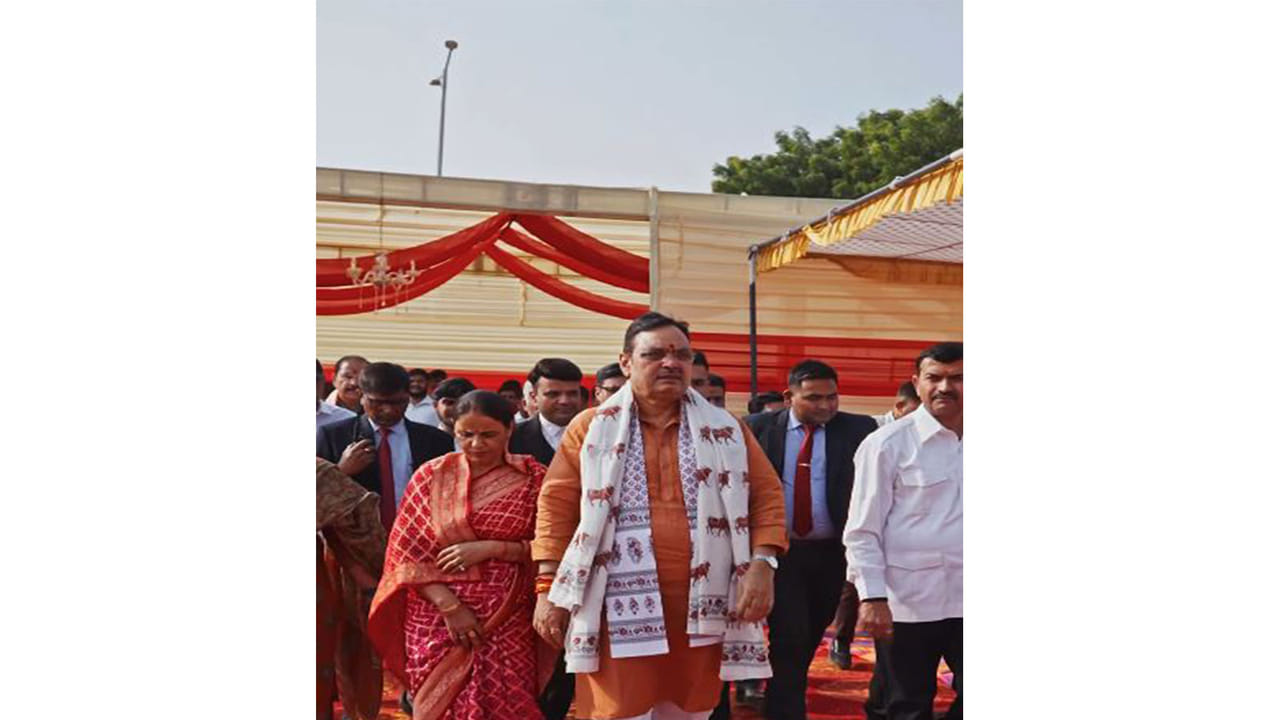
Rajasthan Chief Minister Bhajanlal Sharma marked Gopashtami by visiting historic cow shelters in Jaipur, performing prayers, and offering greetings. He emphasized reverence for Mother Cow while engaging with local community members.
Rajasthan CM Bhajanlal Sharma Celebrates Gopashtami at Cow Shelters
Jaipur (Rajasthan) [India], November 17 (ANI): Rajasthan Chief Minister Bhajanlal Sharma observed the auspicious occasion of Gopashtami on Tuesday by visiting the key cow shelters in the state capital, Jaipur. Accompanied by his wife, the Chief Minister visited the historic Pinjrapole Gaushala located in Sanganer, where they performed special prayers.
Extending his greetings and sharing details of his spiritual engagements on X, Chief Minister Sharma wrote, "The sacred festival of Gopashtami is dedicated to reverence, faith and devotion to Mother Cow. On this auspicious occasion, I worshipped cows at the Pinjarapol Gaushala and the gaushalas in Sanganer and Jotdawala, and prayed to Mother Cow for happiness, peace, prosperity and well-being in the lives of all the state's residents."
Continuing his engagements, the Chief Minister later visited the Ashram Gaushala in Jotdawala, associated with spiritual leaders Baba Sant Shri Ramkaran Das Maharaj and Gurudev Shri Sant Paramsukh Das Maharaj. During his visit to the Sanganer region, Chief Minister Sharma also stopped at the residence of local party worker Radheshyam Jotad in Jotdawala to interact with his family members. "Today, I visited Shri Radheshyam Ji Jotad’s residence in Jotadwala, met warmly with his family members, and inquired about their well-being," Sharma wrote on X.
On Sunday, Sharma said the state government had allocated approximately Rs 3,200 crore for the development of the tribal community over the past three years, with a focus on educational, social and economic empowerment. Speaking at a Janjatiya Gaurav Diwas event, Sharma said the tribal community had struggled for centuries to protect the country's culture, traditions and self-respect, and stressed the need to honour its rich heritage and contributions.
The CM said the Tribal Pride Day, initiated by Prime Minister Narendra Modi in 2021 on the birth anniversary of Bhagwan Birsa Munda, had become an important part of national consciousness. He also highlighted that Droupadi Murmu, who belongs to the tribal community, is serving as the President of India, occupying the country's highest constitutional office.
Highlighting the government's initiatives, Sharma said 10 ashram hostels, three residential schools, a new sports hostel and 250 Maa-Badi centres had been established in the state. Under the PM-JANMAN scheme, 15,233 houses, 23 connecting roads and 15 multipurpose centres had been constructed in the Sahariya region of Baran district, while 51 Van Dhan Kendras had also been established. He added that the Dharti Aaba Janjatiya Gram Utkarsh Abhiyan was aimed at improving the living standards of approximately 55 lakh tribal people across 6,235 villages.
The Chief Minister said under the Prime Minister's vision of 'Sabka Saath, Sabka Vikas, Sabka Vishwas and Sabka Prayas', comprehensive efforts had been made to accelerate development in tribal areas and eliminate Naxalism. Sharma also highlighted initiatives to support tribal farmers, preserve cultural heritage and develop religious sites associated with tribal communities.
He said tribal youth had brought laurels to the country through lacrosse, winning a silver medal at the 2024 Samarkand Asian Championship, gold medals in both men's and women's categories at the Riyadh Asian Lacrosse Games this year, and a bronze medal at the Southeast Asian Lacrosse Championship 2026 in Malaysia. During the interaction, Indian women's lacrosse team captain Sunita Meena and national men's team vice-captain Mohanlal Gameti thanked the Chief Minister for providing sports facilities, including a lacrosse academy in Udaipur, which they said were creating opportunities for players from remote areas. Short films on the development journey of tribal communities and religious sites in tribal regions were also screened at the event.








