
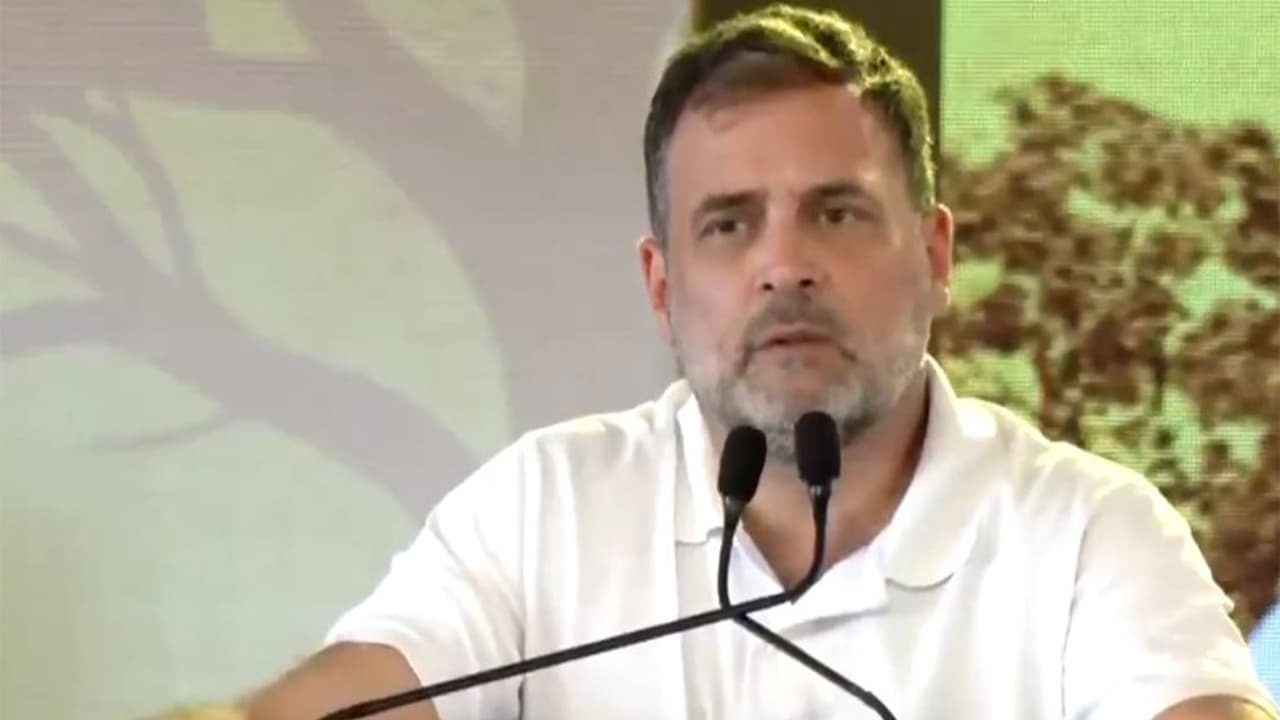
Rahul Gandhi, speaking at Sivagiri Mutt, hailed Sree Narayana Guru as Kerala's most powerful figure. He stressed that both Guru and Mahatma Gandhi's legacies prove that true power lies in truth and non-violence, not force or wealth.
Remembering social reformer Sree Narayana Guru, Leader of Opposition in the Lok Sabha Rahul Gandhi on Friday said that despite not possessing great wealth or physical strength, the saint philosopher was one of the most powerful figures in Kerala.
Speaking at the 100th anniversary commemoration of the historic meeting between Mahatma Gandhi and Sree Narayana Guru at Sivagiri Mutt, Rahul Gandhi said the legacies of Gandhi and Narayana Guru carry a clear message against violence, stressing that nothing is gained through it. "The British had force but no power. Gandhi ji had no force, but he had the truth, so he had power. Narayan Guru did not have strength or huge amounts of wealth, but he was easily the most powerful man in Kerala. Imagine his power that 100 years later, many from the political class have come to commemorate Narayan Guru today. There is a clear message to those who use violence from Gandhi ji and Narayan Guru ji - there is nothing to be gained from it, only to be lost," Gandhi said.
A Parallel with Contemporary Politics
Drawing a parallel with contemporary politics in India, Rahul Gandhi said the political struggle today is also between the values of truth, humility and non-violence on one side, and anger, violence, hatred and arrogance on the other. "The political fight in India is also similar. On one side is truth, humility and non-violence. On the other side are anger, violence, hatred and arrogance. They might have force but no power. The spirit of India is based on the idea of non-violence and truth," he added.
Who was Sree Narayana Guru?
Sree Narayana Guru (20 August 1856 - 20 September 1928) was a saint, philosopher, spiritual leader, and social reformer from Kerala. The Guru actively promoted education, cleanliness, devotion to God, organisation, and agriculture. He encouraged industries as a means for economic independence. He believed that with the right skills, hard work, knowledge, education, and a clean living environment, people could transform themselves into self-confident, self-respecting, fearless, and morally and financially strong communities. (ANI)
(Except for the headline, this story has not been edited by Asianet Newsable English staff and is published from a syndicated feed.)