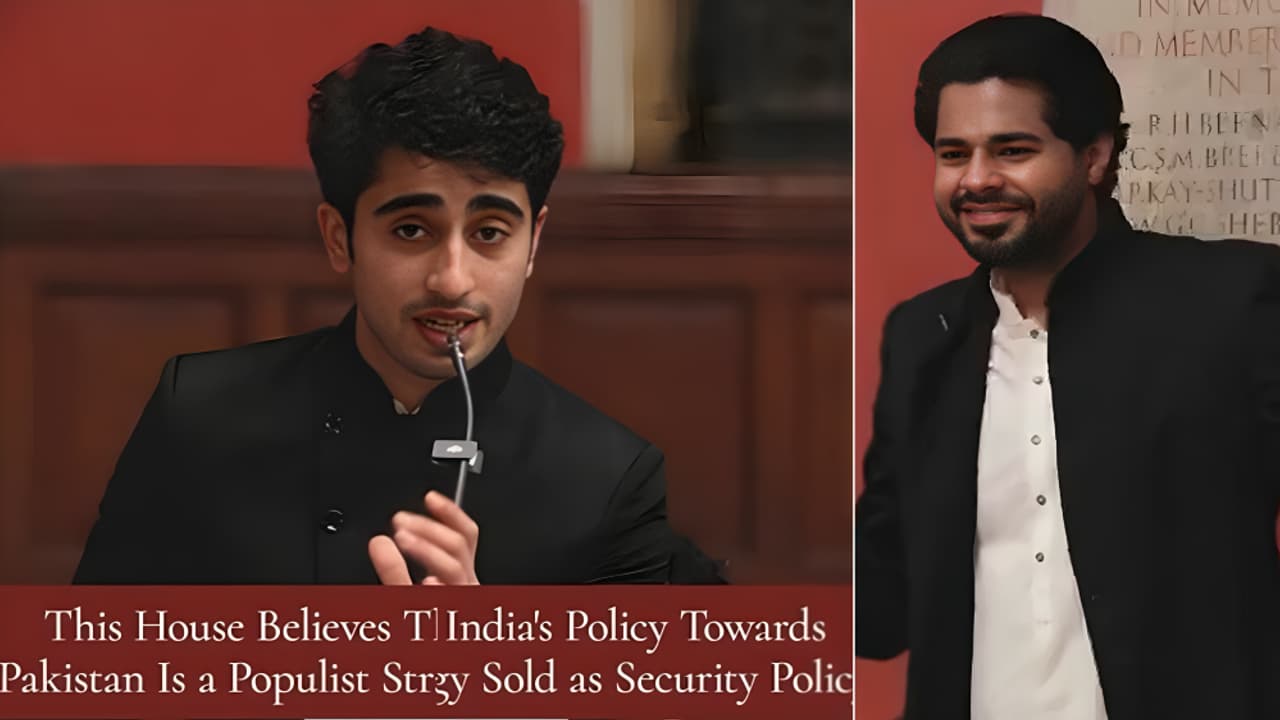
A student debate at Oxford Union has gone viral after Indian law student Viraansh Bhanushali challenged Pakistan’s terror narrative with personal testimony and historical timelines. Clips of Bhanushali's speech have sparked wide discussion online.
Mumbai-born law student Viraansh Bhanushali's Oxford Union speech is going viral amid a major controversy involving Pakistani Union president Moosa Harraj. While Harraj oversaw a disputed, aborted debate that let Pakistan claim a 'win', a separate student debate on the same motion saw Bhanushali decisively dismantle the Pakistani side.
The controversy, earlier, erupted at the Oxford Union Society after its Pakistani president, Moosa Harraj, was accused of staging a political stunt and declaring Pakistan the winner of a debate that never formally took place.
At the centre of the storm is a motion that read: “This House believes that India’s policy towards Pakistan is a populist strategy sold as security policy.” While a formal debate involving politicians and public intellectuals from both countries was expected, that event collapsed amid confusion and claims of sabotage.
Related Articles

However, a separate student-only debate on the same motion had already taken place in November at Oxford University. That debate, led by Indian law student Viraansh Bhanushali, has now gained attention after the video was released and clips went viral online.
Who is Viraansh Bhanushali
Viraansh Bhanushali is a Mumbai-born law student studying at Oxford University. He led the Indian side in the student debate and spoke just a day after November 26, a date deeply linked with terror attacks in India.
Like millions of Mumbaikars, Bhanushali lived through the 2008 Mumbai terror attacks, also known as 26/11. "Ten terrorists from the Pakistan-based Lashkar-e-Taiba carried out coordinated attacks across Mumbai, killing over 250 people and traumatising the city," he recalled during the debate..
Bhanushali used his personal experience to frame his argument at the Oxford Union, saying the debate should be grounded in real events rather than theory.
Debate backdrop and the Pakistan 'victory' claim
The controversy began after Moosa Harraj, the Pakistani president of the Oxford Union and son of Pakistan’s federal defence production minister Muhammad Raza Hayat Harraj, allowed Pakistan to claim victory in a debate that did not happen as planned.
Indian invitees, including advocate-author J Sai Deepak and Shiv Sena (UBT) MP Priyanka Chaturvedi, later said the invitations were shared late and partially withheld, making it impossible for them to attend.
Sai Deepak publicly criticised the handling of the event, accusing the organisers of mismanagement. The student debate, however, went ahead separately and was recorded.
The Oxford Union released the student debate video on December 18.
A serious but respectful student debate
Despite political tensions, the student debate atmosphere appeared serious yet respectful. Bhanushali and Harraj referred to each other as 'friends' during the discussion. Yet, when defending their countries, both took strong and opposing positions.
Harraj argued that India often blames Pakistan for many of its problems, using sarcasm to say Indians would blame Pakistan even for personal misfortunes.
Bhanushali responded with detailed historical references and personal testimony.
Bhanushali begins with 26/11 memories
Bhanushali opened his speech by recalling the 26/11 attacks.
"One of those targets was Chhatrapati Shivaji Maharaj Terminus," he said, explaining that his aunt passed through the station almost every evening. By chance, she took a different train that night and survived.
"I was a schoolboy then, glued to the television as my city burnt," he said. He described the fear in his mother’s voice and the tension in his father’s silence. For three nights, he said, Mumbai did not sleep.
He explained that he shared the story not to darken the mood, but to show why India’s security policies cannot be dismissed as political tricks.
A city shaped by repeated terror attacks
Bhanushali said he grew up near a suburban railway station that was bombed during the 1993 serial blasts. Those attacks killed over 250 people across Mumbai.
“I grew up under the shadow of these tragedies,” he told the audience.
“So when someone claims that India’s tough stance towards Pakistan is just populism dressed up as security, you might understand why I bristle,” he said.
He compared security policies to locks on doors, saying no one installs locks for show if robberies are happening in the neighbourhood.
'I only need a calendar to win this debate'
One of Bhanushali’s most quoted lines came when he said, “To win this debate, I do not need rhetoric. I simply need a calendar.”
He pointed to the March 1993 Mumbai blasts, asking whether an election was near at the time. “No,” he said, adding that the next election was years away.
“Terror did not come because we needed votes,” he argued. “It came because Dawood and the ISI wanted to fracture India’s financial spine.”
Questioning the idea of populism after 26/11
Bhanushali asked what a truly populist government would have done after the 26/11 attacks.
“The public rage was nuclear,” he said. “A populist leader would have launched jets to win the next election.”
Instead, he said, the Congress-led government chose restraint, diplomacy, and international engagement. But he questioned the results of that approach. “Did it buy us peace?” he asked. “No. It bought us Pathankot. It bought us Uri. It bought us Pulwama.”
"We have learnt it the hard way, you cannot shame a state that has no shame," he added.
Timeline matters, says Indian student
Bhanushali then addressed claims that recent India-Pakistan clashes were election tactics. He said India’s general elections had already ended and the government was secure when the violence occurred.
He referred to the April 22 attack in Pahalgam, where terrorists linked to The Resistance Front, described as a Lashkar-e-Taiba rebrand, killed 26 tourists after identifying them by faith.
“They did not ask who they voted for, they executed them, he said.'
Explaining Operation Sindoor
Bhanushali explained the name of Operation Sindoor, linking it to the vermilion worn by married Hindu women. He said the name symbolised the widows left behind after the Pahalgam attack. He described the operation as a precise strike on nine terror launchpads, followed by restraint. “We punished the perpetrators. And then we stopped,” he said.
“That is not populism. That is professionalism.”
‘Defending citizens is not a trick’
Bhanushali said protecting citizens from terror should not be dismissed as political theatre. “If defending your citizens from being murdered is popular, that does not make it a trick,” he said.
He then turned his criticism towards Pakistan, accusing it of using war narratives to distract from internal problems.
“You cannot give your people bread, so you give them the circus,” he said, arguing that war talk is used to convert public hardship into political power.
'India wants boring neighbours'
Bhanushali ended by saying India does not want war.
“We want to be boring neighbours,” he said. “We want to trade onions and electricity.” But he added that until terror is abandoned as a foreign policy tool, India would remain alert.
“If that is populism,” he concluded, “then I am a populist.”
Debate video goes viral amid wider controversy
Although the student debate happened earlier, clips of Bhanushali’s speech have gone viral only now, amid the Oxford Union controversy.
Many online users praised his calm delivery and use of historical timelines rather than emotional slogans.
The debate has once again shown how India and Pakistan continue to clash even in academic spaces, decades after their political conflicts began.
Pakistan's misuse of Oxford Union debate sparks controversy
The planned Oxford Union debate on India-Pakistan relations never took place as Indian participants accused Pakistan of deliberately staging a false narrative to claim 'victory' in a debate (that was never meant to happen).
The motion in question was: “This House believes that India’s policy towards Pakistan is a populist strategy sold as security policy.” The Oxford Union is known for open and honest intellectual debate, but Indian speakers now say the process behind this event was manipulated by the Union’s Pakistani-origin president, Moosa Harraj, who is the son of Pakistan’s federal defence production minister.
According to Indian participants, the debate was presented as a serious international discussion, but the way invitations were handled suggests it was designed to fail. The aim, they claim, was to later project India as unwilling to engage, allowing Pakistan to claim a symbolic win.
Indian speakers point to confusing and delayed invitations
Shiv Sena (UBT) MP Priyanka Chaturvedi said she received an invitation in June and accepted it. After that, she heard nothing for nearly five months. Then, just two days before the scheduled debate, another invitation was sent. By then, it was impossible for her to attend due to parliamentary commitments.
Advocate-author J Sai Deepak shared a similar account. He said he had been confirmed months in advance, along with former Army chief General MM Naravane (Retd) and BJP leader Subramanian Swamy. All confirmations were made well ahead of time.
Deepak said that before he could suggest alternatives, the Union informed him that Suhel Seth and Priyanka Chaturvedi had been contacted and confirmed. Later, however, he was told both had cancelled due to short notice.
Despite this, the Pakistan High Commission publicly claimed that all Indian speakers had pulled out.
Confusion on the day of the debate
On November 27, just hours before the debate dinner, Deepak received a call from an Oxford Union organiser saying Pakistani speakers, including Hina Rabbani Khar and General Zubair Hayat, had not arrived in London.
Deepak had already travelled to the UK after rescheduling court hearings. Due to the poor handling of the event, he refused to go to Oxford.
Later that evening, Moosa Harraj personally called Deepak to apologise. Harraj reportedly admitted he had known since 10 am that Pakistani speakers would not arrive but did not inform the Indian side for several hours. By that time, Pakistan had already claimed India had “walked out”.
Deepak later found out that the Pakistani delegation had, in fact, reached Oxford.
Indian participants believe the debate was never intended to happen. They argue that had it taken place, Pakistan would have struggled to defend its position, while Indian speakers were prepared with evidence of decades-long terror sponsorship and recent attacks, including links to the Pahalgam incident.
They compare the episode to past situations where Pakistan declared victory despite setbacks, such as after Operation Sindoor.