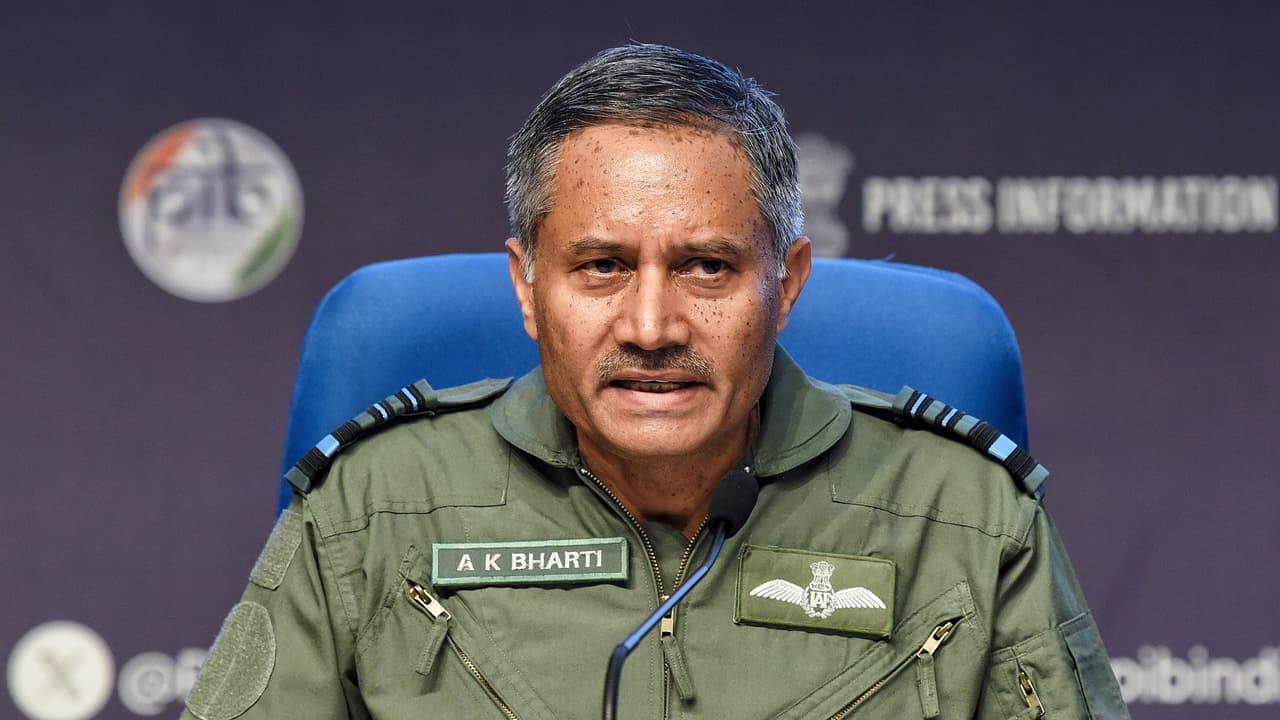
IAF confirms no strike on Pakistan's Kirana Hills nuclear site during Operation Sindoor, targeting only terrorist infrastructure in PoK and Pakistan.
Amid speculation that India may have struck Pakistan’s nuclear facility at Kirana Hills during Operation Sindoor, the Indian Air Force has issued a categorical clarification. Director General of Air Operations, Air Marshal AK Bharti, on Monday confirmed that no strikes were carried out at Kirana Hills, a location alleged to house nuclear installations.
Responding to a media query at a press briefing, Air Marshal Bharti remarked, “Thank you for telling us that Kirana Hills houses some nuclear installation. We did not know about it… We have not hit Kirana Hills, whatever is there.”
Related Articles

The Indian Armed Forces launched Operation Sindoor on May 7, in retaliation to the April 22 Pahalgam terror attack, striking nine terrorist infrastructure sites across Pakistan and Pakistan-occupied Jammu and Kashmir (PoK). The operation was designed with a focus on minimizing collateral damage, and precision strikes were conducted despite intervention by the Pakistani military.
Addressing the media, Air Marshal Bharti said, “We had a detailed brief on the successful joint operations to destroy the terror operation in Pakistan-occupied Kashmir and Pakistan itself... We reiterated that our fight was with terrorists and their support infrastructure and not with the Pakistani military. However, it is a pity that the Pakistani military chose to intervene and back the terrorists, which compelled us to respond, and whatever loss they suffered, it was their own responsibility.”
A video showcasing the destruction of Pakistani ordnance during the strikes was also displayed during the briefing.
India’s advanced air defence system thwarts waves of UAVs
The Air Marshal went on to highlight the role of India’s layered and intricate air defence (AD) system during the operation. He said the AD network, comprising assets from the Army, Navy, and Air Force, successfully neutralised multiple waves of Pakistani drones and UAVs, including loitering munitions and long-range rockets.
“This brings me to the point of how the Indian Forces brought minimum damage to both civilian and military infrastructures in spite of Pakistan's unrelenting forces... The majority populace has a lot to say about the layered and intricate air defence system put in place by the Indian Armed Forces, which includes assets of the Indian Army, Navy and Air Force... This robust AD system comprises a large variety of multilayer AD sensors and weapon systems... Numerous waves of drones and UAVs deployed by Pakistan were also thwarted by the indigenously developed soft and hard kill counter-UAV systems and the well-trained Indian personnel,” he noted.
Chinese-origin missile intercepted, indigenous AD systems praised
In a notable revelation, Air Marshal Bharti said that a Chinese-origin PL-15 missile, which missed its intended target, was intercepted and its debris recovered. He credited the success of India’s air defence efforts to consistent budgetary support from the Government of India over the past decade.
“All these were brought together as an effective AD environment by the IACCS of the IAF. The performance demonstrated by the older battle system also took them (drones) head-on... Another highlight was the stellar indigenous AD, like the Akash System... This AD environment was possible over the last decade because of the unwavering budget allocated by the Government of India,” Bharti said.
“Numerous waves of drones and unmanned combat aerial vehicles employed by Pakistan were also thwarted by the indigenously developed soft and hard kill counter-UAS systems and the well-trained Indian Air Defence personnel,” he added.
The briefing also saw the presence of Director General Military Operations Lieutenant General Rajeev Ghai and Director General Naval Operations Vice Admiral A N Pramod, reflecting the joint operational coordination among the tri-services in executing Operation Sindoor.