
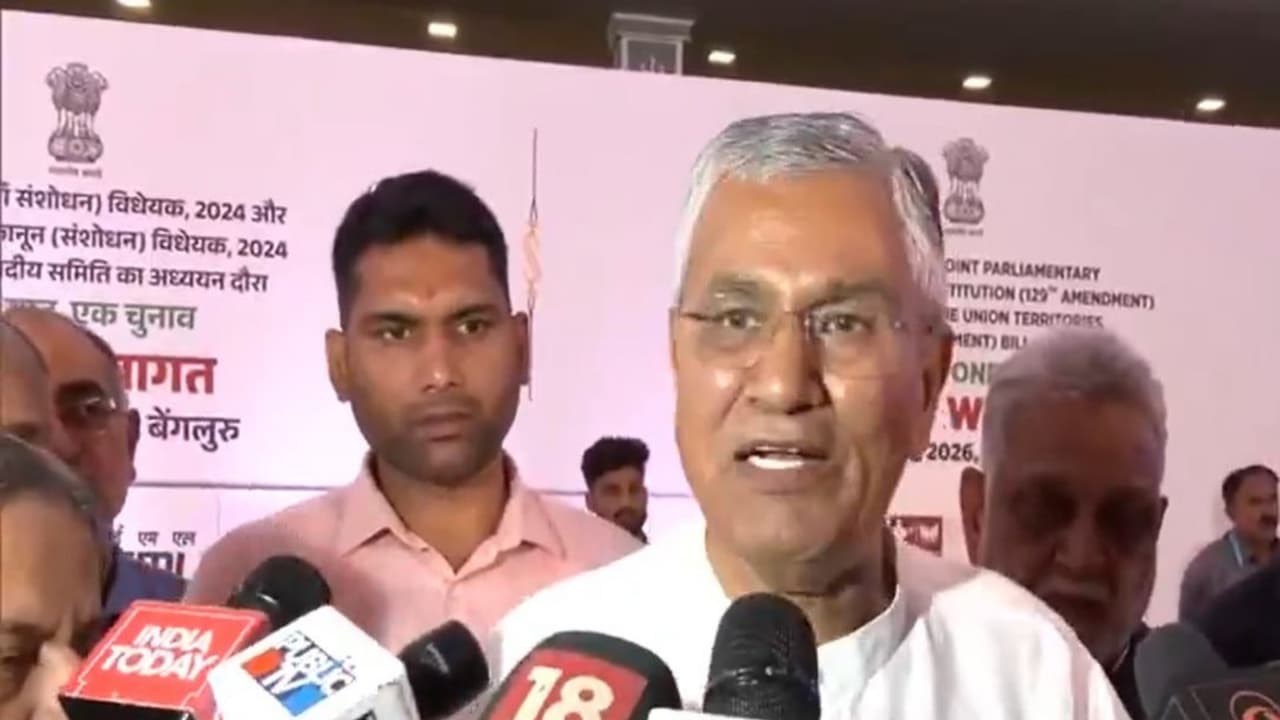
The JPC on 'One Nation, One Election' met Padma awardees in Bengaluru, with its chairman calling voters the main stakeholders. Karnataka DyCM DK Shivakumar opposed it, calling it a politically motivated move that weakens the federal structure.
The Joint Parliamentary Committee (JPC) on 'One Nation, One Election' held a consultative interaction with prominent Padma awardees on Monday to gather diverse civic perspectives. Speaking to ANI, Padma Shri awardee Dr Prahlada Rama Rao said," It is a good exercise, they're getting the views of a lot of people."
Speaking to reporters, Chairman of the JPC formed on 'One Nation, One Election,' and BJP MP PP Chaudhary, said, "...In a democracy, we accord the will of the people a status even higher than that of political parties. If we were to identify the true stakeholders, the ones who stand to benefit the most from the One Nation, One Election initiative, it is the common voter, the general public, and the citizens of the country...The distinguished individuals present our esteemed Padma awardees, each of whom has made significant contributions to the nation, society, or the community through their various endeavours, have come forward to express their views...I am fully confident that, working together, we will be able to arrive at a consensus..."
Karnataka DyCM Opposes Initiative
A day earlier, Karnataka Deputy Chief Minister and KPCC President DK Shivakumar strongly opposed the Central Government's proposed 'One Nation One Election' initiative, calling it a "politically motivated" attempt to centralise power, which would deal a serious blow to the federal structure by weakening all states.
As KPCC President and as Karnataka Deputy CM, he said that he categorically rejects the proposal, which is being crafted to suit the convenience of those at the helm of power at the Centre. "If a government falls mid-term due to political instability, a no-confidence motion, or lack of majority, what is to be done then? Where is the solution to this? Elections are held at different times in different states for different terms -- Karnataka had its election three years ago, Tamil Nadu and Kerala had theirs just recently, and Punjab and Telangana had theirs at different times. How can these elections of varying schedules be synchronised?" he questioned.
Saying that it was a ploy to suppress the voices of regional parties and Opposition parties, he said that the Karnataka Government does not agree with this proposal, and that they remain committed to the overall stand of their party's national leadership. Expressing his views at a dialogue on 'One Nation One Election' organised by the Joint Parliamentary Study Committee at a private hotel in Bengaluru, he claimed that the plan was a politically motivated power-centralising scheme that would seriously damage the federal structure by weakening the states, and it posed a danger to the democratic system, according to a release.
Nationwide Consultative Exercise
Meanwhile, as part of its nationwide consultative exercise on the proposed framework for simultaneous elections, the Joint Parliamentary Committee (JPC) examining the Constitution (One Hundred and Twenty-Ninth Amendment) Bill, 2024 and the Union Territories Laws (Amendment) Bill, 2024, is undertaking a study visit to Bengaluru and Gandhinagar from May 16 to 21 under the Chairmanship of MP PP Chaudhary.
The exercise reflects Parliament's commitment to an inclusive and evidence-based deliberative process on proposals that carry far-reaching implications for India's constitutional architecture, electoral framework and governance systems. During the visit, the committee is engaging with a wide spectrum of stakeholders, including constitutional authorities, elected representatives, political parties (including regional parties), legal experts, administrative institutions, financial and educational bodies, industry and professional organisations, and representatives of civil society. The consultations are intended to capture diverse institutional, regional and sectoral perspectives on the operational, legal, fiscal and administrative dimensions of the proposed reforms.
The visit follows earlier rounds of consultations held in five States--Maharashtra, Uttarakhand, Punjab, Haryana and Himachal Pradesh--and the Union Territory of Chandigarh, where the Committee interacted extensively with constitutional functionaries, state leadership, regulatory bodies, Public Sector Undertakings, financial institutions and other eminent stakeholders across sectors. The committee's continuing nationwide outreach underscores Parliament's commitment to informed deliberation, broad-based consultation and participative engagement on issues central to India's democratic and federal framework.
Committee's Mandate and Timeline
Earlier in March, the Lok Sabha extended the tenure for the Joint Parliamentary Committee's report on the 'One Nation, One Election Bill', allowing the committee to submit its findings by the first day of the last week of the Monsoon Session in 2026. The Constitution Amendment Bill was introduced in the Lok Sabha in December 2024. The Bills were sent to the Joint Committee of both Houses for further examination. (ANI)
(Except for the headline, this story has not been edited by Asianet Newsable English staff and is published from a syndicated feed.)