
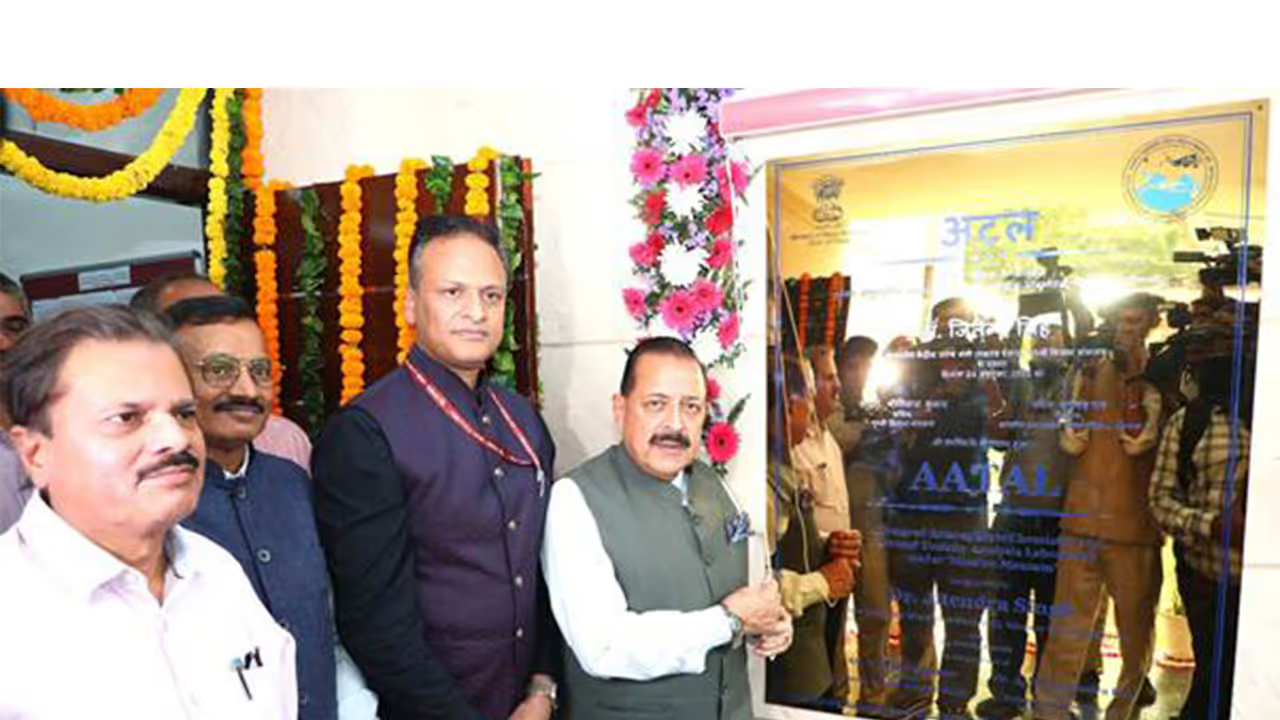
Dr. Jitendra Singh inaugurated the AATAL laboratory in Delhi to provide real-time source analysis and toxicity data for air pollution, moving beyond standard AQI to enable targeted, evidence-based interventions for better public health outcomes.
New Advanced Laboratory to Tackle Delhi NCR Air Pollution
Union Minister of State for Science and Technology and Earth Sciences, Dr Jitendra Singh, on Saturday inaugurated the Integrated Atmospheric Chemistry and Aerosol Toxicity Analysis Laboratory (AATAL), a first-of-its-kind facility aimed at identifying the composition, sources and potential health impacts of air pollution in Delhi-NCR. As per the information given by the Ministry of Earth Sciences, established under the Centre's Mission Mausam initiative, the facility is equipped with advanced instruments to analyse atmospheric pollutants and identify their real-time sources, enabling authorities to move beyond conventional Air Quality Index (AQI) readings towards evidence-based pollution control measures.
Focus on Composition and Source Identification
Speaking at the inauguration, Singh said the facility would help scientists determine not only the extent of air pollution but also its composition, the contribution of different sources and its potential implications for human health. "Earlier, the discussion would largely revolve around whether the pollution level was 100 or 200. This facility will help us understand the composition of pollution as well as the contribution of different sources," the Minister said. He added that the facility would provide real-time information and advance forecasts to help authorities take timely and targeted action against pollution.
Technical Capabilities and Real-Time Analysis
AATAL will help distinguish between various sources of air pollution, including vehicular emissions, industrial activities, biomass and crop-residue burning, construction and road dust, as well as pollutants transported from neighbouring regions. During a demonstration, Singh pointed to real-time data indicating that transport was contributing approximately 25 per cent of Delhi's air pollution at that particular moment, while the overall pollution level stood at around 180. The facility is equipped to analyse fine particulate matter (PM2.5), atmospheric gases, metals, toxic elements and other aerosol components. The analysis is expected to help scientists understand the chemical composition of pollutants and assess their potential toxicity and associated health risks.
Integration with Decision Support Systems
The laboratory has also been integrated with IITM's AIRWISE (Air Quality Warning and Integrated Decision Support System for Emissions), which combines air-quality observations, forecasts and source-apportionment data to support pollution management. According to the project team, the forecasting system provides air-quality predictions at a spatial resolution of 400 metres for the next 72 hours, enabling authorities to assess pollution levels and identify likely sources across different locations in Delhi. Dr Sachin Ghude, Project Director, MAQWS, said the integrated facility would strengthen air-quality management by providing early warnings and detailed information on the sources contributing to deteriorating air quality. He said the information would assist the Commission for Air Quality Management (CAQM) and other implementing agencies in identifying major pollution sources, planning targeted interventions and assessing their effectiveness. The system is expected to support decisions related to preventive measures and responses under the Graded Response Action Plan (GRAP), particularly during periods of deteriorating air quality.
Need for Collaborative Governance
Emphasising the need for coordinated action, Singh said air pollution could not be addressed by a single department working in isolation. He stressed the importance of collaboration among the Ministry of Earth Sciences, the Ministry of Environment, Forest and Climate Change, pollution-control authorities and disaster-management agencies. The inauguration was attended by Dr T Srinivasa Kumar, Secretary, Ministry of Earth Sciences, Dr A Suryachandra Rao, Director, IITM, and DG IMD Dr Mrutyunjay Mohapatra, among others. The establishment of AATAL marks an effort to strengthen the link between atmospheric research and policymaking by combining real-time monitoring, chemical analysis, source identification and forecasting to enable a more targeted response to air pollution in Delhi-NCR. (ANI)
(Except for the headline, this story has not been edited by Asianetnews Editorial staff and is published from a syndicated feed.)