
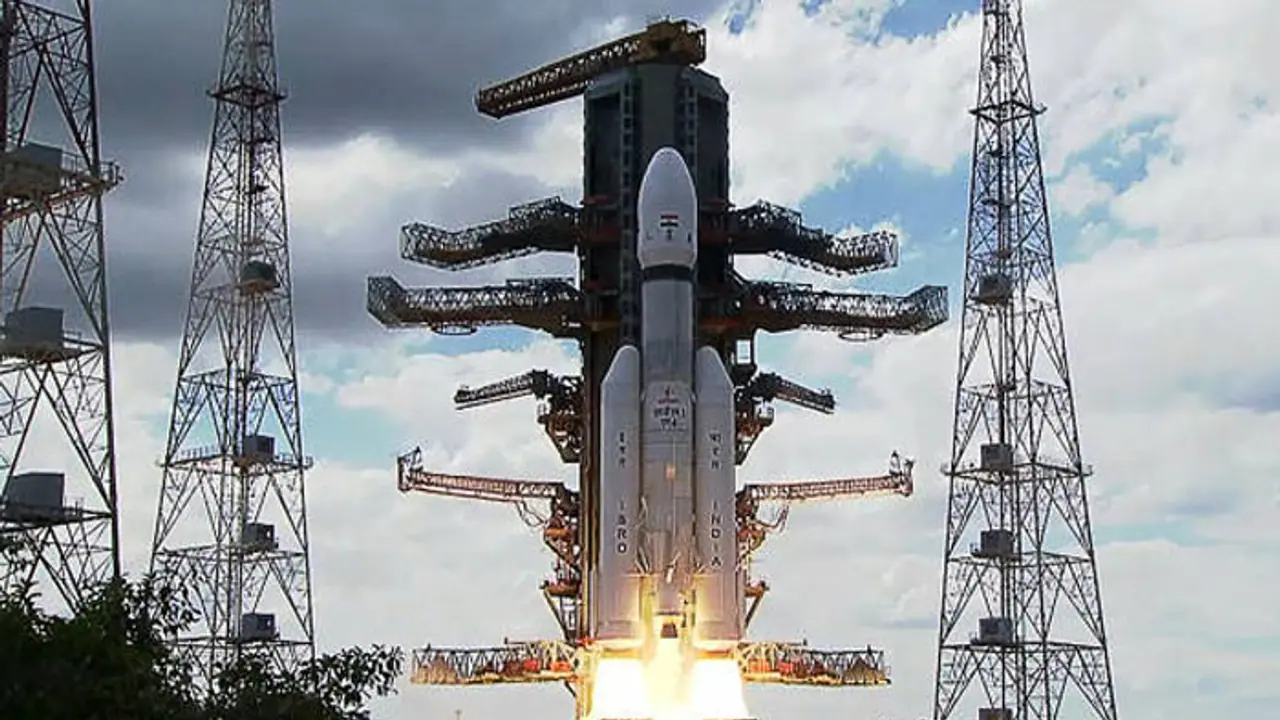
This year's theme is "Viksit Bharat: Innovating, Collaborating and Inspiring to Global Space Leadership" — in simple words, build our own technologies, work together with partners at home and abroad, and inspire the coming generation towards science, technology, engineering and mathematics.
India's journey began quietly. Aryabhata, our first satellite, was launched in 1975 with Soviet help. Chandrayaan-1, in 2008, found evidence of water molecules on the Moon. Chandrayaan-2, in 2019, left behind an orbiter that still circles about 100 km above the Moon, sending pictures sharp enough to show objects as small as 30 centimetres. Mangalyaan, our Mars Orbiter Mission, reached Mars' orbit on 24 September 2014. Built for six months, it worked for over eight years.
The pace has grown fast. AstroSat, our first dedicated astronomy satellite, studies stars using X-ray, optical and ultraviolet light together. Aditya-L1, launched in 2023, watches the Sun from a point 1.5 million km away. XPoSat — short for X-ray Polarimeter Satellite — was launched in January 2024 to study the most violent objects in space, like black holes. In January 2025, SPADEX, the Space Docking Experiment, made India the fourth country able to join two spacecraft together in orbit and separate them automatically. In June 2025, Group Captain Shubhanshu Shukla became the first Indian aboard the International Space Station through Axiom-4. In July 2025, NISAR, a radar satellite built jointly by ISRO and NASA, began watching our land, forests, glaciers and oceans.
The road ahead is busier. TRISHNA, an Indian-French mission planned for 2026, will take heat-based images of the Earth to help farming, water management and climate study. Gaganyaan will carry three Indians about 400 km above Earth for three days, with an uncrewed test flight late in 2026 and the crewed flight targeted for 2027. Chandrayaan-4, planned for 2027, will bring Moon samples home. Chandrayaan-5, or LUPEX, with Japan, will study water near the lunar south pole. A Venus Orbiter Mission is planned for March 2028, a partly reusable Next Generation Launch Vehicle is being developed, and the Bharatiya Antariksh Station should be fully working by 2035.
Behind these missions, as our earlier National Space Day report explained, something bigger is changing. Space is no longer only a government activity. It has become a fast-growing business, driven by private firms, investors and new technologies like reusable rockets and artificial intelligence. The global space economy is worth nearly $650 billion today and may cross $1 trillion by 2035. Almost 80 per cent of this value comes not from rockets, but from everyday services built on satellites — digital banking, navigation, modern farming, disaster management and national security.
India has grabbed this chance. Policy reforms opened the sector to private players, created IN-SPACe and strengthened NewSpace India Limited. From fewer than ten space startups in 2019, we now have more than 300, including Skyroot Aerospace, Agnikul Cosmos, Pixxel, Dhruva Space and Bellatrix Aerospace. The government wants our space economy to grow from about $8.4 billion today to $44 billion by 2033, and nearly $100 billion by 2040.
But one quiet problem could slow this down. Earlier, money was the biggest worry for new space companies. Today, funds flow in from governments and investors. The real shortage now is of skilled people.
Modern space work needs far more than aerospace engineering. Building a satellite today calls for knowledge of artificial intelligence, semiconductor chips, quantum communication, photonics, advanced heat-resistant materials, cybersecurity, robotics, geospatial analytics and embedded systems. Space companies also need experts in patents, finance, international law, sustainability and technology management. The future belongs to mixed teams, not lone specialists.
India produces one of the largest numbers of engineering graduates in the world, yet very few come out with hands-on experience. They have rarely done payload integration — fitting a satellite's instruments together and testing them — or clean-room work, which means assembling delicate equipment inside a dust-free laboratory. Mission planning and satellite software are also unfamiliar. Startups spend months training fresh recruits, raising costs and delaying technology. We do not lack degrees; we lack readiness from day one.
The answer is not more seats, but better teaching. At MIT, Stanford, Caltech, TU Delft and Cranfield, young minds design satellites, build CubeSats — shoebox-sized satellites — and practise missions in simulation laboratories. In India, IIST Thiruvananthapuram, IIRS Dehradun and the IITs at Bombay, Kanpur, Madras and Kharagpur run ISRO-funded satellite projects, while BITS Pilani, VIT Vellore and SRM back research teams and space startups. Such practical work must become normal, not optional.
As we said earlier, India's real launchpad is trained minds. Not money, but talent will decide our journey towards Viksit Bharat 2047.
(Girish Linganna is an award-winning science communicator and a Defence, Aerospace & Geopolitical Analyst. He is the Managing Director of ADD Engineering Components India Pvt. Ltd., a subsidiary of ADD Engineering GmbH, Germany.)
