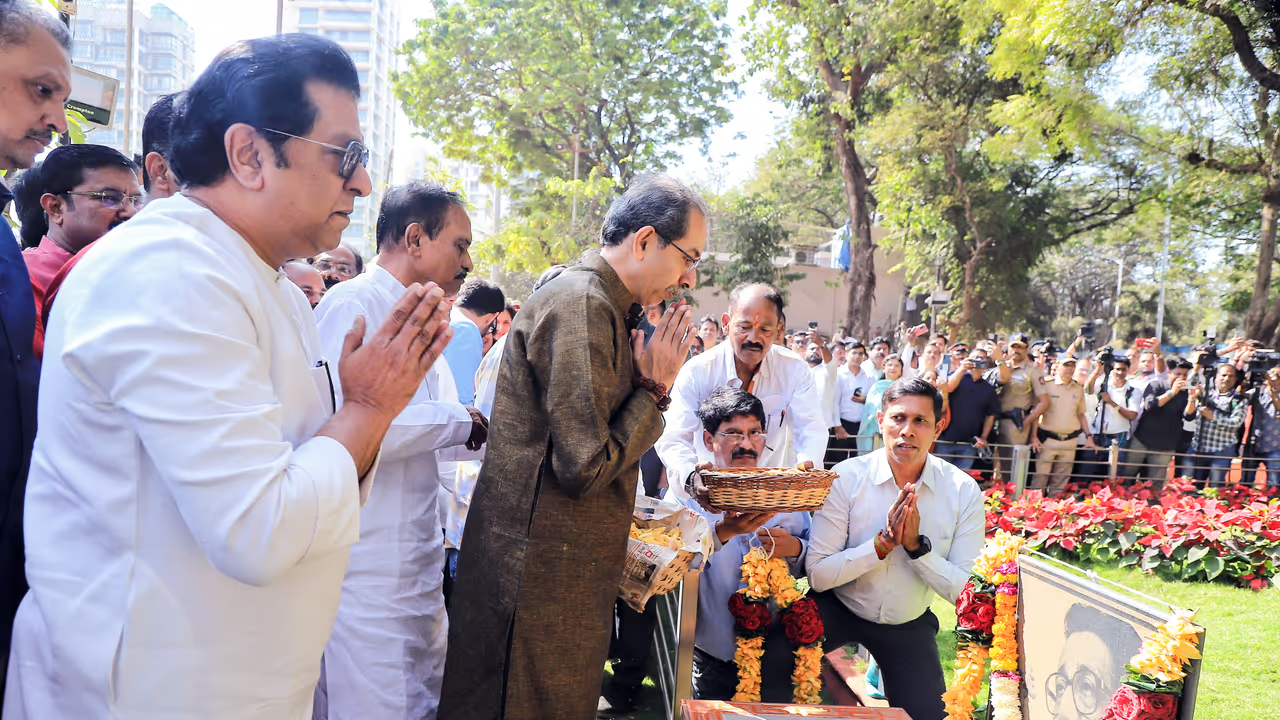
As Mumbai’s civic polls near, data reveals a shrinking Marathi share, school closures, housing displacement and stalled economic mobility—raising tough questions about decades of Sena rule and Marathi empowerment.
Mumbai has always worn two identities at once. It is India’s financial capital, driven by migration, capital flows and ambition. At the same time, it is the city won for Maharashtra after a fierce linguistic and political struggle — a city emotionally claimed by the Marathi manoos.
As civic elections approach, these two identities are once again colliding. A renewed debate over the “shrinking Marathi percentage” in Mumbai has moved from emotional rhetoric to hard questions about governance, economics and long-term outcomes — particularly after nearly 25 years of uninterrupted Shiv Sena control of the Brihanmumbai Municipal Corporation (BMC) under Uddhav Thackeray’s leadership.
Numbers Behind the Anxiety: A Shrinking Share
The anxiety over Marathi identity is not merely rhetorical. Census and civic data reveal a clear demographic shift.
Related Articles

According to the 2011 Census, Marathi speakers made up around 35.9 per cent of Mumbai’s population. Hindi speakers accounted for 22.9 per cent, Urdu 13.5 per cent and Gujarati 11.3 per cent, underlining Mumbai’s multilingual character even then.
More recent demographic estimates suggest the Marathi-speaking share has fallen closer to 30 per cent, driven by continued migration, redevelopment-driven displacement and rising housing costs. For critics, this decline is not just numerical — it symbolises diminishing political and economic leverage in the city that was once the heartland of Marathi culture.
Civic Power Without Economic Security?
For decades, Shiv Sena projected itself as the protector of Marathi interests, particularly through its dominance of the BMC — India’s richest civic body. The corporation today commands an annual budget exceeding ₹50,000 crore, meaning that over 25 years, several lakh crore rupees passed through its control.
Yet critics ask: how much of this translated into lasting economic empowerment for Marathi residents?
Large infrastructure projects — roads, flyovers, bridges and drainage systems — generated massive contracts. Allegations persist that tendering processes favoured a small, entrenched group of contractors. While Marathi workers continue to dominate street-level businesses — from food stalls to small shops — they remain conspicuously absent from the top tier of civic contracting. Many Marathi engineers and contractors say entry barriers remained high, even under a Sena-led administration.
From Mill Towns to Luxury Towers
Nowhere is the sense of displacement more visible than in central Mumbai’s former mill districts — Lalbaug, Parel, Dadar, Sewri and Girgaum. These neighbourhoods once formed the cultural backbone of Marathi Mumbai, sustained by textile mills that employed generations of workers.
Mill closures and redevelopment projects over the past two-and-a-half decades transformed these areas into high-end commercial and residential hubs. Authorities promised displaced mill workers housing on the same land, but many former residents say complex eligibility rules, delays and soaring maintenance costs forced them out.
Large numbers of Marathi families moved to Virar, Badlapur, Karjat and Kasara, severing daily cultural and social ties with the city’s core.
Housing Costs and the Long Commute
The housing squeeze has had measurable consequences. Today, a significant proportion of Marathi workers live in Thane, Palghar and Raigad districts, commuting daily into Mumbai. Four-to-five-hour round trips on overcrowded local trains have become routine.
Critics argue that redevelopment under the Sena-led BMC prioritised vertical growth but failed to ensure affordability. While old chawls gave way to taller towers, maintenance costs in redeveloped buildings rose sharply. Many original tenants say they could not afford these charges, effectively pushing them out while developers emerged as the biggest beneficiaries.
Education: Pride Without Opportunity?
The debate over Marathi identity also extends into classrooms — and here, the data is stark.
Between 2014–15 and 2023–24, the number of BMC-run Marathi-medium schools fell from 368 to 262, a loss of more than 100 schools in a decade. Even more telling is enrolment. Between 2019–20 and 2024–25, student numbers in Marathi-medium civic schools dropped from around 1.32 lakh to about 85,500 — a decline of nearly 35 per cent.
As per the BMC’s 2025 yearbook, Marathi-medium primary schools now educate around 36,205 students, compared to 41,611 students in English-medium civic schools and 64,549 students in Hindi-medium schools.
Education experts argue this reflects a deeper failure: Marathi was celebrated emotionally in politics, but not strengthened as a language of economic opportunity. Urban parents increasingly see English education as essential for mobility, accelerating the decline of Marathi-medium institutions.
Raj Thackeray’s, Warning: “Marathi Manoos Will Be Rendered Powerless”
Against this backdrop, Maharashtra Navnirman Sena (MNS) chief Raj Thackeray has issued one of the sharpest warnings ahead of the civic polls.
In the first part of a joint interview with Shiv Sena (UBT) chief Uddhav Thackeray, published in Saamana, Raj Thackeray said migrants were not just coming to Mumbai for livelihood.
“Those from outside the state are not just coming for livelihood, but they are forming their own constituencies.”
Calling the issue an “old wound”, he claimed: “It is an old wound...efforts are on to realise the dream of separating Mumbai from Maharashtra.”
Drawing parallels with history, he added: “Today, the atmosphere is similar to what it was during the Samyukta Maharashtra movement when Gujarat wanted Mumbai to be its part.”
Targeting the BJP, Raj Thackeray said: “Those who want to separate Mumbai from Maharashtra are in power in the Centre as well as the state.”
He warned that control over civic bodies was crucial: “Marathi manoos will not be able to do anything if they (BJP) control the municipal corporations.”
Uddhav Thackeray: ‘Development Without Planning’
Backing his cousin, Uddhav Thackeray criticised the BJP-led government’s development narrative.
“The BJP publicises development, but it leads to destruction rather than progress.”
Calling it “development without planning,” he said: “The government does not know what it wants.”
He added: “Unfortunately, those in power are Marathi or from Maharashtra, but they have nothing to do with the people of Mumbai.”
And alleged: “They only work for contractors.”
Eknath Shinde’s Counter-Offensive: ‘Their Love Is Fake’
Maharashtra Deputy Chief Minister Eknath Shinde launched a blistering attack on the Thackeray cousins, questioning their record during decades of civic control.
“These cunning people earned only money all these years and looted Mumbai.”
He added: “Some people only remember Marathi manoos during the polls. But what have you done for the Marathi manoos.”
Rejecting claims that Mumbai could be separated from Maharashtra, Shinde said: “No one can break Mumbai from Maharashtra. People of Mumbai do not want politics of emotions, but development.”
Calling for an end to corruption, he said it was time to free Mumbai from the clutches of a “Bakasur” demon — a reference to the Thackeray family’s long hold over the BMC.
Beyond Emotion, Towards Accountability
For many Marathi voters, the debate has moved beyond symbolism. The declining Marathi share in Mumbai, the erosion of Marathi-medium education, limited access to high-value civic contracts and forced migration to distant suburbs point to structural challenges that slogans alone cannot fix.
As elections draw closer, the central question confronting Uddhav Thackeray and his allies is no longer just about identity — but whether long years of civic power delivered economic security, opportunity and dignity to the community whose struggle secured Mumbai for Maharashtra.
The answer, voters suggest, may finally be written at the ballot box. The elections will be held on January 15, and votes will be counted the next day.