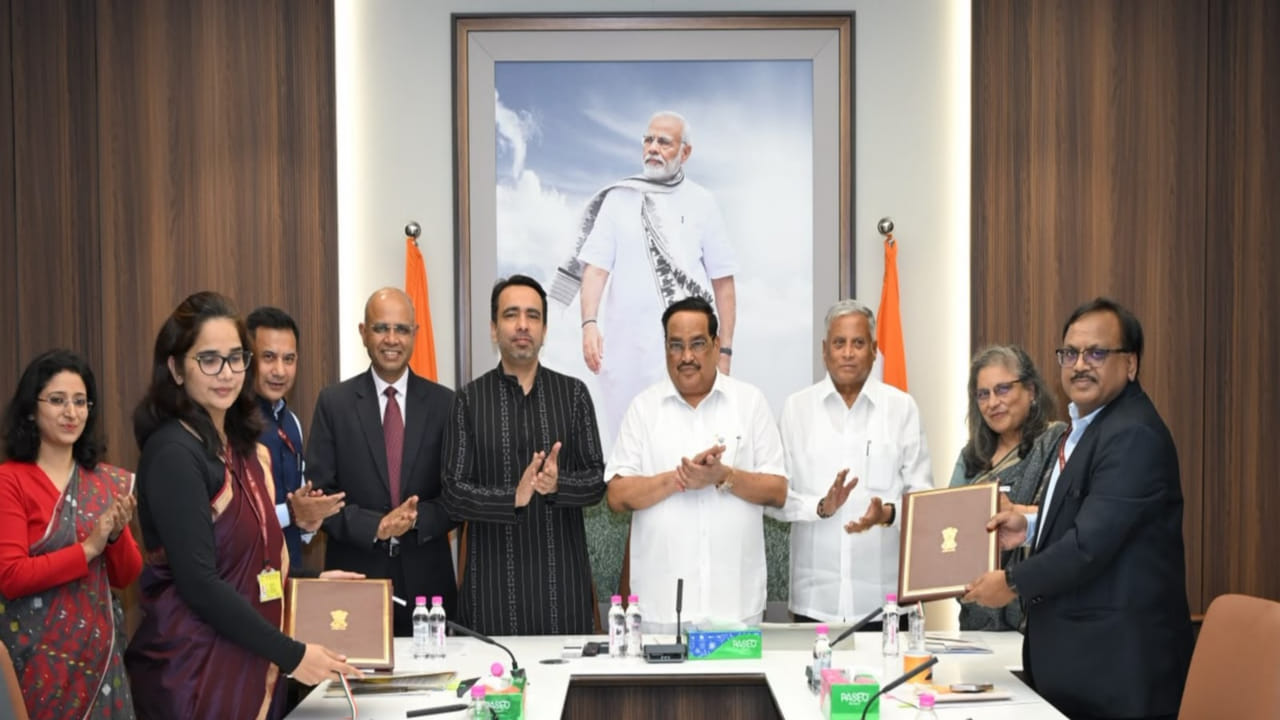
The Ministry of Jal Shakti and Ministry of Skill Development signed an MoU to launch the Nal Jal Mitra programme. It aims to train 100,000 youth under Jal Jeevan Mission 2.0 to maintain rural water infrastructure and create local employment.
New Delhi [India], November 25 (ANI): In a significant stride towards ensuring long-term sustainability of rural drinking water infrastructure and generating local employment, the Department of Drinking Water and Sanitation (DDWS), Ministry of Jal Shakti (MoJS), and the Directorate General of Training (DGT), Ministry of Skill Development and Entrepreneurship (MSDE), on Wednesday signed a Memorandum of Understanding (MoU) for the Water Supply Operation & Maintenance Skilling Programme (Nal Jal Mitra) under the Jal Jeevan Mission 2.0 (JJM 2.0).
According to a release from the Ministry of Jal Shakti, the MoU was signed in the presence of CR Patil, Union Minister of Jal Shakti, V. Somanna, Minister of State, Jal Shakti and Jayant Chaudhary, Minister of State for Skill Development and Entrepreneurship, at the residence office of MoJS, New Delhi. The agreement was formally executed by Swati Meena Naik, Joint Secretary, NJJM and Sunil Kumar Gupta, Deputy Director General, DGT. Debashree Mukherjee, Secretary, MoSDE, Ashok KK Meena, Secretary, DDWS, Kamal Kishore Soan, Additional Secretary & Mission Director, NJJM, and senior officials from both Ministries were present during the MoU signing.
The Union Ministers present on the occasion appreciated the initiative, highlighting its significance in strengthening rural water supply systems through a skilled local workforce and creating livelihood opportunities for rural youth. They acknowledged the importance of inter-ministerial collaboration under the ‘whole of government’ approach in leveraging the country’s vocational training infrastructure to support the objectives of Jal Jeevan Mission 2.0.
Briefing on Jal Jeevan Mission 2.0 and the skilling initiative, Ashok KK Meena, Secretary, Department of Drinking Water and Sanitation, said that with nearly 16 crore rural households now connected through tap water supply systems, the next priority is establishing a robust operation and maintenance ecosystem capable of supporting these assets over the long term. He stressed that timely technical support should be available within villages and nearby areas so that routine operational issues can be addressed quickly without dependence on external agencies.
Meena highlighted that the partnership between DDWS and DGT would connect India's vocational training ecosystem directly with the rural water sector. Through structured classroom learning and hands-on exposure at functioning village water supply schemes, a new cadre of trained youth will be developed to support operations and maintenance activities. He added that the database of certified candidates would be made available at district and Gram Panchayat levels, enabling States and UTs to engage skilled personnel in accordance with their respective policies and requirements, the release said.
The MoU formalises a collaborative framework between DDWS and DGT for implementing the Water Supply Operation & Maintenance Skilling Programme under Jal Jeevan Mission 2.0. The initiative aims to create a trained and certified workforce capable of supporting the operation and maintenance of rural piped water supply systems while leveraging the existing ITI and NSTI network across the country. The MoU targets the training and certification of at least 1,00,000 (one lakh) candidates during the extended period of the Jal Jeevan Mission, with an estimated outlay of approximately ₹111.93 crore borne entirely by DDWS from its departmental-level expenditure.
Developed by the Central Staff Training and Research Institute (CSTARI) under DGT in consultation with DDWS and approved by NCVET, the short-term training (STT) course comprises 120 hours of institutional training (theory and practical) and 45 hours of mandatory On-the-Job Training (OJT). Target group & dual certification will be offered as an optional elective for existing and pass-out trainees of Craftsmen Training Scheme (CTS) Fitter and Plumber trades across Government ITIs and NSTIs.
On successful completion, trainees will receive an NSQF-aligned Short-Term Training (STT) certificate from DGT in addition to their National Trade Certificate (NTC). The curriculum covers plumbing, water distribution systems, pumps and motors, basic electrical work, water quality monitoring, and routine O&M. Through the 45-hour OJT--facilitated by DDWS at functioning rural piped water supply schemes--trainees will gain direct experience in real-world village conditions.
The National Instructional Media Institute (NIMI), a subordinate office of DGT, will serve as the Training Partner for fund disbursement, training coordination, assessment, and certification. DDWS will support trainer orientation, OJT site identification, and share the database of certified candidates at District and Gram Panchayat levels for potential engagement in O&M roles in accordance with respective State HR policies. A Joint Steering Committee, chaired by an officer not below the rank of Joint Secretary, DDWS, will oversee rollout, targets, and fund utilisation.
The partnership between DDWS and DGT marks a significant step towards institutionalising operation and maintenance capacity within India's rural water sector, the release said. By embedding water supply O&M skilling within the country's established vocational training ecosystem, the initiative will create a sustainable pipeline of certified Nal Jal Mitras equipped with technical and field-level competencies. The programme is expected to support long-term functionality of rural piped water supply infrastructure, strengthen service delivery at the grassroots, and generate meaningful livelihood opportunities for rural youth, thereby contributing to the objectives of Jal Jeevan Mission 2.0. (ANI)