Backed by a Rs 47-crore Indian Navy contract and Rs 13 crore in fresh funding, the dual-use ROV performs critical deep-water inspections, hull testing, and maritime research. Equipped with 4K cameras, multibeam sonar, and a robotic arm, EyeROV is leveraging BRICS networks to accelerate global expansion across commercial and defense markets.
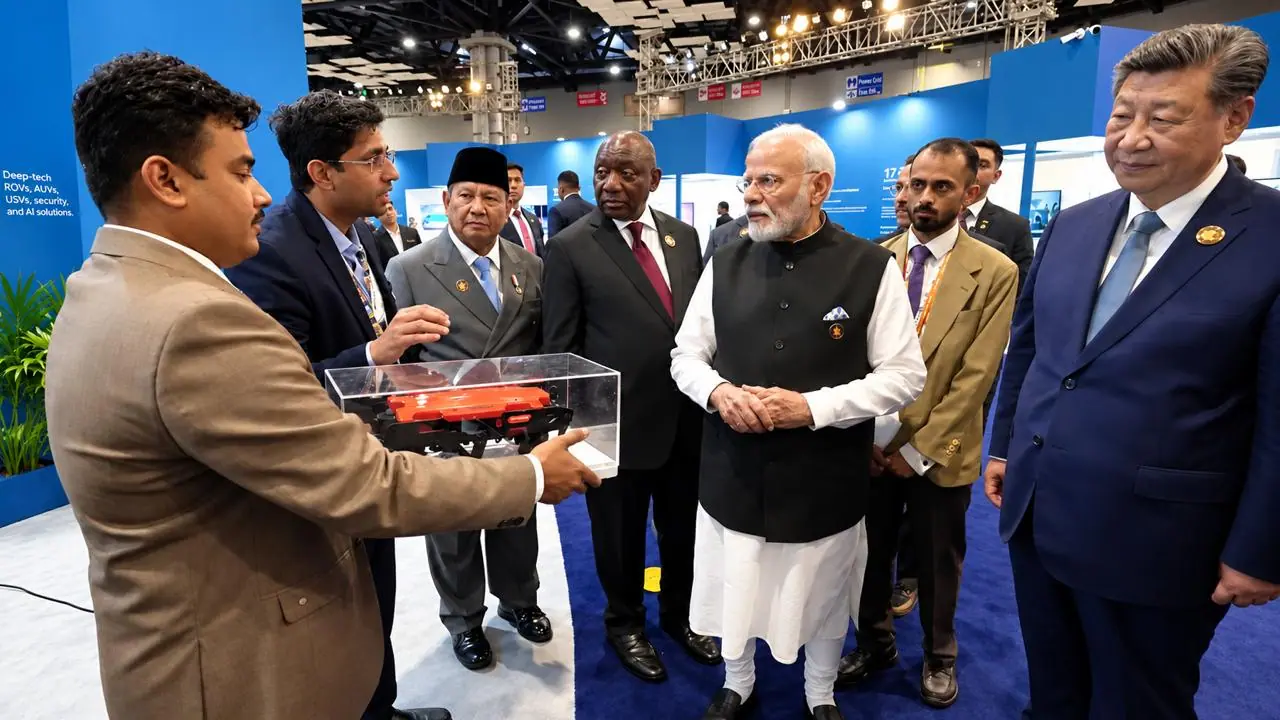
At the BRICS Business Forum in New Delhi on 11 September, Prime Minister Narendra Modi said the grouping could help take the innovations of India's more than 200,000 startups to global markets. His message was to "Make in India, Innovate with India, and Scale for the World". A day later, six leaders toured a pavilion where one of those startups, EyeROV, was showing an underwater robot.
What the product inspects defines it. EyeROV's TROUT product sheet lists undersea communication cables, ports and offshore energy installations as its targets and calls the vehicle dual-use technology. The company says dams, bridges, ports and offshore installations are hard to reach underwater, and that its robots help operators examine them, gather data and plan maintenance.
EyeROV offers inspection of oil and gas assets for corrosion, leaks and structural faults, as well as hydropower tunnels and penstocks. Its client list includes ONGC, BPCL, NHPC, Tata Power, Adani and Maersk. It holds an ISO 45001:2018 certificate covering the design, development, manufacture and servicing of its robotic systems, and says it has completed more than 150 projects for over 80 clients.
Related Articles

Vehicles can be bought outright, or the company can carry out the inspection itself as a service. Founder Johns T Mathai says 75 per cent of customers are government bodies and public sector units.
The company's pitch to overseas buyers rests on price as well as performance. EyeROV describes its offer as safer, more efficient and cost-effective, and says its entire technology stack is developed in India. The engineering record backs that up: TROUT carries a 4K camera with 10x optical zoom, a dual-frequency multibeam sonar, an ultrasonic thickness gauge and a three-degree-of-freedom arm, and the Indian Navy ordered it in a ₹47-crore contract announced on 30 September 2025.
Abroad, EyeROV says it has completed more than 100 deployments across India, West Asia, the Asia-Pacific and Europe.
The BRICS networks are meant to shorten the road to buyers. At the forum, Modi announced a BRICS Incubator Network, a BRICS MSME Portal and a BRICS Startup Innovation Fund. He also proposed that 100 BRICS startups a year be helped into other member markets, with 1,000 new business partnerships annually. Business-to-business matchmaking at Bharat Innovates was arranged with FICCI, CII and ASSOCHAM. The BRICS members account for 49.5 per cent of the world's population and 26 per cent of global trade, which gives the platform considerable reach.
EyeROV also has funding to support its plans. It raised ₹13 crore in February 2026 in a round co-led by AWE Funds and Unicorn India Ventures, with the money earmarked for research, new products and international expansion.
In its 17 September release, the company says it is widening its presence across international markets. With leaders from several BRICS nations having seen the robot first-hand, the next announcement of a buyer, country or order is the one to watch.
Designed and built in India by Kochi-based IROV Technologies Pvt Ltd, the EyeROV Trout is a military-grade remotely operated vehicle (ROV) made for deep-water exploration, autonomous navigation and advanced payload integration. It works across defence and civilian roles, including search and rescue, offshore research and maritime inspection, from undersea cables and ports to offshore energy installations. Its standing is reinforced by a ₹47-crore Indian Navy contract and an iDEX DISC 7 SPRINT win, and it is able to perform non-destructive testing on ship hulls and submerged structures.
Visual tools include a 4K H265 camera with 10x optical zoom and a Full HD wide-angle camera that tilts through 90°. A 3-DoF robotic arm with a grabber, rope cutter and recovery jaws handles manipulation, while dual-frequency multibeam imaging sonar, DVL/USBL positioning and an ultrasonic thickness gauge provide sensing. The i-Control Hub software projects camera feeds, sonar and position data onto S63 Electronic Navigation Charts and supports auto-depth, auto-heading, station keeping, GPS waypoint navigation, geofencing, return-to-home and subsystem self-tests.
Pilots work from a 21.5-inch IP65 display that stays readable in sunlight, along with a programmable 5-axis, 15-button joystick.
About the author: Ashu Mann is an Associate Fellow at the Centre for Land Warfare Studies. He was awarded the Vice Chief of the Army Staff Commendation card on Army Day 2025. He is pursuing a PhD in Defence and Strategic Studies. His research focuses include India-China territorial dispute, great power rivalry, and Chinese foreign policy.
Disclaimer: The opinions expressed are solely those of the author and do not reflect the views or stance of the organization. The organization assumes no responsibility for the content shared.