
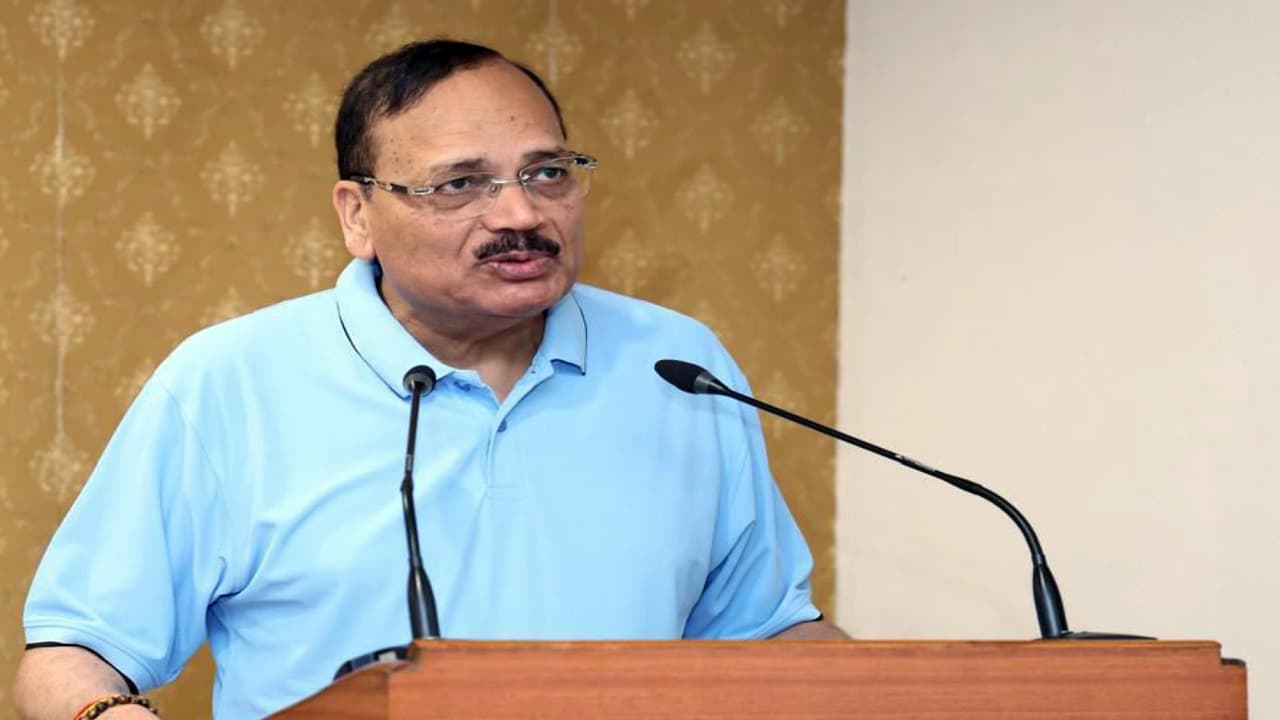
CJI Surya Kant stressed that judicial reform is a continuous process that must start from district courts. He called for strengthening infrastructure, leveraging technology, and ensuring gender and regional diversity to build public trust in the judiciary.
Chief Justice of India Surya Kant on Thursday emphasised that judicial reform must be viewed as an ongoing and continuous process rather than a destination and the focus should begin at the grassroot level of district courts, where ordinary citizens first approach the judiciary for justice rather than the top tiers.
In an interview with DD News, CJI Kant said no one should assume that judicial reforms have been completed, as new challenges will continue to emerge in the judicial system.
He said the responsibility of carrying out judicial reforms rests not only with the current leadership but also with those who come after, as the process requires continuity.
"Whatever problems arise, whatever new challenges come into the system, accepting those challenges and finding a solution to them is our judiciary's responsibility," he said.
Judicial Reform Must Begin at Grassroot Level
Highlighting the need to strengthen district courts, CJI Surya Kant said the common man generally approaches the District Court first, and therefore these courts must have strong infrastructure and facilities.
"The biggest one I understand is that which we need not from the Supreme Court, but we should start from the District Court," he said.
He said litigants should get an environment in district courts where they feel that justice would be delivered impartially, honestly and within the framework of law.
"The District Court should have a very good, strong, and robust infrastructure, facilities, and for the litigant, there should be a good environment there where he feels that, yes, I have come to such a place where with impartiality, honesty, and within the meaning and scope of law, justice will be done to me," the CJI said.
Leveraging Technology for Efficiency
Justice Kant also identified the effective use of technology as one of the major challenges and areas of reform in district courts.
Reflecting on the use of technology to reduce the time, CJI noted that it can be used to reduce the time spent by judicial officers on case and docket management, including maintaining files, scheduling dates and tracking cases at different stages.
"Technology has a very big contribution in that," he said highlighting that judicial officers must leverage technology to streamline case management, tracking, and scheduling thus saving precious judicial time for substantive decision-making.
The CJI said such reforms should continue from district courts to High Courts and the Supreme Court.
He also highlighted how technology has already transformed the judicial system, saying people sitting in different parts of the country can now file cases in the Supreme Court from their villages and lawyers can participate in hearings through virtual platforms.
Promoting Diversity and Inclusivity in Judiciary
Chief Justice Kant further noted the Supreme Court has begun translating its judgments into 16 regional languages, enabling citizens to read rulings directly on their mobile phones in their native tongues.
Justice Kant also emphasized regional and gender diversity in judicial appointments stating that representation of different sections of society is considered during the elevation of judges.
Justice Kant emphasised that diversity and inclusivity are important for strengthening public confidence in the judiciary, particularly through greater representation of women and different sections of society.
He said the Supreme Court has appointed a woman judge in the past few months after a gap of five years.
Futher, in his interview with DD News, he said that for the first time in the nation's judicial history, four women served concurrently as Chief Justices of High Courts.
While one has since retired, three continue to serve on the bench, alongside ongoing efforts to elevate more women judges across various High Courts, he said.
He said, "Diversity is important, and our different fields should get good representation. Such evaluation of all these issues takes place in the Supreme Court at the time of elevation. And when we talk about inclusivity, special care is taken to ensure that the women's category also receives full representation."
CJI stated, "I would like to state this in a satisfying manner that after five years, in the past few months, we have been successful in appointing a sister, a woman judge. In the past few months, for the first time, it happened that in the country, at one time, four women became Chief Justices of High Courts. Out of them, one of our sisters has retired, but three are still in service."
The CJI said efforts are also being made to increase the representation of women judges in High Courts. The broader objective, he said, is to ensure that every section of society feels that there is a place for them in India's judiciary.
"So, similarly, in High Courts as well, we have made every effort to appoint women as judges, and such an effort is ongoing so that every section of society feels that the judiciary of India has a place for them, said the CJI.
The Role of Judicial Activism
Justice Kant, responding to a question on the balance between judicial neutrality and judicial activism, said the judiciary has a constitutional responsibility to protect the rights of sections of society that may not be in a position to approach courts on their own.
The CJI emphasized that public interest litigation (PIL) and suo motu actions are vital tools to bridge the justice gap for India's financially and socially deprived populations who cannot easily approach courts.
"Judicial activism should not be taken otherwise. It is an integral part of our legal and constitutional responsibility," CJI Kant stated, explaining that instead of traditional two-party litigation, representatives bring forward the systemic deprivation of a large section of society so that the court can restore rights to those who cannot stand before it.
"In our country, there is a large population that is socio-economically backwards, who are not in a position to easily approach the court for their legal and constitutional rights", he said.
"So, often for community rights, people's rights, social rights, and constitutional rights, the court itself, or when someone comes to the court as a representative of the public, through Public Interest Litigation (PIL), sometimes through suo motu action, or in any other form, taking steps to protect those rights is our constitutional responsibility," he said.
Explaining judicial activism, CJI Kant said it comes into play when someone approaches the court not to seek relief for their own individual rights, but to highlight the deprivation of rights of a larger section of society.
He added that the judiciary can then act to restore those rights to the affected people even when they are not physically present before the court.
He said, "People call that responsibility 'judicial activism'. The purpose of this activism is simply that, compared to two parties using the traditional way of hearing a case, if a person comes forward who does not want to claim their own right, but brings up the issue that a large section of society is being deprived of its right-and we give back that right to the public through a medium even when they are not physically present before us"
CJI said judicial activism, therefore, should not be viewed separately from the judiciary's core role, as protecting such rights is an integral part of its legal and constitutional responsibility. (ANI)
(Except for the headline, this story has not been edited by Asianet Newsable English staff and is published from a syndicated feed.)